
Photo: Na’ama Yehuda
Speed of passage
Matched
By change
Of time.
A City moment
Snatched
By yellow
In its
Prime.
For Cee’s Fun Foto Challenge: Yellow

Photo: Na’ama Yehuda
Speed of passage
Matched
By change
Of time.
A City moment
Snatched
By yellow
In its
Prime.
For Cee’s Fun Foto Challenge: Yellow


They came for the car today.
It’s just a car, she tried to tell herself. It would not make sense to keep it. Not with the fees and with the debt on it only increasing. Oh, she tried, but there was no way around the loss of it.
No way around loss. In general.
She couldn’t bear to go outside to see it off. She stayed indoors, her nose glued to the window, her sweaty palms pressing life-lines into the glass, her heart in shreds.
It’s been his car.
And he would not be coming home to drive it.
Note: Dedicated on this Veterans Day (US) and Remembrance Day (The Commonwealth), to all who fought and won and lost and left and returned, or left and did not return, or not in the same way they’d left. And to the many who still are away in uniform. You are seen. You are known. May all come home whole. And may humanity one day learn peace and no more war.

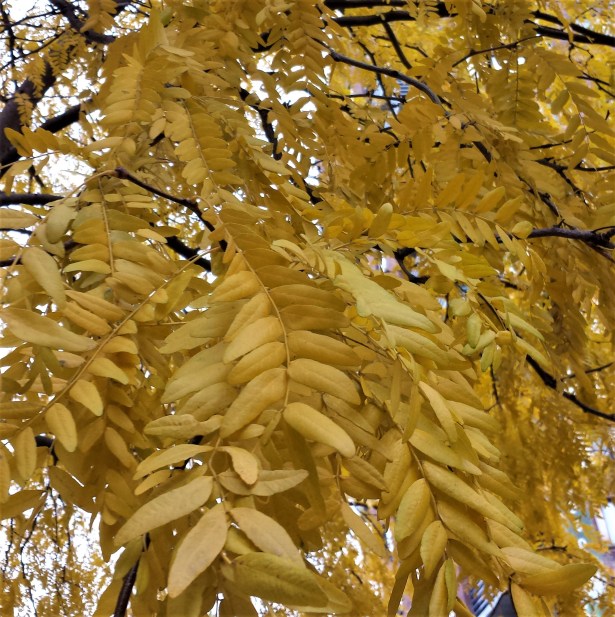
Photo: Na’ama Yehuda
Yellowed gold
Touching white
Lighting day
Glinting night.
Perfect fingers
Splayed bold
Last hurrah
Before cold.
For Dawn’s Festival of Leaves


Photo: Guyana, by Joshua Gobin on Unsplash
“Have we always been here?”
“‘Always’ is a long-winded word,” Papa’s melodic voice told me a story was coming. “Some people lived here before our ancestors. Some had come after we’d already been here. The land and the water were here before any humans had come. The word ‘always’ does not mean one thing.”
“Moses said we’re not from here. That we were brought here as slaves.”
“Are you a slave?”
“No, Papa.”
“Are you here?”
“Yes, Papa.”
“You and I are Guyana born. Have you worked this land, swam in the Essequibo, witnessed Kiaeteur Falls, walked the savanna, ate manioc?”
“I have.”
“So you have your answer, Son. We’re all children of land and water. All born of wombs filled with water, all depend on water, and will one day become rain and go over the falls. Your ancestors got here. You’re here. Where else would you be from?”
For What Pegman Saw: Guyana, South America


Finally.
She shrugged her pack off and lowered herself so her back rested against a tree, blessing — for the umpteenth time — the waterproofs she’d splurged on several years ago. The purchase had meant giving up puddings for two months, but she’d never regretted the trade-off.
Food was essential, but so was heeding nature’s call for spending time in the outdoors. It was required nourishment for her soul.
In any weather, no matter damp or cold.
Soon she’d make the tent, gather wood, and light a fire to cook her oats on. But first she just sat, filling her lungs with air and her mind with calm contentment.
Raised in the city, she didn’t know how hungry she was for the outdoors until friends invited them to join a camping trip. She was ten.
Her parents hated every minute of it. For her, it had been like finally finding home.
For Crimson’s Creative Challenge #52


Photo: Monika Grabkowska on Unsplash
She looked so fraught
I thought she fought
For what she brought.
She apparently did not
But then still she almost forgot
To tell me of some fish she’d caught
And how distraught
The worms she bought
Were at the thought
That she decided that she ought
Just put potatoes
In the pot.
For Linda Hill’s SoCS challenge: “ght”


There it was.
Now she knew what would certainly happen. It did not matter that the calendar had counted down the days for many weeks. It did not matter that arrangements have been made, checklists marked, letters sent, particulars organized. She suspected, she resisted, she pretended …
Till now.
“Pink sky won’t lie,” her grandfather had always said. A fisherman all his life, he’d counted on the minutia of the heavens to warn or greet his days.
She’d learned to accept his observations, no matter how disappointed she was with a last minute reversal of plans he’d made for her to go with him. “The water is no place for children today,” he’d say. And saddened though she’d be, she knew enough to respect his judgment of the weather, and knew him well enough to know that nothing she could say or do would dissuade him once he’d made up his mind.
“God may control the weather,” he’d tell her (though always well out of earshot of her grandmother, who would’ve boxed his ears for speaking heresy, grown man or not). “But to me the weather is the real God. I can’t see God, but I sure can see these skies, and I know what they tell me. I heed those clouds. I heed those waves. I heed those colors in the sky.”
And heed he had. Though heeding did not mean one could always escape the wrath of what was coming.
The waves had claimed her grandfather when she was not yet ten. A fast-moving storm that all had later said no one could’ve out-rowed. She almost stopped believing after that. Stopped taking heed.
Because if Grandfather couldn’t read the sky or if the sky could hide its meaning from him, why even bother trying? What will be, will be. Que Sera sera.
And yet, someplace, she never did stop checking the color of the heavens every morning. Somehow, she never did stop glancing out of windows, no matter where in the world she found herself, or how far from any seas or oceans.
Oh, she listened to the forecast. She had the Telly on while she got herself ready for the day. She checked the extended before she packed.
Yet she trusted few things better than what her own eyes showed her: Pink sky at night, sailor’s delight. Pink sky in the morning, means sailor’s warning.
The sky were ablaze.
It was dawn.
She considered herself warned.
For Sue Vincent’s WritePhoto Challenge


“Peach jelly and olives?! Are you serious?”
“As a heart attack.”
Jack shuddered. This may well be the end result.
Jill’s pasta sauce concoction reminded him of “after-school snack” on days his mother had to work late and the school-bus would drop him off at his uncle’s house. Uncle Simon would have a tall glass of bluish milk waiting, alongside a dish of crackers topped with lemon-lime marmalade and loaded with sardines.
The mere thought of Jill’s recipe gave him the runs.
Good. Saved by the throne.
“Sorry, Hon. I must’ve caught something at work. I better have plain toast.”
For Rochelle’s Friday Fictioneers
Note: Dedicated to my cousin Noam, who reportedly loved sardines-and-jelly sandwiches. I remember being horrified by the very idea and saddened that he would never enjoy them again. Four years my senior, he died at war, just weeks past his nineteenth birthday. We miss you, Noam (sandwiches and all)!


Photo: Hongmei Zhao on Unsplash
In the blackest night
She woke
To hear the flutter of her
Heart
Singing melodies of courage
In her ears.
As the hours ticked
Long seconds full of
Ink,
And stretched worries
She had long learned how to
Blink,
She held on to
Wisps of memories
Mirrored in her unshed
Tears,
And recalled the echoes
Of abandon
In the giggles
Of her very early
Years.
For the dVerse Poetics challenge: Black

A place to improve my writing skills, and that's all.
We're not thriving, we're creatively photosynthesizing under duress.
History of the Bloomingdale area on Manhattan's Upper West Side
A creative miscellany of mythic fantasies
a weekly flash fiction prompt inspired by google maps
A community for writers to learn, grow, and connect.
To participate in the Ragtag Daily Prompt, create a Pingback to your post, or copy and paste the link to your post into the comments. And while you’re there, why not check out some of the other posts too!
I can't sleep...
Alternative haven for the Daily Post's mourners!
never judge a girl by her weight
original fiction and rhyme
You have reached a quiet bamboo grove, where you will find an eclectic mix of nature, music, writing, and other creative arts. Tao-Talk is curated by a philosophical daoist who has thrown the net away.
A photographer's view of the world - words and images to inspire your travels and your dreams
Life in progress
Straight up with a twist– Because life is too short to be subtle!
WordPress & Blogging tips, flash fiction, photography and lots more!
Light Words


 Na'ama Yehuda
You must be logged in to post a comment.