
The mother of one of the children I work with called to let me know they’d would have to cancel their session for the week. There were some unexpected problems and she had no arrangement for the older child. Her youngest, whom I see in Speech Therapy, has several developmental issues, and the mother–a single parent–shuttles him for several remedial therapies every week. She sounded anxious and wrung out, so I asked her if she wanted to tell me more about what was going on.
“My older son had a bad experience with someone,” she sighed.
“What kind?”
“He usually stays with my mom when I take Mick* to therapies, but my mom’s away for a couple of months to take care of her sister who is having heart surgery. I found a sitter for him, but the sitter can’t come to my house, so I take him there and pick him up on the way home. Everything has been fine the first two weeks and Dan loved going …”
“But?”
“He was really upset when I picked him up yesterday. Said he never wanted to go back …” The mom sounded quite upset herself.
“Did he tell you why?”
“He said he didn’t like being there anymore. You know where my mind went … I was thinking the worst … but I didn’t want to put words in his mouth, so I tried to breathe and told him I respected his feelings and that we’ll figure out what to do, but it would help me to know what about being there he didn’t like … At first he just shrugged and looked down and such. Then he told me someone had come to visit the babysitter and brought a ‘really big scary dog who jumped.’ He got scared but the babysitter laughed it off and called him a baby and kept egging him on to pet the dog, ‘not be so yellow’ and not ’embarrass himself’ … and kept sending the dog toward him. Dan wanted to go home but he ‘knew I wasn’t there’ because I was in PT with Mick and he didn’t know what to do … I’m relieved nothing worse happened … but I feel awful he was scared and I wasn’t there. When I called the sitter, he was dismissive and said ‘it was just a dog and it wouldn’t hurt for the dude to toughen up some’. I won’t send him there again!”
We rescheduled for when she could bring both children, at least until she found another option.
“It was good you listened and took him seriously,” I tried to reassure her. “You can’t always protect kids from having an uncomfortable experience, but you can give them the power to reach out and have you help make sure it doesn’t go on. He told you something changed, and you’re taking steps to keep him safe. He did well for telling you, and you did well by not pooh-poohing his worries. In fact,” I added, “this is probably a good opportunity to speak with both kids about things they CAN do if they ever feel uncomfortable or need help. Just like adults, kids feel more secure if they know there’s a plan.”

Many adults have some form of emergency plan. We know what we’ll do if there’s a fire. We know what to do if someone ails. We have an idea of who can help if we’re feeling scared or intruded upon. We have phones and know how to use them. We have friends and family we can call on, we understand ‘gut-feelings’ and know that danger requires a response.
While children don’t need to figure out their own safety plans, it can be very helpful for them to have some tools and to have rehearsed certain scenarios during times of calm.
It is why schools have fire drills. It is why you should have one in your house–in day time as well as during dark. Make it fun, but keep it serious: it can save lives to know what way one is expected to go, what the alarms sound like, who to look for, where to convene, what exit to use, how to make it to the door with your eyes closed (think: dark and smoke and a blaring alarm …).
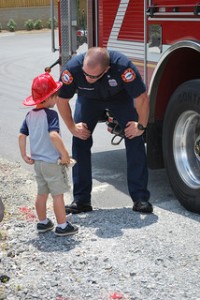
It is why children need to know to call 911 (and that it’s not a toy or something to ‘experiment on’). Why it helps to teach children to ask for help from people in uniform and/or from mothers with children (while most strangers are probably safe, uniformed people are often ‘in official capacity to help’ and mothers with children can often feel less intimidating and know how to respond age-appropriately to a child in distress).
Children as young as three can memorize their first and last name, as well as their parents’ names, what they do, and where they work. They can memorize their address (make it into a song …). Four-year-old can memorize a phone number. At five they can practice writing it from memory.
In addition to immediate safety, children should also be taught what to do ‘in case’: what if they find themselves separated from you in a mall or public gathering? What if they’re someplace else (with a baby-sitter, school, a birthday party or sleepover) and feel something is wrong? What can they do if they don’t feel safe?
Children should know they can always reach out to you, and need not worry about hurting the feelings of the adult they are with (you’d be surprised how often children don’t call a parent because they worry they might upset the adult they’re with). They need to know you will not be angry with them if they tell you they’re uncomfortable or scared. They need to know you’ll find a way to make it better–it may not be possible for you to fly in from another State in the middle of the night, but you might be able to speak with someone where the child is, or to otherwise assess whether more extreme measures are required–children shouldn’t feel they have to figure it out on their own if things feel too much to manage.
Teach children what to do if they need help and cannot reach you. Who else can they call? A good friend of the family? Another family member? A classmate’s parent?
Teach them when it is a good idea to call 911: If there’s a fire (even if they’d caused it), if they think something really bad is happening; if they or someone else is being hurt or might get hurt real soon if someone doesn’t come to help; if someone (especially an adult, but also if the adult in charge seems unable to manage the situation) is out of control or inappropriate; if the person in charge ‘acts weird or scary’ (children may not know to identify drunk or drugged, but often do pick up on something that’s not as it should be).
Reassure children they shouldn’t get in the car with anyone they don’t feel safe riding with, who breaks the rules or is being tricky or secretive. It doesn’t have to be a stranger. You don’t have to explain drunk or drugged to very young children (though it might not be a bad idea to bring up the issue with older elementary school children), but you can give the child a sense of control for when they feel unsafe and ill at ease. I know a child (age 9) who refused to get in the carpool because the adult had texted while driving and had her eyes off the road for what felt like very long. That child’s mother had discussed safety with her, so she was able to say to the driver: “My mom doesn’t let me ride in cars where someone is texting. Please put the phone away until we get there.” When the driver refused, the child asked to call her mom.
Many parents are afraid to discuss problematic situations with their children. They think about sexual offenders, they worry about making their child feel unsafe in the world.
In reality, discussing safety skills is just as important as teaching children how to cross the street, how to wait for the light to change, how to use (and not use) tools and sharp objects, what to touch (and not). Preparing your children to manage unexpected situations is just as important. It gives them skills to be less helpless. Role play and practice these at home. Let them know it is okay to reach out and that you’ll figure out how to help … Reassure them they should tell you if they think they’d done something wrong … even if they worry you’d be mad: That you’d like to know and would help and love them anyhow.
As for the little boy: his mother had a good discussion with him (and his younger brother), and together they’d made some plans.
They talked about ‘listening to tummy messages’ (intuition) which let them know something was not okay. They talked about things they could do: Call mommy or grandma, call Auntie Nell (who lived nearby and was willing to be standby help), call 911 if they were really afraid or needed someone to come right away. They talked about how it was okay to tell about things that didn’t feel right, and that they didn’t need to keep secrets they didn’t want to keep. That their bodies were theirs, and so were their feelings. That being scared is not bring a crybaby and they didn’t need to touch, go, see, try, say things they felt weren’t okay, went against the rules in their house, or felt ‘not right.’
And the little guy?
He learned his mother was there for him. That it was okay to let her know how he felt and he didn’t have to protect her or worry or figure out things on his own. That he was just as important to take care of as his younger brother. That he could listen to his gut. That it wasn’t okay for anyone to put him down or make him feel ashamed to tell. And … that the world can at times be uncomfortable but he did not have to manage it alone and knew what to do if he felt he needed help.
Do your children know what to do if something happens? If a caregiver doesn’t show up to pick them up? If they find themselves alone someplace? If they feel intruded upon? If they are told confusing things? If they are asked to break rules they don’t think should be broken? Do they know who they can call on if you’re not around?
Make a plan. Today is a good time!

*names changed to protect confidentiality



























You must be logged in to post a comment.