On Nov.7–Making Peace with Suicide–a recommended new and powerful book!

Launching November 7, 2014!

Making Peace with Suicide: A Book of Hope, Understanding, and Comfort

By: Adele Ryan McDowell, PhD

Sometimes a new book comes along that deserves a special shout out–this is one !

I am delighted to help spread the word about Adele McDowell’s new, powerful, and heart opening book.

I’ve known Adele for almost 18 years now, and she is the real deal: knowledgeable, compassionate, deeply empathetic, super-sensitive, and down-to-earth. She understands human suffering and human potential, the depths of pain and the triumphs of spirit, the reality of trauma and the tangible hold of hope.

The combination of her skill and personality make her the best person to approach and manage such a tender topic, and she does so with much heart and practical advice.

The book is filled with information and much needed explanations to one of the most heart-wrenching realities of human connection and loss. It is also filled with anecdotes, candid testimonies, and personal paths through grief and healing.


Read it!

Join the launching celebration on November 7 and be one of the first to own a copy!

Get it on November 7, 2014!

Making Peace with Suicide: A Book of Hope, Understanding, and Comfort

By: Adele Ryan McDowell, PhD

Get it on Amazon November 7! http://www.amazon.com/dp/0982117620/ref=pe_385040_121528360_TE_dp_1

About the book:

Insightful, compelling, and compassionate, Making Peace with Suicide: A Book of Hope, Understanding, and Comfort takes a good hard look at the world-wide phenomena of suicide.

This book is designed for anyone who has lost a loved one to suicide and felt that sucker punch of grief; for anyone who is in pain, walking unsteadily, and considering suicide as an option; and for anyone who works with, guides, or counsels those feeling suicidal and/or suffering the profound grief from a suicidal loss.

Making Peace with Suicide includes stories of courage, vulnerability, and steadfastness from both the survivors of suicidal loss as well as the unique perspective of the formerly suicidal. It offers shared wisdom and coping strategies from those who have walked before you. It explores the factors leading to suicide and the reasons why some do and some don’t leave suicide notes.

Making Peace with Suicide sheds light on the phenomena of suicide vis-à-vis our teens, the military, new mothers, as an end-of-life choice, and asks if addiction is a form of slow suicide. It provides a seven-step healing process and opens the door to consider suicide and the soul, the heart lesson of suicide, and the energies of suicide.

If suicidality has impacted your life, Making Peace with Suicide is a must-read! You will be guided through the unknown territory, given insights to allow understanding, stories to help you heal, and ways to make peace with a heart wide-open. Making Peace with Suicide is good medicine for the body, mind, and soul.

Praise for Making Peace with Suicide

“Suicide is one of our most painful, difficult, confusing and wounding of human experiences. Dr. Adele McDowell addresses this topic with love and beauty. She non-judgmentally restores empathy, compassion and understanding.  She courageously offers deep tending in a “place of primal pain.” And she is comprehensive, sharing the history, complexity, universality, and even positive dimensions of this mysterious act. Whether you are contemplating or have survived the attempt, lost someone to suicide, or counsel and help these populations, Adele McDowell’s Making Peace with Suicide will bring you hope, healing, compassion and understanding.”

–Edward Tick, PhD; Director, Soldier’s Heart; Author, War and the Soul and Warrior’s Return

“With sensitivity and compassion, Making Peace with Suicide explores the depth and breadth of suicide and offers insights and healing. This book is essential reading.”

–C. Norman Shealy, MD, PhD

“No topic could be more timely than suicide. This remarkable book addresses people who have contemplated ending their lives as well as those who have to deal with the aftermath of those who succeeded. But it will also be invaluable to mental health workers and military chaplains, especially those who deal with young people who have been bullied and veterans with PTSD. For such a complex topic, Dr. McDowell’s writing style is reader-friendly and the stories she presents may well evoke tears. Her wise recommendations include teaching self-mastery techniques to help people cope with the stress of a success-oriented society. I have read many books on this sensitive topic, but none with the breadth and scope of Making Peace with Suicide.”

–Stanley Krippner, PhD; Co-author, Personal Mythology: The Psychology of Your Evolving Self and Haunted by Combat: Understanding PTSD in War Veterans

“Finally. A book that explains—in the simplest of terms, in a non-sensational, non-academic manner—the phenomenal, worldwide epidemic we call suicide. If you read one book on mental illness and how it affects our world, READ THIS ONE!”

–Ginny Sparrow, Editor, American Association of Suicidology

“Adele bravely and compassionately tackles a topic that many people avoid discussing—suicide. Yet in the understanding of it, the confusion and sense of loss is greatly eased. Making Peace with Suicide is rich with insight and healing methods all intended to help heal the void we feel when we lose a loved one to suicide. It’s also written for those who are suicidal to help them understand their pain and despair, and to let them know there is always help and there is always hope. I wish I had this book to read when my best friend took her life.”

–Carol Ritberger, PhD, author of Healing Happens with Your Help: Understanding the Hidden Meaning behind Illness

“This powerful book, written by a psychologist and former suicide-hotline responder, speaks to us all, about a present epidemic, surrounded by shame, taboo and secrets. Offering many personal stories, Adele helps the reader to find peace speaking to both those who believe they’re the only person who has ever felt this desperate and to the survivors whose lives are thrown into turmoil. This excellent book, full of useful resources, is essential for everybody who feels alone with their issues of life or death, bringing greater understanding, acceptance and comfort.

–Christine Page, MD, seminar leader & author of The Healing Power of the Sacred Woman

“As a minister/therapist for more than thirty years as well as a wife who lost her military husband to suicide, I have never found a more compassionate, effective book on suicide and its aftermath. This book serves many needs and highlights the myriad ways in which suicide changes one’s life direction. I cannot say strongly enough how powerful and helpful this book is.”

–Rev. Colleen E. Brown, Unity minister

“The loss of a loved one by any means is traumatic. When the loss is by suicide, in addition to the grief of the loss itself, survivors are often left riddled with guilt, anger, shame, and endless questioning, by both themselves and by others. In Making Peace with Suicide, Dr. McDowell gently and brilliantly weaves vital suicide survivor education with comforting and inspirational thoughts and quotes, all designed to direct the reader on a path of healing, resolution and peace.  A must-read for anyone who has been touched by the tragedy of suicide and left to answer the question, ‘Why?’ ”

—Carole Brody Fleet, award-winning and bestselling author of Widows Wear Stilettos…; Happily Even After…; and When Bad Things Happen to Good Women

“A subject such as this is never easy to digest. However, with Adele’s wisdom and guidance through her experience, this is a must read. We are in a new world now. Let Adele’s wisdom guide you with her insights for a new perspective on suicide.”

–Mona Delfino, author of The Sacred Language of the Human Body


Get Making Peace with Suicide on Amazon, November 7!

The Shame Game

Last year, a preteen I worked with told me about a child in her class who began cutting herself. The classmate showed this child the  scars but swore her to secrecy.

We discussed the kinds of secrets that one should not keep (the ones that feel ‘too big’ to keep, or are about someone being hurt, or feel wrong to keep, or come from shame or guilt), who to tell (a parent, a teacher, a trusted adult, even the school nurse), and how. The girl was relieved to know that she did not have to keep this scary secret (“I get worried that maybe she’ll like, bleed to death or something and then she’ll die and it will be my fault for not telling anyone …”).

In our conversation, the reasons children self-harm also came up: to deal with difficult feelings, to express pain they don’t know how to verbalize, to feel alive, to feel numb, to ‘try and see how it feels’, to be noticed … And what to do if she ever felt the urge to hurt herself (thankfully, she said she never did feel that way, but it never hurts to give some options just in case …).

Relieved though this girl was to know she could share this secret with someone, the preteen was also worried that it will somehow become known to the other children and how it will make things worse. “Kids are already like, making fun of her for everything …” she fretted, “so, if they found out she’s like, cutting … they’d be all like, joking about it and texting and stuff ….”

Apparently the self-harming classmate–not the most attractive by other students’ standards (directly derived from society’s harsh shaming of anyone who does not adhere to a very narrow range of ‘acceptable’) was found to have confessed a crush on a boy in a higher grade … Someone found the note where it had fallen from the girl’s pocket, ‘kindly’ photographed it, and circulated it in among the students, along with some choice words about the girl’s morality (you can insert your own words here, copied from the shaming terminology of grownups toward women and girls: ugly hurtful words that are meant to cut to the core). A cascade of comments and ugliness ensued, along with catcalls, leering, and whispered words.

“Some kids even say that she’s like, you know … the ‘c’ word …”, the girl blushed in embarrassment and indignation. “She didn’t even kiss him or anything …” she said, then added urgently, “not that it would even be okay if she did let him kiss her … or, you know, stuff …”

The “if she did let him” did not escape me … nor did the outright meanness of exposing vulnerability and turning it onto some way to cause harm. The backbone of bullying.

Bullying is a very real issue, and not only in children and teens. The culture of putting down others for real or perceived differences and flaws is disturbing, and for those caught in it, it is often shattering. Bullying thrives on shaming, and shaming reflects a void of compassion and empathy. It is especially apparent on websites, news media, twitter, Facebook, and many online blogs: people behaves in ways that are purposely hurtful, narrow minded, and outright cruel; and it is somehow seen as witty and cool.

It is not cool.

It is not witty.

It is cowardly and it is heartless.

It is, really, a form of terror. Insidious and sneaky, but no less meant to cause helplessness and pain.

The truth is that bullying is not ‘fun’ or ‘funny.’ Cruelty of words is especially cowardly, and cyber-bullying is uniquely hurtful in that it can easily seem like the whole world is (and indeed can be) laughing at one’s misery. Many would cringe at the sight of someone literally cutting another person or kicking them in the groin, yet somehow cyber-bullying has become a culturally accepted means of expressing disdain and showcasing ignorance. Meanness is not frowned upon, but adopted and propagated. It should not be so. It can and must be stopped.

Some of the things people (children, but not only children) write:

“Why don’t you just kill yourself so we can be rid of you?”

“You are so ugly that you shouldn’t have been born.”

“Everyone hates you. Just go jump from a bridge or something.”

How have we let it come to that?

The conversation I had with the preteen was not unique–bullying often occupies children’s conversations. However, I was reminded of the one I had with this particular preteen as I watched Monica Lewinsky break her silence and deliver an outstandingly candid and important speech–her first public talk in 16 years. Lewinsky calls out the shame culture that allowed (and cultivated) the ugliness toward her in the late 90s, and which is all too alive and well today and still takes lives–figuratively or literally.

Monica Lewinsky survived it, but not without immense cost, and she would not have survived it had it not been for the compassion and empathy of family and friends who held her close through the awfulness.

Not everyone has people to hold them through bullying, and not everyone survives it. Even in those who do, the price is often very high.

Watch this video, and pass it along. It is important. It is worth the time.

Because the Shame Game can only be played if we perpetuate and feed it, and it will cease if enough of us practice compassion and empathy. Like the preteen who turned to me, and would not be a silent witness to pain or bullying, let us all become ambassadors for compassion and ending shaming.

Let there be no more casualties of shame, no more shattering of souls. Let us not be instruments of despair–directly or by our silence.

Back to School–Challenges and Hope

back to school

Back to school. Eyefuls and hearts full of children in new clothing and shiny shoes totting sparkling backpacks that are yet to be dragged, thrown, pulled, and sat on. Images of parents, some relieved for end-of-summer entertainment chores, others sorry for the loss of time together, and many more managing an alternating roller-coaster of both … Children with their own mix of dismay and anticipation: back to homework, also reconnecting with classmates and interesting new things to learn.

Back to school is a bittersweet time for most. A loss of freedom yet a gaining of routine that can often be stabilizing. A time for new beginnings and old worries. Fresh expectations and maybe the memory of disappointments. There are anxieties and stresses about friendships, best-friends, cliques, teachers, lockers, who would sit with whom in the cafeteria, fitting in. Mixed into the tetchy anticipation are all too often often nagging worries about too-difficult studies and possible overwhelm.

This time can be even more potentially stressful for children who have language-learning difficulties and past experiences of failure. For them going back to school might brings up memories of struggle and inadequacy, of confusion and all-too-frequent errors and correction. They may associate school with overwhelm and be anxious about the end of respite that summer offered. At the same time that they may still be excited about reuniting with their friends or meeting a new teacher or trying out the new school supplies in their pristine notebooks; they may also hold worry and distress that, too, needs space alongside the excitement. Mixed feelings may be difficult for these kids to explain, further adding to confusion.

Children rarely have one feeling at a time (most of us don’t, really) and the salad of emotions is frequently shifts and is difficult to tease apart. Especially so for children who have some difficulty with communication, processing, and language. It can help to let them know that it is fine to have all kinds of thoughts, worries, and emotions tumbling through their minds and bodies. Verbalizing the experience helps demystify it and helps give words to what may otherwise feel like undefined unease in the pit of little stomachs and vague distress exploding into weepy bouts and unexpected tantrums.

Back to school time can be tender, and fortunately there is much that you can do to help!

If you had not done so yet, it may be a good time for a brief ‘postmortem’ of the previous school year: What worked and what didn’t? What are they proud of? What were favorites and what was least so? What would they change if they could? What was most helpful? What would have helped? Is there anything or anyone they’d miss? Anyone they worry revisiting?

Time, too, for a heart-to-heart about this school year before it begins in earnest: What are they excited about? Does anything worry them, and if so, what it is? Who are they looking forward to meeting? Who are they not keen on seeing again? Is there anything they are not sure about? Anything about which they feel more confident? And … what do they need? How can you help?

For those for whom narrative is a challenge, it would help if you share your own back-to-school stories: The best year, the worst year, your favorites and least. What gave you joy and what causes you worry. Modeling your own mixed feelings gives permission for the child to have a mix within themselves, and provides a framework for their own descriptions. Add your thoughts and feelings about them and their new beginning: Your excitement for how much they’ve grown and your touch of sadness for the end of summer pleasures; your hopes for a good year and your wishes it would not be too stressful or too difficult.

Do not, however, criticize or bring up ultimatums. Things like “last year you did not try very hard so this year I expect you to do better …” or “you better work hard this year or there’d be no play-dates …” or “I don’t want to hear bad things from your teacher about you like I did last year …”–they wound, not help. Shame strips hope away and erodes confidence. Absolutely vent your frustrations and fears to other adults you are close to but not in the presence of the child who evokes them–you need a soft place to fall but it should not be your child who provides it for you …

No child wants to do badly in school or to misbehave. Using last-years woes (over which the child now has no control anyway) as leverage for this year demands does little to give motivation. Failure will happen–we all misstep, we all make errors, have bad days, act out sometimes, forget, neglect to follow some direction. If the child enters school afraid or disillusioned they may reach conclusions that it is not worth the try if they are already half-way into punishment …

So … be on the child’s side. Encourage. Inspire. Allow a new beginning and fresh hope and confidence. You don’t need to praise failure or ignore hardship, but you can find a way to re-frame difficulties through effort and maturation. “I know that last year was challenging at times but I am so excited to see how much you have matured this summer” and “Let us work together to make this year the best year yet both in school and at home.”

Prepare. School supplies and school clothing are important. So are arranging schedules and anticipating needs and letting the child be part of whatever decisions they can have some input for and control over. Familiarity with routines is important for any child but even more so for the child who may need help with comprehending and following cause-and-effect, sequence, and directions.

How to do it? Talk about the coming schooldays’ schedule. Point out when school starts and ends, how long things take (the school bus, getting home, homework), what other things will need to be accommodated. Discuss the merits of good sleep and healthy nutrition, negotiate (or explain) a clear a time to rise and time to go to bed, time for other tasks as needed. This arranging of routine and timetable can be made fun–life should be looked forward to and manageable–after all, there are so many amazing things to find out and adventures to be had!

To make things more concrete and minimize the need to hold all the details in memory, you can draw a visual schedule together: clocks with crucial times to follow, lists of things to do each morning and after-school, timetables for after-school activities and therapies. This preparation will be further enhanced if you review the school schedule (and any unusual things like holidays and school trips) over weekends so the child knows what’s expected and what to expect.

Make sure you leave time for the child to have unstructured play. Ensure there is some time for boredom, too. In this day and age when life is busier and schooldays long and demands overwhelming, it is difficult to fathom children given time to daydream and get bored. However, these are crucial for imagination, creativity, rest, and assimilation. Children will daydream–might as well make time for it so it does not take place in class or during homework.

Secure some time for reading and snuggles. Schedule it in. It is no less important than homework or baseball or tutoring. YOU reading TO the child, that is. Beyond the pleasure of connection and time together in story adventure, there is ample research showing it as a wonderful best way to increase their language and comprehension, to expose them to worlds beyond their own and deepen their listening. Reading to your child will enrich your connection and provide a time and place for shared relaxation as well as important opportunity for sharing what may otherwise not find a way to bubble up and be spoken of.

Preparing the school staff is helpful, too, if special accommodations or understanding are required. Consider speaking with the school ahead of time (or early in the school year) so that you limit your child needing to stand out as different or wait for accommodations. You’ll also get a sense to who the teachers are and which one may call for more teamwork and coordination than others.

Prepare yourself, as well … Not for the hardship, but for self-care. See that you not forget your own needs for good food, enough sleep, time to breathe, to exercise, to call a friend, to laugh, to cuddle. Stress is no more good for parents than it is for children …


It is a tender and exciting time, this back to school adventure of new beginnings. Even as it may awaken the frayed remnants of old worries, it offers amply opportunity for building confidence and bolstering hope. It is filled with growth and re-connection. May the cooler weather and the changing times herald soft days and brilliant colors, and may it bring on glorious learning ready to unfold.

Happy Back To School to All!

What Do Babies Think? An excellent Ted Talk

baby loved

An acquaintance once stunned me and a colleague when she noted she believes that, “babies are basically a lump of meat just lying there until they are 10 months old.”

After I collected my jaw from the floor, I went on a long winded explanation (okay, tirade …) about all the things that we know and that prove infants are anything but lumps of meat until they reach 10 months old. In fact, they are active learners and interactively relating beings from the very moment they are born. Babies are so visibly actively engaged that I recall my absolute incredulity at the very notion that anyone can think them “lumps of meat just lying there.”

Well, they are not “just lying there,” not one iota so. Don’t know how the notion got into this acquaintance’s head, but she was wrong.

This fabulous Ted Talk is a great (and I admit far less tirade-like) way of explaining some of how they are very much the opposite. It is well-worth listening to. In it Alison Gopnik describes some things you may not think babies can do, as well as how they might be doing them.

Oh, and don’t miss the adorable ‘little scientist thinker’ video embedded in her talk. He defines “cute”!

What Do Babies Think?

http://www.ted.com/talks/alison_gopnik_what_do_babies_think?

kid science1


Dreams–Fabulous exercise re-blogged

How about a dream exercise?

Check out this latest fun and fabulous post from Adele Ryan McDowell’s excellent blog:

Adele and the Penguin

http://adeleandthepenguin.com/how-about-a-dream-exercise/


And to send you happily along your way,

a little blessing if you may …


“May your dreams be filled

with laughter and play

to last you through

the merriest day!”

[Na’ama Yehuda]

merry day

“A” is for Average?

tired child

The woman on my answering machine sounded anxious: “I got your name from a friend of mine. You come highly recommended and you really helped her kids. I know you are really busy but can you please call me back about my child? I have a 5th grader who really needs your help.”

I called her back. Based on her wording–and her urgency–I fully expected to hear details about a child who is falling behind academically. A child with teachers worrying about difficulty with vocabulary, comprehension, attention, expressive writing, memory, fluency, or a combination. Possibly a referral from an orthodontist about tongue thrust issues, or about stuttering. Or hearing remediation.

The mother’s pleading was real enough, but the cause for it surprised me (though it ought not to–this is not the first time!): Her son, entering 6th grade in the fall, was receiving “only B+ and A-” on his reports and tests. She wanted “to give him some extra help so he can do better at school.”

Being a clinician, I don’t see children unless there is cause to see them. Normally developing children don’t usually need speech-language-therapy. Still, sometimes parents don’t know how to exactly explain the difficulties their children are experiencing, so to be sure there is no issue needing remediation, I probed some more: was there a particular reason she thought he should be better than he was already doing? What were her son’s strengths and weaknesses, did he receive assistance in the past? Though the child’s grades were very respectable, especially for a highly competitive private school, grades don’t tell the whole story about a child’s abilities. Also, some children can be good students and still perform below their actual potential because their actual ability is excellent, not average. It is important then to find out what holds them back. Was that the issue here? Why would a mother worry about a child’s basically good–if not exceptional–academics?

From the information the mother provided, it seemed that the child’s ERBs were average and that his IQ test (which had been required for his school admission at the time), showed average abilities in both verbal and performance measures. His vocabulary scores have always been age-appropriate. He conversed well in two languages, and read voraciously. The child was solidly within the 60th percentile or so in all measures. Moreover, the mother reported that he is a happy, social, kind young man with many interests, who enjoys sports and likes most his teachers. Even by the mother’s own account, the child was doing well.

And yet, as she was seeking ‘help’, apparently not well enough.

There are several issues in why this is a problem. One is that grades can be inflated so that they do not actually reflect a child’s abilities in a race to showcase a higher class/school average than may otherwise be warranted. It doesn’t have to happen in all schools to be a problem. Paradoxically ‘partial inflation’ would even make it worse: if some schools inflate grades and push “B”s to look like “A”s, then a “B” in a school that does not inflate grades can appear a failure in comparison even though the measured ability is the same.

Another problem is that in today’s competitive education and unrealistic expectation for ‘above average’ performance from everyone (a statistical impossibility), even good is no longer good enough. Even a ‘real’ B, is not seen as adequate for a student who may well be a B-student. Average is unacceptable. Excellence is required. B and A- are not sufficient. Especially not when there are the of A+ and even A++ or A+++

In a timely article in CounselingResource, Gordon Shippey, a Licensed Professional Counselor from Atlanta, touches on this very topic, as well as the realities of grade inflation. His article, “A is for “Acceptable”, is a must read.

Among many other things, Shippey notes: “If A was acceptable, there would need to be A+, A++ and A+++. In fact we’d need as many different gradations as could reasonably be detected. This would give exceptional students something to aim for beyond “A.”

Actually there ARE already the A+ and A++ and A+++ as realities in some schools. Students now no longer aim for 100 on a test (that became ‘merely acceptable’) but feel the pressure need to get ’105 or 110 or more for ‘bonus’ or a ‘truly well done job.’ It may give excellent students some margin of distinction, but it does not release the squeeze on others, for whom even an “A” no longer seems okay.

grade explanation

When I went to school, 100 was as high as you could get. It meant perfection. It meant no errors, best performance. Full stop. Now 100 is ‘almost best’ and ‘almost excellent’; and an A paper or even an A+ paper does not equate with remarkable.

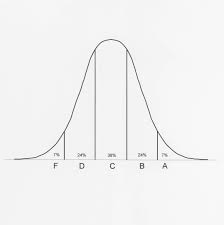
The bell curve did not shift, but the names we call each place on the curve did. A no longer depicts a small portion of children with superior performance (7% or so, of students). Now A is for Average.

grade

Normal Grade Distribution Curve

There is something seriously wrong when average performance for an average student is looked at as failure. Average children are not stupid. Average means “as expected.” Average means “okay.” Children with average school performance are presenting skills equivalent to what is expected of the majority of children their age. Expecting all children to be ‘above average’ is not realistic. Pushing a good-effort B student to get only “A”s (and above) is a recipe for stress and worry, for frustration, disillusion, anxiety.

I certainly understood the mother’s plea. She was being carried along in the currents of requirements and expectations Shippey speaks about, and she believed–and her belief was strongly reinforced by teachers’ notes, societal pressure and the higher-education reality–that it was required of her child to be remarkable. Remarkable is the new ‘expected.’

Grades used to be a measure of a child’s ability and effort. We rightfully demanded that children to do their best and put an honest effort, but it was pretty clear that not everyone could be at the top of the class. By definition, this cannot be.

Nowadays, grades are not so much a measure of a child’s ability and effort as they are an artificial soup made of an (often unfair) measurement of a teacher’s skills, a school’s ranking and a district’s relative superiority. Grades are measured for political gain and their manufacture sustains a multimillion industry of ever reinvented ‘teaching programs’ (and recently, ‘common-core’ goals), which are rarely developed by educators. Grades are big business. Less so about the kids.

The saddest part is, that children know it.

Children always sense unfairness or hypocrisy, they may not know to explain it but they feel when they are in a halls of mirrors. They realize that they are cogs in a machine. They perceive that they are being measured by academic yardsticks that do not really measure them and yet they are to be judged solely by.

The system needs to change. It is unhealthy, and children are reflecting it–in anxiety, depression, disillusion, burn-out, anger, attitude, apathy, a sense of invisibility and impossible demands.

In the meanwhile, the dilemma of this mother (and many other parents)–and in a way mine as a clinician who can hone a child’s ability or give them a leg up–is whether to feed into the system and push that child forward. Whether to put him into intense tutoring and ask him to perform beyond his skills and at the price of other areas of development; or leave him to learn at his normal (if average) rate and enjoy his childhood at the price of his potential future.

If it were your child, your potential client, what would you have done?


Keeping Children Safe–a how to resource!

talking to children about abuse

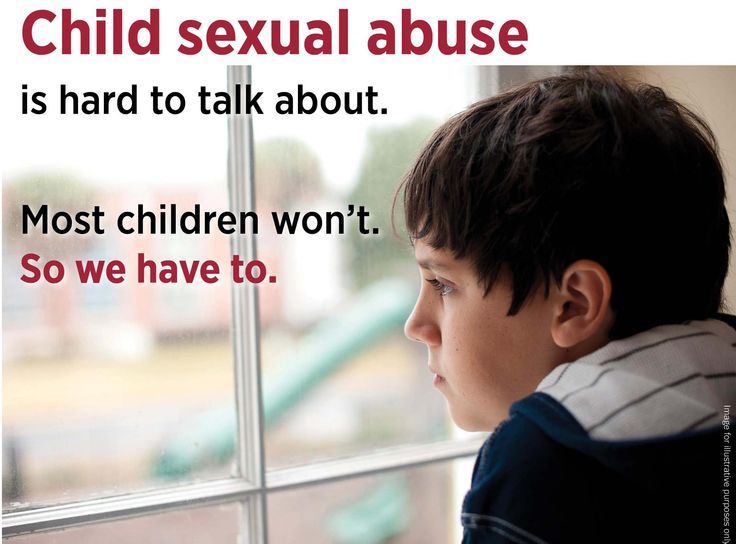
When it comes to keeping children safe from sexual abuse, many parents are baffled as to what to do. They don’t want to scare their children or give them ideas about the world being unsafe, and at the same time worry that lack of safety skills may place their children in danger of being exploited.

Parents don’t know when to start, how to bring the topic up, what to say (and what not to say). Many prefer to not bring up the issue at all, or focus only on ‘stranger-danger’–even though 90% of child sexual abuse happens in the hands of people familiar to the child (and upward of 75% by caregivers). It is difficult to conceive that children can be harmed this way. No one wants to believe that people they may know could be unsafe. We want to believe we can keep them safe from everything and everyone. Always. Moreover, the whole issue can bring up painful memories in those who pushed away their own experience of inappropriate touch.

Embarrassment, too, often complicates caregivers’ discourse about sexual abuse, as does worry about questions that one may not know how to respond to or that would raise issues of immodesty.

Even among those parents and caregivers who do discuss safety and sexual-abuse prevention, many don’t realize that keeping children safe goes beyond a one-time ‘talk’ about the topic.

Fortunately, there are resources like the one below, which do an excellent job introducing the issue of safety and body boundaries in children, from infancy through to adolescence. It is a very good place to start!

If you are a parent or a caregiver–read it. It may give you information or suggestions you did not think of before. If you are not a direct caregiver–share this with others who are. They will thank you. More importantly, the children would be safer.

http://www.themamabeareffect.org/empowering-our-children.html

themamabeareffect

Of course, children’s safety extends well beyond sexual abuse prevention. Verbal and physical abuse, bullying, and neglect are other sad realities for all too many children. We all should be vigilant to notice, intervene, and seek help for any child at risk. Any risk. It is our responsibility as adults to do so.

This resource, and other educational and practical tools for improving child safety are only one step and target certain risks, but are still immensely important to read and incorporate. This offers a very good start. Following these recommendation can help.

The reality is that even with all the information and education possible, we may not be able to stop some things from happening once. However, with good information and open communication, we can at the very least teach our children what to listen to (and what not to listen to or believe), and we can reinforce clearly how they can come to us with any discomfort, concern, worry, or imposed secret. This can help can minimize the likelihood of the unwanted happening. Just as important if not more–by providing children with good, ongoing, open communication about their bodies, their right to safety and honoring their intuition–we can ensure that what might happen will not escalate and will not happen again. Because they’ll come to us. Because they’ll tell. Because we will make it stop.

Click. Read. Learn. Share.

http://www.themamabeareffect.org/empowering-our-children.html

CSA we have to talk about it

ADHD or Trauma?–The Likelihood for Mistaken Diagnosis

trauma brain

A new study shows that a child with an ADHD diagnosis is more likely to have also experienced stress and trauma early in life.

Clinicians working with traumatized children and adolescents have long noticed–and noted–that it was not unusual for children with trauma histories to be diagnosed (and possibly all too often misdiagnosed) with ADHD. 

What complicates the clinical picture is that a child can have ADHD and trauma history (or Autism and trauma history). In fact, children with ADHD and children with communication disorders are more likely to be maltreated than children without these issues.

As the article below states, and what is very important to take into account, is the need to rule out trauma as the cause–or contributor–to the child’s clinical presentation, rather than simply assume that a distracted, inattentive child has ADHD. Assessment needs to address the possibility of trauma, and intervention approaches must be adjusted accordingly. For example, medication for ADHD may not be appropriate for a child whose inattentiveness is due to hypervigilance. It is crucial to ensure that past trauma be treated and ongoing trauma be addressed, so that the child can let go of the coping skills adopted to manage overwhelm.


The article is copied below. You can also read it on the original webpage by clicking on the title below. For more information about trauma and development, click here.


News Analysis: Are We Misdiagnosing Childhood Traumas as ADHD?

Children with attention deficit hyperactivity disorder (ADHD) receive a diagnosis based on their behavior: age-inappropriate fidgeting, inattentiveness, hyperactivity, and trouble sitting still and concentrating. However, according to new research presented today at the Pediatric Academic Societies annual meeting in Vancouver, Canada, these behaviors may also be linked to childhood trauma.

A research team analyzed data about 65,680 children ages 6 to 17. (The data was taken from the 2011-2o12 National Survey of Children’s Health.) The children’s parents answered questions about whether their kids had been diagnosed with ADHD, how severe their symptoms were, and whether they were taking any ADHD medications. The parents also reported on whether the children had had any of nine adverse childhood experiences (ACEs): poverty, divorce, the death of a parent or guardian, domestic violence, neighborhood violence, substance abuse, incarceration, familial mental illness, or discrimination.

“Diagnoses of ADHD have increased over the last decade, and there has been a concomitant rise in stimulant medication use,” said Nicole Brown, an assistant professor of pediatrics at the Children’s Hospital at Montefiore and lead author of the study, in an interview with Healthline. “Many of my patients also experience trauma during childhood, which often exacerbates ADHD symptoms and poses diagnostic challenges with respect to teasing out whether their symptoms directly result from the trauma they experience.”

About 12 percent of the children who participated in the survey had been diagnosed with ADHD. Parents reported that these children had also experienced higher rates of all of types of ACEs than children without ADHD.

The children with ADHD were also more likely to have experienced a greater number of adverse events. Seventeen percent of children with ADHD had experienced four or more ACEs, as opposed to 6 percent of children without ADHD. The children who had dealt with four or more ACEs were almost three times are likely to be using an ADHD medication as children with three or fewer ACEs, and their parents rated their ADHD as being more severe.

ADHD and Trauma: The Chicken and the Egg

How is ADHD connected to stress and trauma? There could be a number of explanations.

First, it’s possible that doctors are simply mistaking the signs of trauma in children for ADHD. “What we find is that there is often an overlap in the symptoms of children who have ADHD and children who have experienced trauma, particularly small children,” said Alicia Lieberman, professor and vice chair for academic affairs at the University of California, San Francisco, Department of Psychiatry and the director of the Child Trauma Research Program at San Francisco General Hospital, in an interview with Healthline. “The inability to concentrate, the fidgetiness, the inability to pay attention, the distractibility, the restlessness, and the irritability are often behaviors that trigger a diagnosis of ADHD. And often, the people making the diagnosis do not ask what happened to the child, what kind of experiences the child has had.”

Brown agrees that this may explain her findings. “Studies have also shown that symptoms of post-traumatic stress disorder (PTSD) or acute stress disorder resulting from adverse life events closely resemble ADHD symptoms, so there is a high likelihood for clinicians to diagnose ADHD and overlook a possible trauma history,” she said.

Another explanation is that children with ADHD may be more likely to get into trouble and to experience traumatic events as a result. “Children with ADHD can become more impulsive, can be more annoying to parents that might be depleted, so children with ADHD might be at greater risk for being maltreated or getting into accidents, which might in turn trigger PTSD,” explained Lieberman.

Finally, researchers know that stress in the early life environment might affect the development of the brain. “It’s also possible that being exposed to a traumatic event increases the likelihood of developing psychiatric disorders that have a range of manifestations, including anxiety, post-traumatic stress disorder, and ADHD,” Lieberman said.

“When a child is presenting difficult behavior, the first thing to ask is ‘What happened to the child?’ rather than ‘What is wrong with the child?’”

Under this lens, ADHD is only one of many possible outcomes that can result from early-life trauma. And even then, ADHD might just be a sign of what’s to come. “We know that early life adversity produces developmental changes consistent with ADHD, but it produces many other effects as well,” explained Regina Sullivan, a professor of child and adolescent psychiatry at the New York University School of Medicine. “As a child is developing, and there’s a neurobehavioral deficit, how that is expressed changes during development. ADHD can sometimes be symptoms of neurobehavioral problems that will emerge later in development.”

Sullivan added, “Early life trauma and stress can interact with genetics to produce different disorders based on the age the trauma was experienced and the particular type of stress or trauma. Different-aged children, and children with different genetics, and children with different personalities, will respond differently to a given stress.”

Are We Medicalizing Stress?

Rising rates of ADHD diagnosis and medication use raise the question: are we turning normal levels of life stress into a medical condition? Lieberman points out that more than 60 percent of children report that they have been exposed to some kind of victimization in the previous year, and more than 10 percent have had five or more exposures. For many children, ACEs aren’t rare, they’re the norm.

And when kids are under stress, they’re more likely to act out. “When a child is presenting difficult behavior, the first thing to ask is ‘What happened to the child?’ rather than ‘What is wrong with the child?’” said Lieberman. “The recommendation that the authors of the study make about the importance of screening for trauma exposure in every child that is showing symptoms that can be associated with ADHD is extraordinarily important and timely.”

In these circumstances, medications probably aren’t the answer. “While stimulant medications may prove beneficial for some children, they may not be the most effective management strategy for all children,” said Brown. “Children with ADHD diagnoses who have experienced trauma may additionally benefit from specific behavioral interventions that are tailored to addressing their underlying trauma histories.”

However, Sullivan cautions against drawing too many conclusions about a child’s past from his or her diagnosis of ADHD. “Not all children with ADHD have had early life adversity,” she said. ADHD also isn’t necessarily a sign of other disorders to come. “Sometimes, when someone has ADHD, they maintain those ADHD symptoms throughout life, changing somewhat, but they still have the diagnosis of ADHD.”

It will be many years before the root causes of ADHD are fully understood. Until then, doctors must try to figure out which symptoms are caused by trauma, while also ensuring that children with ADHD get proper treatment for the disorder itself.

adhd

Pendred Syndrome–a Query

A query from a parent:

“My son was just diagnosed with Pendred syndrome. He already has hearing aids from when we discovered he has hearing loss when he was 8 months old, but he needs stronger ones now because his hearing got much worse. The doctor said that he may end up deaf and that we need to check his thyroid, too. My son is already getting PT with early intervention because he is not walking yet at 18 months but we’re going to put him in speech therapy, too. What is Pendred syndrome and is it true my husband and I gave it to him? Will the therapy help with his hearing? There’s so much technical stuff and I’m really worried.”

Dear Worried Mom,

Of course you are worried. It would be overwhelming for any parent to have their child diagnosed with a problem, let alone one that can continue to affect them and that may change with time. A good step is to seek more information–as you are doing now, and hopefully will continue to do.

I’m glad that your son is already getting amplification (i.e. hearing aids) and that they are going to be adjusted/changed to reflect the change in his hearing–this is very important, and is a big step of helping him develop the best way possible. Am glad that he’s getting PT, too, if his motor skills can use some help; and that you are going to begin Speech-Language-Therapy with him, to ensure he makes the most out of his hearing and that his speech and language can develop as well as possible.

I hope that your pediatrician and the clinicians you’ll be working with (in Early Intervention, the ENT, the Audiologist, etc) will refer you to more information about Pendred syndrome, hearing loss, and rehabilitation of hearing loss in young children. Do let them know you are concerned and discuss your worries with them–I am quite confident that they will have resources, support, and more specific answers for you.

In the meanwhile, here’s a summary of some of the main features and issues in Pendred syndrome. This is not in any way a comprehensive review of Pendred or what the course of it would be in your son’s case. Nor is it a specific recommendation as to what to do in your son’s case, but I hope this overview will nonetheless give you some information to start with.

Pendred syndrome is a genetic disorder that causes early hearing loss in children. The syndrome is named after Vaughan Pendred, the physician who first described people with the disorder. It is actually the most common syndromal form of deafness in children–it is estimated that Pendred syndrome accounts for 5-10% of hereditary deafness cases! It is an autosomal recessive disorder (which basically means that both parents need to be carriers of the recessive gene–but the parents often have no symptoms and often don’t know that they carry the gene), and is associated with abnormalities of the cochlea, sensory-neural hearing loss, and diffuse thyroid enlargement (goiter). It can also sometimes create problems with balance.

Children who are born with Pendred syndrome may begin to lose their hearing at birth or soon after birth (like in your son’s case), and often lose hearing by the time they are three years old. The hearing loss is sensory-neural in type. When hearing is present at birth, it will usually worsen over time, with some children with Pendred syndrome becoming totally deaf (but not all, some children do have residual hearing or a lesser hearing loss). The hearing loss in Pendred syndrome is usually bilateral (in both ears), although one ear may have more hearing loss than the other.

Childhood hearing loss has many causes. Researchers believe that 50 to 60 percent of cases are due to genetic causes, and 40 to 50 percent of cases are from environmental causes (e.g. substances that damage the inner ear, such as certain antibiotics or chemotherapy medications).

The first part of a diagnosis of Pendred syndrome often includes the discovery of a hearing loss via a child failing a screening test or the presence of a hearing loss being found. Not all hearing loss in childhood is related to Pendred Syndrome, so the clinicians evaluate many things before considering the diagnosis and it can indeed take a bit of time before things are known for sure. Things like the kind, timing, amount, and pattern of hearing loss; the anatomy of the inner ear structures; the child’s balance and thyroid, etc. All these can help the health care professional determine whether to seek genetic testing and imaging tests for the inner ear, and to conclude whether a child has Pendred syndrome or some other type of progressive deafness.

Pendred syndrome can make the thyroid gland grow larger (when a thyroid gland grows too large and can visually bulge on the lower neck, it is called a goiter). The thyroid is a small, butterfly-shaped gland in the front of the neck, just under the ‘Adam’s apple’ and just above the collarbones. It plays an important role in the way the body uses energy from food, as well as in normal growth and development. Some thyroid issues in childhood (e.g. Grave’s Disease) can cause growth problems. However, in Pendred syndrome children often develop properly even if their thyroid is affected and their levels of thyroid hormones are usually normal. Not everyone with Pendred syndrome gets a goiter, and it typically develops in adolescence or early adulthood. Not all goiters are problematic, but if a goiter becomes large, it can impact breathing and swallowing and then treatment may be necessary. So an endocrinologist (doctor trained with diseases and disorders that involve the hormonal/endocrine system) is probably a good person to get involved even if only for followup.

By the way, it is still not clear to scientists why some people with Pendred have more issues than others (e.g. some have goiter and others don’t).

Alongside hearing loss, Pendred syndrome also can affect the vestibular system, which is the system which controls balance. The good news is that most children and adults with Pendred learn to adapt to whatever vestibular dysfunction they have and can manage routine tasks and daily balance requirements well. That said, because of the vestibular issues, some babies with Pendred syndrome may start walking later than other babies.

To get a bit technical: It is believed that Pendred syndrome is caused by mutations (i.e. changes) in a gene called SLC26A4(formerly known as the PDS gene) on chromosome 7. To be born with Pendred syndrome, a child would need to inherit two mutated SLC26A4 genes—one from each parent. Because it is a recessive gene, the parents are only carriers of the mutation (i.e. they don’t have the syndrome themselves). In a family where both parents are carriers, a child has a chance of 1:4 to be born with Pendred, and a 1:2 chance to be born a carrier. It is often recommended that if people are concerned about the possibility of Pendred (e.g. in a child or future children) that they seek genetic testing and counseling.

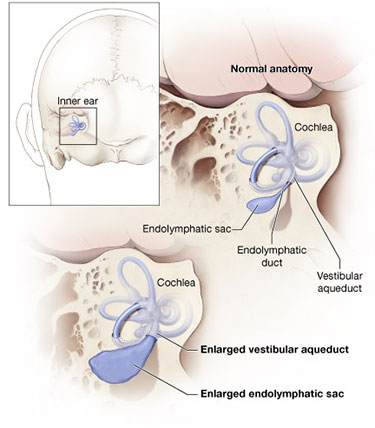
The anatomy of the inner ear is often viewed through imaging techniques such as magnetic resonance imaging (MRI) or computed tomography (CT), which allows viewing the cochlea and the vestibular system. The cochlea is the spiral-shaped part of the inner ear that converts sound into electrical signals that are then sent along to the brain through the auditory nerve. A healthy cochlea has two-and-a-half turns, but some persons with Pendred syndrome may have a cochlea with only one-and-a-half turns. The vestibular system includes a part called vestibular aqueduct. It is a kind of a bony canal that runs from the vestibule (the part of the inner ear between the cochlea and the semicircular canals) and the inside of the skull. Inside the vestibular aqueduct there is a fluid-filled tube called the endolymphatic duct, which ends with a balloon-shaped sac. People with Pendred syndrome may have an enlarged vestibular aqueduct, and the endolympatic duct and sack may also be enlarged.

Below is an image of the inner ear in some people with Pendred syndrome, taken from: http://www.nidcd.nih.gov/health/hearing/pages/pendred.aspx

http://www.nidcd.nih.gov/staticresources/images/PendredFS-enlarged-vast.jpg

When it comes to helping children with Pendred: First of all, to minimize the risk of worsening hearing loss, children with Pendred syndrome may be advised to wear head protection when engaged in activities such as bicycle riding and skiing (to avoid trauma to their head). They may be advised to avoid contact sports or situations that can lead to extreme, rapid changes in pressure such as scuba diving or hyperbaric oxygen treatment.

Like with your son, the treatment of children with Pendred syndrome indeed often involves a team of specialists. These could include an audiologist, speech-language-pathologist, otolaryngologist, endocrinologist, geneticist, physical therapist, and primary care physician. Not all need to see the child all the time, and not necessarily throughout childhood, but it is always good to have those who are working with the child communicate with each other as need be so that they can coordinate goals and needs and work as a team. Don’t be shy about asking professionals to collaborate–they can’t and won’t do so without your consent.

Hearing amplification (hearing aids, and for those who need them: cochlear implants) can greatly minimize the impact of hearing loss on language and development. Children with Pendred syndrome should start early treatment with a speech-language-pathologist, to help gain communication skills and learn how to maximize their use of their hearing aids or cochlear implant. So I think it is probably an excellent thing for your son to begin with an SLP now, when any gaps or difficulties, if there are any, hadn’t had a chance to grow wide. In addition to hearing rehabilitation through working on discriminating, identifying, understanding, and processing sounds and language better, speech-language-pathologists can also help children with Pendred syndrome with speech, voice, and language development. The hearing itself may not be made better, but how the child used the hearing they have can be get a lot better with treatment. Treatment can help minimize the impacts of hearing loss on development, language, communication, and learning. Physical therapy can help with balance issues, and help aid with motor-goals (such as walking, and later running, climbing, and so on).

It seems that your son is already up to a good start, by having a parent who is interested in getting more informed about his condition and who is seeking to follow through on the best treatment plan for him. I wish you and your son all the best, and a lovely, joyful, satisfying healthy childhood.

Clapping, singing, and Peek-A-Boo

A query came from another young mother:
“I have a six-month-old baby and I’m a single mom without much money to take her to mommy-and-me classes and such. Are there games or activities I can do with my baby at home to help her language development? She’s healthy and doing everything she’s supposed to do at this age, the doctor says. Thanks, Doing My Best.”


Dear “Doing My Best”,

It sounds to me like you are on the right path already by even wanting to know how to do more with your little one! Being a single mom is difficult, let alone having limited funds. The good news is that you don’t need to spend money on classes and expensive toys and gadgets–YOU, and things you already have at home, are the best ‘tools’ for your baby–you likely have everything you need already!

Babies have an innate ability to develop language, and are marvels in how they manage to make meaning of the world around them. Almost all they need for it is you and exposure to language through you–their caregiver. She needs your attention, sensitivity, time, and commitment. There are many things you can do during your everyday activities with her that would foster comprehension, listening, turn-taking, sound production, connection, shared attention and cognitive development–all the makings of language and communication development.

Language exposure is important, so talk to your child about everything you do. Use her name when you call her, look at photos of herself and yourself and other people she knows–point to the photos and tell her who these are. Books are great, as well. Read to her every night–it is never too early to start and make it a habit. Board books are sturdy and great fun, and you can let her turn the pages if she wants (lift-flap books where she can ‘find’ things are fun, too).

You don’t need to buy many books–maybe just get a few favorites. Borrow the rest at the library. Take her with you if you can and choose the books together. Make this part of your fun time. You don’t need to read every word in a book, either–flow with it, narrate the pictures, respond to her reactions (e.g. “yes, you are touching the lion, that’s the lion and he can roar… and that’s the giraffe, look how tall it is! It can reach all the way up in the tree!”). Make book-reading part of your connecting and listening time.

Everyday activities are excellent opportunities for language exposure: narrate whatever you are doing together, when you are out on a walk, in the playground, food shopping, or doing household chores (she can help …) such as folding laundry, straightening up, or mushing cooked veggies for her food (“Oh, here’s your red shirt! Let’s fold your shirt so we can put it in your drawer. Look how nice and clean it is! Now…where are your socks–here’s one sock, and here’s the other… You want to hold the socks? Here you are. Oh, aren’t you smart! You know they go on your feet! Let’s put them on–one sock on this foot, and another sock for that foot …”) etc.

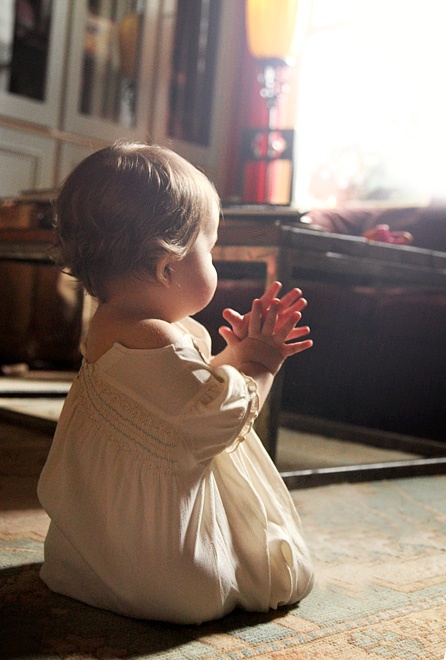
Take turns by playing games like peek-a-boo, clapping, nursery songs that have predictable body movements (the wheels on the bus, itsy-bitsy spider … borrow a CD from the library if you don’t remember them, you’ll know them by heart in no time…). Take turns banging on things to make noise together (you don’t need to spend money on a drum, an upside down pot with a spoon works great, too …), build a ‘tower’ from a few blocks and knock it down, then build again and let her knock it down (plastic cups or containers work well. You can fill closed containers with some dried beans of pasta if you want–for heft and sound–just make sure they are sealed tight!). Babies love repetition, so be ready to do this quite a few times.

You can roll a ball back and forth, pick up toys together (it may take a while, if she decides that taking out of the box is just as much if not more fun!), hand her spoons to put in the drawer, fill and empty a basket of lemons or oranges (no items smaller than a Ping-Pong ball, because they can be a chocking hazard), fill and empty a cup with water during bath-time.

Model symbolic play: ‘feed’ the stuffed animals and dolls with a spoon, put them to bed, ‘offer’ them a bottle. Put them in the stroller and take them for a walk in the house, play peek-a-boo with the dolls and let her have a turn, as well.

Through it all, talk to her. Listen to what she is ‘saying’ (babbling…) back. Comment about what you are doing. Comment a lot about what she is doing, her expressions, the sounds she’s making, how she might be feeling, how she makes you feel. Praise her for achievements (picking up a cheerio and managing to get it into one’s little mouth is no small feet of coordination!), let her know you are interested and that she is interesting, lovable, adorable, and fun.

Language development is closely related to and develops right alongside cognition, motor ability, sensory ability, listening, and understanding things about the world (e.g. you let go of the spoon with sweet potato on it, and it falls on the ground, making pretty splatter…! Mommy picks it up and wipes the floor, and when you let go of it, it falls again! How fun!…). Use your everyday interactions with your little one to comment on your world and hers, on your shared experiences. You don’t need commercial specific toys: let her play with wooden spoons, plastic containers (these can nestle, and you can also put things in them…and take things out…), an empty seltzer bottle with some pasta in it, pots and pans. A dish-towel makes a great ‘peek-a-boo’ cover, and a blanket for the teddy bear, too.

Babies and toddlers are utterly and preciously amazing. She’s already learning every day, and you have the opportunity to be her most important connection, attachment figure, playmate, and teacher–all in one. Enjoy her, and I wish the two of you oodles of fun!

clap