Space To Roam

dark-clouds-on-a-sunny-day SueVincent

Photo: Sue Vincent


When they first left the city she was devastated.

She knew it was the better choice. That the twins’ sensitive lungs could not function in the pollution. That Mark’s temper improved whenever he had something green to look upon. That there will be less pressure on her to perform.

And yet … she mourned.

She worried that they will be terribly lonely. That the twins’ needs will drive her to distraction and that there will not be enough there to keep her mind from wandering into the darker corners of herself, especially in the days each month when she was already prone to the morose. She worried she would hate it. Hate him. Resent them.

She couldn’t have been more wrong.

The rolling meadows became an endless canvas of interest. The twins spent hours in the fresh air, content to watch the play of light and shade as clouds raced across the sky and birds fleeted and hares scampered and hawks floated languidly above. They did not cry nearly as much. They slept. They began to respond. It gave her time to know them. Their facial expressions and appetites and unexpected curiosity.

She was learning to know Mark better, too, and she liked what she was getting to know better than what she’d believed she’d liked when they first met. He was kinder since they moved. More patient. Less ashamed.

She knew he’d blamed her for the twins. For their impairments. For trying to birth two babies together and then doing it so poorly that she not only gave them damaged children, but was not likely to birth again.

In the city the children were a constant reminder of his imperfections. He was saddled with them yet found little comfort in babies who were sickly and odd-shaped and would likely never walk by his side. He was “the man with the cripples,” and though he never outright said it, she knew he resented the children for that. She knew he resented her, and that he hated his family for gifting them this exile.

But in the small estate in the middle of nowhere, surrounded by hills and bogs and streams and all manner of wild things, her husband seemed to find compassion. For himself. For her. For the children.

He calmed.

He took long walks.

He discovered fatherhood.

Neither of the twins smiled much, but when they did it would transform their wizened little faces into absolute delight.

In a moment of unexpected impulse, Mark discovered that he could make Tommy smile by spinning him high in his arms. And after that he could not get enough of Tommy’s dimple. Or Ronny’s laugh.

She could not get enough of Mark’s.

And she knew she would never forget the morning when she found Mark asleep in the nursery, draped on the daybed with the children cradled one to an arm. She loved him then in a way she did not believe possible.

So yes, when they first left the city, she had been devastated.

Yet in the vast open spaces of a fresh start, their grief diluted, they found a place to roam.

They found each other.

They found home.


For Sue Vincent’s WritePhoto


When It Leaves

shimmer SueVincent

Photo: Sue Vincent


“What is that thing?”

Melanie squinted against the glare. Shrugged. “A microscope with duck feet.”

Tony frowned. His sister was easily the most annoying person to ever occupy the Earth. Well, after James. James was worse.

The boy stole a look behind him as if expecting James to manifest, even though he knew that the youth was many miles away. You just didn’t know. With James.

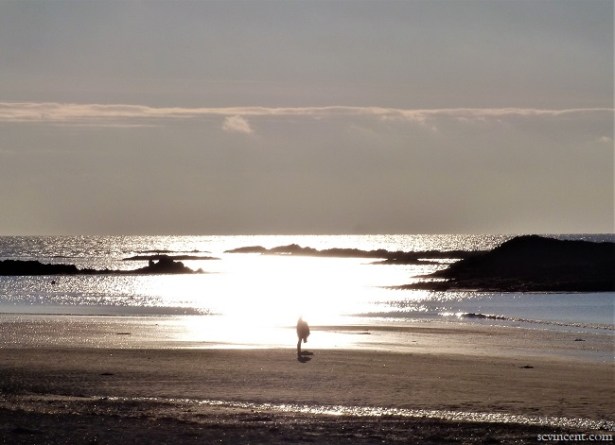
Melanie rested her chin on her knees, hummed under her breath, and played imaginary piano with her toes, watching the sand swish around her soles. She was hungry. She wondered what they’ll have for dinner. She lifted her head to glance around. The beach was slowly emptying but it was too early to check the bins.

And anyway, it was Tony’s turn.

She couldn’t keep doing everything for him. He was never gonna learn.

Her stomach growled and she sighed and squinted again at the odd shape on the sand. “Yep,” she pursed her lips. “Definitely a microscope with duck legs.”

Tony made that sound in his throat that she knew meant he was distressed but didn’t want to show it. She ignored him. He had to toughen up.

The quiet between them lingered. It felt stretchy. Like a taught rubber band wound over a finger. Melanie stared. That thing didn’t move.

“It’s an alien,” Tony finally said.

Melanie nodded. Could be.

Tony breathed. “I wonder where the spaceship is.”

“Yeah.” Melanie sat up, suddenly intrigued. “And I wonder when it leaves. You think that if we ask, it would agree to take us with?”


For Sue Vincent’s WritePhoto


Soul Archeology

vista SueVincent

Photo: Sue Vincent


They were literally walking on the bones of ancient past.

The bones of actual ancients, too, if you want to be exact about it.

He contemplated telling Liz then decided she was more likely to be spooked than awed by the notion. So he let the soles of his trekking boots crunch wordless greetings with each step, and he set his mind to wonder, radar-style, about the centuries he could not see and so few even knew about, yet lay here for every person to experience. Literally. Through the mounds. These monuments to earlier.

It was an odd thing. History.

Will others one day tread upon the remnants of his, and will any ever stop to wonder about the life he’d lived, the vistas his eyes had feasted on, the memories he’d placed into the air with every exhalation?

If so, what would they think, and how did he feel about the possibility?

Not great, he realized. Especially if those future humans would by then have skills for viewing molecules of thoughts or the equivalent … His mind, unearthed, would be a bit like having archeologists come across a buried midden: plenty of data, but far from being the end one would wish presented for scrutiny.

He shuddered. More from shame than worry.

“These are man-made,” Liz noted from behind. The path was narrow and they could only walk single-file.

He nodded, unsure whether she had misinterpreted his reaction or — as she sometimes could be — was eerily on point.

“I wonder if they had intended for anyone to walk on these,” Liz added.

He stopped. There was something in her voice. A fullness.

He turned to her. Her cheeks were wet. Her eyes were red. How long has she been crying?

Her lips turned up at what she must have seen in his expression. “I’m fine, Shawn,” she breathed. “It is just that there’s a sense of spirit pushing like a memory-foam against my feet …”

His own eyes filled and he shook his head, surprised at the emotion.

“See?”

“I do,” he nodded, reached for her hand.

The fields below them stretched wide and green to the horizon. The air sighed with the scents of grass and rain and years and sun.

“This place,” he braved, “it makes me want to be a better man.”


For Sue Vincent’s WritePhoto


The Longest Walk

Photo: Sue Vincent


She rose with the sun, her brow still damp with the essence of dream. Soon enough her feet were, too, from dew and from the small drops of silence that mornings bring.

There was little to say, and much space to accompany.

It was a good day.

It had to be.

There will be time much later on, for all the things she might still need, and all the words she may still say, and all the sorrows she no longer wished to borrow.

In the meanwhile, she walked on, crushing dandelions, breathing lavender.

The fields stretched ahead as the disc of light leaned hot against the sky. The air shimmered, dancing in the sun.

Or wavering.

It would not matter, in the long run.

She walked on.

Eventually she’d have to turn around, retrace her steps, return into the pace of tending, bending, sending, lending, fending.

And it would still be a good day.

For the dawn poured the generous morn into her, washing her, filling her, scenting her soul. Step by breath by step by breath, immersed into the longest walk her present moment could recall.


For Sue Vincent’s WritePhoto


Her Reflection

silver-1 SueVincent

Photo: Sue Vincent


She walks along the dunes. There had been very little time away from others. So very few opportunities to be alone. She needs this more than air.

Morris agreed to keep an eye on the children. They were not enthused.

“He’s boring, Mama!” Ethan complained.

“Yeah, and his breath smells!” Lilly pouted.

“You don’t have to kiss him,” she replied. “And if you are bored, I can leave you some chores.”

They skulked away, displeased, but there was nothing for it, grumpy neighbor-as-babysitter or not. She knew she was becoming increasingly impatient. She did not want to cross the line into unkind.

It wasn’t their fault that Paul left. It wasn’t their doing that their dad did not see fit to shoulder any responsibility. She knew they missed him. He didn’t even think of calling on their birthdays. She knew Ethan cried for his dad in his sleep.

She almost took them with her to the dunes. Almost made it a family outing. Lilly loved running in the sand. Ethan’s eyes always lit up at the space. Like her, he loved the breeze and silence.

But she could not. Not this time.

This time she needed to replenish. For herself. For them. They needed a sane mother. She was running low on how.


She walks and breathes and ruminates and lets the worries and the sorrows stream out and flow down her cheeks and neck and chest till they evaporate.

There was a time she had hoped to have a house on the dunes. There was a time she had a dream of living in the solitary calm of gulls and tides and estuaries.

It wasn’t that she regretted having the children (marriage was a whole other story, given what non-partner Paul turned to be). She did not. Not once. She couldn’t imagine her life without them. Just for this morning, though … she needed to let be a part of herself that did not have them in its center.

She walks as if in daydream. The light shimmers and the estuary glints silver in the shrinking distance. It gives her peace. A reminder of how every stagnant-looking pool may in fact be only a pause in flow.


For Sue Vincent’s WritePhoto challenge


Eventually

Photo: Sue Vincent


He spent the day lying in the field. Waiting.

Eventually someone would miss him, or wonder about how come he is so late.

Eventually they will think of sending someone to check.

For the moment, all he could do was gaze up at the skies, his leg in an angle that no leg should be in, and his breath curtailed to the smallest gasps as to limit the stabbing pain that traveled through him – like a snake’s bite and a red-hot poker combined – if his lungs filled up enough to move the lower part of his torso. He’d never been more acutely aware of how all joints connect.

A marvel, really.

And a pain.

He almost laughed at his own joke only to remember the infinite well of torture that he’s been finding over the hours he’d been this way. There was no bottom. Only crests of agony he could know and not know of, ride and fall off of, let be and let go.

In the first hour after it happened he’d been angry at himself for the stupidity of attempting to leverage boulders that should not be attempted solo. The stick, not sturdy as he’d hoped, snapped in half, sending him to the ground in an way he could not reconstruct for the blinding nausea of torment that had ensued. He didn’t know what part of his leg it was that broke, or not exactly. Raising his head even just a little led to the world spinning and a blackness closing in, and not only from the clouds that seemed to gather.

He wasn’t angry anymore. There was nothing left in him to spare on blame.

The grayness above grew heavy. It would not be long before the rain.

He’d be miserable in the muddy wet.

It would also bring people faster. They would not expect him to misread the weather. They’ll question. They’ll come.

A drop tickled his nose and he suppressed a sneeze, almost crying with desperation to avoid more pain.

A call sounded, and for a fraction of a second his heart soared. But in the next, awareness filled in: it was not a human’s.

He opened his eyes to a quartet of geese flying overhead. Wings flapping asynchronously against a rising wind.

“Fly safe,” he mouthed, eyes overflowing with misery in spite of himself. They could move. He was jealous. He was helplessly alone.

More drops fell. Tears or rain, it did not matter.

He held on to the imprint of the silhouettes against the spitting heavens.

Soon, his family will realize he hadn’t come home. Soon they’ll wonder about it enough to worry where he was. They’ll send someone.

For the moment, all he could do was breathe, and hold in all the sobs, and let the pain wash over him like rainfall.


For Sue Vincent’s WritePhoto


A Key To The Heart

Photo: Sue Vincent


The last thing she believed was that her great-grandmother’s words had been literal.

The old woman was prone to tall tales, lore and fairies, rumors and gossip, odd potions and odder notions. There were always layers of meaning. Lessons. Some ancient moral to decipher. A hidden understanding.

As a young child, Patricia was fascinated by Gramma Gee. She would spend hours dreaming about the meaning of the words of mystery from the wizened woman who had more wrinkles than skin and whose spine bent halfway parallel to the ground.

But by the time she turned an adolescent, Patricia found the elder’s cryptic talk to be boring, dated, and annoying. She only went to visit to assuage her mother’s guilt, and even then did so without enthusiasm and for the briefest stay.

When Mom died at the end of a long illness while Gramma Gee continued living, Patricia — then a college student — stopped visiting altogether. She’d convinced herself that the old woman in the cheerless room in the old people’s home was senile and would not know the difference, but in her heart’s heart she knew that she was angry. Every day the ancient lived felt like one stolen from her mother.

Patricia wondered if her mom had felt that way after Nana died. The sudden death that bled Nana’s life into her brain had left Mom bereft and lonely. Patricia was not quite four years old at the time.

It did not seem fair. Two holes bracketed by a woman so old there could not have been a good enough reason for her to still live.

Then, on Patricia’s twenty-sixth birthday, Gramma Gee breathed her last. She’d just turned ninety-five.

She left Patricia everything: Two tattered suitcases of documents, moth-eaten blankets in a trunk that could have come out of a horror movie, a box of knickknacks, and a four-leaf clover key wrapped in a piece of leather in the shape of a heart.

“There is a key to the heart, and you can use it.”

Patricia had heard Gramma Gee say this phrase more times than she cared to remember. She’d thought it romantic at some point, then irritating.

But was it more than an expression? And if so, a key to what?

The attorney who was the executor of Gramma Gee’s meager estate was no help. A harried man with droopy spectacles and droopier hair, he had not much to tell her. “It could be in the documents,” he said, nicotine-stained fingers fidgeting for her to sign the papers on his desk and let him go handle some other oldster’s odds and ends. “I believe there’s a deed among the documents. To some house in the old country. I don’t expect it to still be standing. Most are not.”

It was mostly not.

But a section was, and part of a stair sticking out of broken walls. And the owner of the bed and breakfast nearby had a small tractor and a strong son he could lend. When they cleared away the rotten beams and tumbled stones and mounds of weeds, there was an intact part of ancient wall revealed, and more steps.

And at the end of those, a closed door. Set with a heart-shaped lock.

She had the key.

And she could use it.


For Sue Vincent’s WritePhoto challenge


The Others’ Side

Photo: Sue Vincent


“Why is it this way, Mama?”

The woman let the small hoe drop from her hand. She straightened, hands over the small of her back, achy from the bending. The plot was spare, and the harshness of many a hard winter had stripped most of the topsoil off, leaving more pebbles than dirt. Still, it was better than nothing, and she was thankful.

The child had been sorting stones into piles. Larger ones. Medium ones. Smaller. There were repairs to make to walls and fences, and very little in the way of clay. Sizing stones helped make the puzzle of fitting the best bit in the best place, easier. It was a tedious chore that the girl somehow managed to make into a game. She had that magic in her, Margot did, the spark of joy that Annabelle spent every night praying would not ever have cause to slough off or be snuffed out.

“Mama?”

Annabelle nodded and turned her head toward the object of the child’s query. She’d had no option but to sit the child facing the chasm. One did not turn one’s back to the mist. Disrespectful. Ill fated. Even for children, who normally carried more protection by nature of their youth. Still, it was best to take precaution, and what the child learned early, she was less likely to forget later on and take a wrong step.

There was reason this plot was made available. Not many farmed so near the rift. Some claimed the uneasy air made foodstuffs grow small and weary.

Some did not have the luxury of growing theirs elsewhere.

“The light does not quite shine there the same way,” she said.

“What did they do?” the child’s voice was filled with pity, not fear, and Annabelle did not know whether in this particularity the compassion was something to celebrate or warn against.

“Some say they’d tied their soul to dark,” Annabelle sighed. The split and its reality was not something often spoken of. Yet unless some miracle happened and their circumstances changed, the child was destined to spend many days in close proximity to the Others’ side. It was better she heard truth from her mother, than distortions from those who felt more comfortable with lies.

She felt the child’s small hand slip into her calloused palm.

“They are not different than us, Margot. Not really. There was time before the split, before the earth heaved and the crack formed and separated this land into its pieces, where we all lived mixed together, if we even knew we were more than one kind. Now those who had happened to be on the parts that became the other side of this canyon, have the mountains dump the clouds onto them and the rapids raise a constant mist. It diminishes their sun.”

The child shuddered. Annabelle squeezed her hand to reassure her.

“There are those who chose to make their fear into a hatred, Margot. And that led to needing to make those one hated, be worthy of such ill-regard.”

“So they are good?”

“Most are. And some very likely aren’t.”

“And the big rocks?” Margot turned her head to inspect the piles she had just made. The stones balanced atop each other in formations mirroring the massive ones on the misty horizon.

“Put there, no doubt. No one quite knows why or how. Some say the ghosts of evil did it. The goblins that spit poison from the earth and crack the ground. I? I think it was people who’d arranged them. As you had the smaller ones.”

Annabelle had never shared with anyone the image that she’d seen nine months before the child was born. The figures scurrying on the impossible embankment, tucking what appeared to be smaller stones in the places where rocks nestled atop one another. The reverent silence of the people had her wonder whether they perhaps saw the rocks as headstones, memorials to those who had been lost to the maw that had swallowed so many when it had first sliced open the ground. A maw many did not believe anyone crossed.

She used her free hand to lift the girl’s chin so their eyes met. “Why did you put them this way, child?”

The gray eyes widened for a moment. In thought, not worry. “I wanted to respect the other stones, Mama. Their balance. How they don’t fall into the underside.”

Annabelle’s eyes filled. Her breath caught.

She smiled.

She never did find out who had forced her that night. She was blamed aplenty as it was, and so she never did tell anyone that she’d believed it had been someone who might’ve seen her watch them. Someone from the Others’ side.


For Sue Vincent’s WritePhoto


Carve The Cliffs

Photo: Sue Vincent


The calls of people searching for him reached his ears but he ignored them. They’d find him soon enough, and there would be punishment for him whether he answered or not. He preferred making good use of his time till then. Listening to other things.

The gulls dipped and screamed above the crashing surf. A rain-cloud hovered over the water, advancing like the searchers toward an inevitable drenching of the shore. It was his perfect weather. This mist on air. The colors. The expectation.

Did the cliffs welcome the rain or dread it? Sometimes he wondered whether for the rocks, perched above the ocean, there was relief in showers washing like tears down their stony cheeks.

He could see those. Tears. Cheeks. Faces. Hidden in the rocks.

Others mocked him for it. They said he was loose in the mind. Lacking logic. Too dreamy. Insane.

They tried beating it out of him. Did they think their thumps and slaps and lashes could drive away who he was, the way a kick sometimes dissuaded a stray dog from nosing near the chicken coop? There were times he’d wondered, curled in sobbing misery, whether it would not be better if they could.

Yet as soon as the sting subsided and the tears dried and a new morning dawned, he would feel the itch inside his soul awaken, stronger. It could not be squelched. It would no be ignored. There were spirits in those mountains. There were faces in the cliffs. He saw them. Heard their call.

An arm grasped his shoulder. Shook him. Slapped his head. Angry words garbled at his ears. He let the scolding drip to the ground. He let himself be led.

When he was grown, he vowed, he was going to carve the cliffs and release the stone-people from the prisons of ancient overgrown rock. He was going to help, so the rain could wash, freely, down their liberated cheeks.


For Sue Vincent’s WritePhoto


The Ball And The Bread

Photo: Sue Vincent


“You’ll stand on one side of the bridge, and I’ll cross it to the other.”

Millie considered.

Sylvia could be tricky. Sometimes the spunky neighbor was a delightful friend. Other times … not so much. And that’s not counting mishaps. Millie lost tally of how many times her playmate had landed her in trouble.

Millie’s hand rose to absentmindedly rub her backside. It still sported a bruise from the last ‘adventure’ Sylvia took them on. That tree limb would never grow again, and Millie’s piggy bank was half-emptied from the fine her parents had levied.

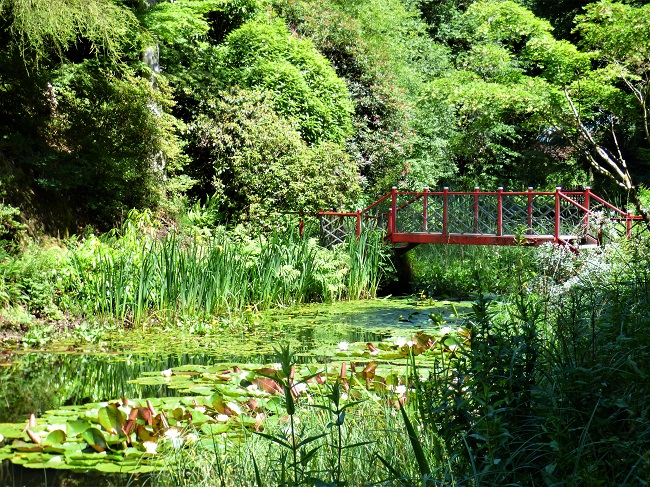
She looked at the pond. The water lilies floated serenely on the surface. A dragonfly hovered before dipping elegantly to paint a ripple. A frog leaped and splashed and swam underneath a wide green leaf. A bird chirped nearby.

It was perfect.

“I’m fine just relaxing here on the bank,” Millie decided.

“We won’t disturb anything,” Sylvia countered, flinging a braid behind a shoulder.

Millie shuddered. It was one of the things that were uncanny about Sylvia. Millie was positive the girl could read minds.

“I brought a ball,” Sylvia enticed. “And bread.”

The ball must be Denny’s, Sylvia’s brother, and almost certainly swiped without permission. The bread? Well, that was probably not ill got.

“No ball,” Millie said, then sighed. Somehow she always gave in to what became a kind of bargaining, when she in fact wanted none of the options to begin with.

“Great!” Sylvia scampered across the narrow bridge. “I’ll toss bread crumbs in the water and make some waves. You corral. Let’s see how many frogs we can get!”


For Sue Vincent’s Write Photo