Digging To China

KeithKreates250

Photo: Keith Channing


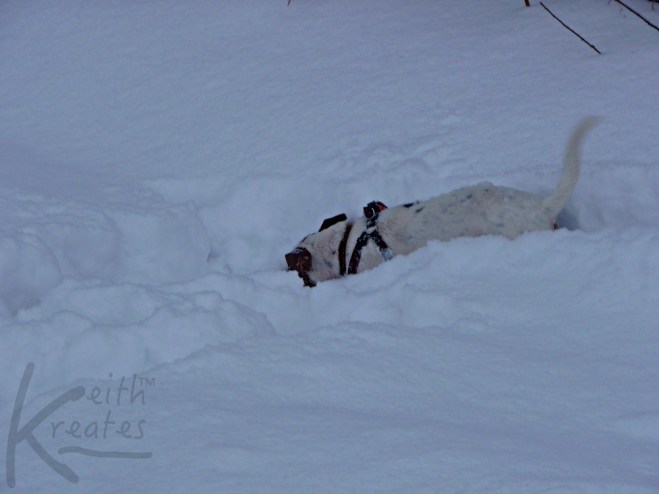
“Winter is the best for digging!”

Icicles hung from Snout’s whiskers, and his tail wagged excitement. The cookies-n-cream dog had two settings: asleep and overexcited.

It was exhausting.

Dumbo yawned. She stood under the dubious cover of a naked tree, and tried to make the least contact between her paw-pads and the frozen ground. Soon enough their human would stop staring into the hypnotizing rectangle, realize that he can do the same thing indoors, and “Cum’eer” them home. All she could do in the meanwhile was endure.

A bird took flight from a branch above her head and a pelt of snow plonked right onto Dumbo’s back. A shudder traveled from the tip of her nose to the end of her tail, shedding snow as it went. Now she was wet as well as cold. Stupid bird didn’t even have the decency to pick a different tree limb to launch itself from.

Dumbo hated winter.

She hated rain. And ice. And snow. And hail. And wind. And any type of weather that didn’t come with a built-in dry spot to sun herself in, preferably without any flying insects or pull-on-your-ears baby-humans or a housemate that believes the only kind of recreation befitting a dog is one that involves digging smelly things out of the ground.

She should’ve been born a cat.

Cats don’t have to go out in all weathers just to relieve themselves, and no one expects them to sniff others’ butts or follow orders or look happy about it. It was beneath a dog to be envious of a feline, but there it was.

“Come dig!” Snout barked enthusiastically.

“No thanks,” she muttered.

“You’re wet already, might as well have fun!” the smaller dog almost disappeared into the white mounds, paws tunneling in double speed into the frozen substance on the ground.

The human looked up, smiled, and pointed the hypnotizing rectangle at Snout’s behind, before checking the contraption, and raising it again in Snout’s direction.

Great. Mini-dog images. It meant they’d be stuck outside for another era. Who cares if the tip of Dumbo’s tail was ready to fall off from the cold.

“Come dig!” Snout yipped. “There’s stuff underneath here. Who knows what we’ll find!”

Dumbo yawned again and licked her chops in irritation. Go dig yourself to China, she thought, and stay there, too … see if I mind.


For Keith’s Kreative Kue #250


Bauble Bob

tolhouse CrispinaKemp


His father declared him hopeless. His mother bemoaned his daydreaming. His brother called the boy a fool. His teachers rapped his knuckles, dressed him in the dunce’s cap, slapped his head. Nothing helped. His mind continued meandering and his pockets remained filled with bauble nonsense.

By the time Bob turned sixteen, the village elders had resigned themselves to him becoming one who loitered by the stream, carried water for the old, and attracted the cruelties of the young.

The last thing anyone expected was that Lord Bailey’s new wife, who hired the young man for the price of bread and ale to repair some fallen stone in her abode, would so enjoy the river rocks and pebbles utilized as repairs by Bauble Bob, that she’d have him adorn her gate, her walls, even her door.

Soon enough there wasn’t a manor around he hadn’t been called to restore.


For Crispina’s Crimson’s Creative Challenge #66


The Way It Used To Be

storm SueVincent

Photo: Sue Vincent


There were hollows underneath the old ruins. They could be reached through the small shadowy glen that indented the hill where the remains of the stone structure stood.

Da had said that the underground spaces had likely been storerooms, but in Konnor’s mind they could just as easily have been dungeons. People had such things in castles and forts and towers. In old times.

Or perhaps still did. You never knew what could be lurking underneath someone’s residence.

He used to go to the ruins with Baldwin. It had been their favorite play space. They’d crawl through the opening in the rocks which led to a small roundish place with hand-hewed walls that still showed marks of chisels, complete with what must’ve been a doorway to other spaces but was blocked by a tumble of large stones.

They had made a plan to clear those, he and Baldwin, once when summer was long and they were bored and needing an adventure. They were soon disabused of the notion, however. Not only were the stones heavy and the tugging of them sweaty work, but the dust that fell on their heads from the ceiling made them realize that the whole thing could come down and leave them buried.

They weren’t ready to be buried. Not when ghosts and goblins waited to grab any who stepped into Death’s domain.

So they left the rockfall alone and found that their imaginations managed to terrify each other well enough without actually discovering what hid underneath and behind the areas into which they had no ingress.

Then Baldwin got sick, and when the fever subsided his legs did not work anymore and one of his arms was weak and he became morose and pale and could no longer come play in the ruins. When Konnor came to visit him, Baldwin reclined in his bed and frowned and said that dungeon stories were stupid and for babies.

Konnor stopped mentioning their games. He visited less and less until he only went when his mother made him. Baldwin was too angry and there was nothing Konnor could do right and he felt awkward and worried and sad.

His feet still took him to the ruins — they knew the way so well — but it wasn’t the same without Baldwin. The place felt spookier. Lonelier. Colder. Silent in a way that breathed him guilty. The stories that had been so exciting felt empty and Konnor began to think that perhaps the hollow, too, was for babies.

He turned his back on the ruins and tried to forget the way things used to be.

Then one day, as his feet walked him by, he heard mewling. At first he wondered if those were ghosts come to haunt him … but the insistent whines sounded too much like complaints brought forth by small, needy, hungry, living things.

He crawled in. His torch lit an area of newly fallen stones and a squirming mound of furry wobbly creatures.

It had been heedless to enter face first into a den. He would have been taught a painful lesson by the parent, had she not been crushed under one of the stones. It couldn’t have been long. Her motionless form was almost warm.

The pups mewled and one wriggled to nuzzle blindly against Konnor’s palm, seeking comfort. It was only when he picked them up into his shirt that he realized something.

“The stories we told may have been for babies,” he told Baldwin when he unveiled the brown head of a pup that had snuggled into the crook of his arm, “but the dungeons seemed to have produced some real younglings.”

“And this one,” he planted the helpless creature in Baldwin’s withered lap, “needs someone who understands. Da says her back must have been crushed. Her hind legs are paralyzed.”

Baldwin’s eyes grew round and as he reached to touch the pup, she licked his finger. “I’ll call her Dungeon,” he said gently and his voice held a hint of sparkle. “For the way it used to be.”


For Sue Vincent’s WritePhoto challenge


Slip Slidin’ Away

Photo prompt © Rochelle Wisoff-Fields


Now that it was time, she couldn’t get herself to do it.

The ice around her heart mirrored the slick coating on the deck, the driveway, the car. The accumulation of cold thinned. Her resolve cracked.

It dripped and melted into tears where the memories took hold. Where the sweet moments were as real as the many that weren’t.

Perhaps she should just wait longer. Hope for spring. Pray for summer’s warmth. Forget the frozen tundra that their relationships had become. The hurt. The broken bones.

The more she was nearing her destination, the more she was slip slidin’ away.


For Rochelle’s Friday Fictioneers


Bonus track of the song that played in my head as soon as I saw the photo:


One With The Herd

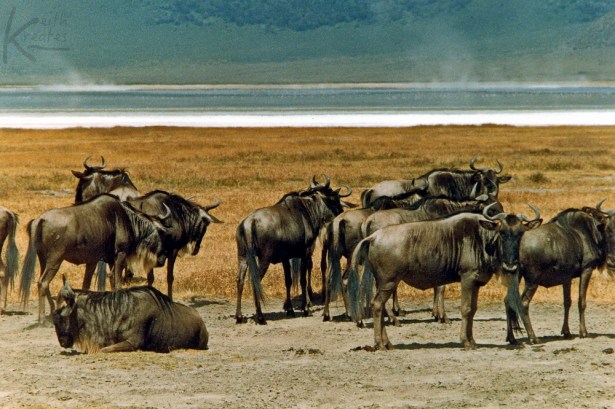
wildebeesta KreativeKue249

Photo: Keith Kreates


It was never about the things he wanted to do.

It was never about where he wanted to go, what pasture he preferred, which direction he wished to head.

Conformity. Yeah, he knew all about it. How it was the only way to herd.

Still he found small ways to rebel: He’d lie down when others were grazing, chew his cud while the Head Honcho was patrolling, turn his backside to the wind when it went against every custom to do so.

“You will get yourself kicked,” his mother, who has long given up on instructing him but still couldn’t help herself from trying, lowed in his ear.

“Or eaten,” his sister, grown and soon to mother her own, added.

Their mother’s eyes were sharp horns of disgust at the sacrilege. One did not talk about becoming prey where one was already primed to be the hunted.

He shrugged and refused to turn his nose into the wind, though he could not control the small twitch of his ears, flattening to try and discern danger.

The cows, one young, one old, left to graze at the edge of the parched field.

He remained with his head petulantly bowed, feigning disinterest in any thing ahead. He’d been born to the herd. Without it, he’d be dead.

But it did not mean he had to be one with the herd.


For Kreative Kue #249


Golden End

ricky-rew-v3Vt8RrwT18-unsplash

Santo Tomas, Spain (Ricky Rew on Unsplash)


It was a golden end.

To the day. To their journey. To what they managed to do together, for the first time in a long time without bitter exchanges that gouged their hearts and left them both scarred.

The trip to Santo Tomas was an impromptu thing. The healing they’d invested in was not.

“We could go, you know,” he’d mentioned as she’d browsed to pass the time while waiting outside the therapist’s office. It was always an awkward time, sitting together in the ante room, aware that what came next was lancing boils and airing out things too noxious to attempt alone.

“Can we, though?” she’d replied, layering many meanings.

“I think so,” he’d said.

His hesitation, more than anything, was what had her agree.

The therapist’s hesitation, too. She wanted to prove the woman wrong.

She watched him jog by sun-glow. Her heart warmed. They were going home.


For What Pegman Saw: Santo Tomás


Sentry Sign


“Can you believe this weather? The sun is …” she stopped cold, her jaw frozen in mid-sentence. Her heart thundered, threatening to escape the confines of her chest.

“Mauve?”

Eric’s voice sounded as if filtered through molasses. Someplace in her stunned mind she noted to herself that she finally understood why cartoonists slurred speech and movement into agonizing slow-motion during moments of high-drama. It was as if the world itself spun differently. Time simultaneously lingered and lost all definition.

Her finger labored against a suddenly-too-heavy gravity. She pointed at the gravestone.

“The swirls,” she managed, her tongue was a parched brick in a desert.

She forced herself to breathe and swallow. Paradoxically the motion released some moisture back into her arid mouth.

“It is the mark of my ancestors,” she whispered. “A sacred, secret, rarely-used Sentry Sign. I’d only seen it once. I didn’t even know they’d been to this land.”


For Crispina’s Crimson’s Creative Challenge


The Two Stones

Photo: Sue Vincent


She shivered in the early winter chill and pulled the woolen cloak around her. The wind whipped her hair – always unruly – into her eyes. Her fingers stung. The day was above freezing, but the cold damp still had a way of swimming through her clothing to steal away her body heat. Her face felt stiff and she rubbed her hand over her cheeks and chin to warm them.

She picked up her pace only to slow down again once she neared the stream. The slope was treacherous and she did not fancy the possibility of a dunking in the bone-chilling water. How different this was, she mused, from the summer days of her childhood, when along with friends she had raced down the slope with the absolute intention of being the first to splash in.

The stream had seemed bigger then. Wilder and yet in some ways tamer.

She did not know at the time the other stories it could hold. The risk it would foreshadow.

She was still an innocent then.

As if in answer to her mood, the wind picked up and buffeted the edges of her cloak around her legs, threatening to unclothe her. She pressed her lips together in determination and shook her head. Not here. Not now. Not ever.

Not again.

The stream was lower than expected for the time of year, but she knew the looks could be deceiving. It wasn’t just depths that could kill you. Or the flow.

She picked her way carefully to the bank. She stood a few yards downstream from the ancient laundering stones that jutted at the widening where the narrow brook burbled into a seemingly placid pool before splashing down in tiny waterfalls at the other end. The women still used the flat rocks when she was a young girl. They’d crouch on the stone to slap the fabric as the stream carried away the suds and dirt and the occasional bloody stain.

Moss now covered the stones and she knew it wasn’t just the change of season that had led to the greening. Women had laundered in all seasons. They’d break through thin ice to brave the numbing cold if they had to.

But no one had used the rocks for a long time now.

Perhaps not once since.

It had been a late summer day, the warm air filled with scents of aging flowers and over-ripe fruit and a whiff of sweat. There was the ‘thwack, thwack’ of scythes from the fields and the hum of bees and the calls of children and the wailing of a baby, cranky for the breast. The laundering stones were draped with wet fabric, the water foaming slightly with the soaps.

Then came the scream.

The rush.

The hush.

The wide-eyed horror.

Two small children, tangled in a vine, floated to bump against the rocks at the end of the pool, the current threatening to carry them over and downstream. Like broken puppets on a string.

They’d been playing and must have banged heads under water, or on a sharp rock, or on some other, less understood, thing. Their thrashing would have been noticed, but they must have been lost to the loud playfulness of others, or to the slap of clothing and the scrape of washers against stone. Or to how quickly they dropped.

She shuddered as the image superimposed itself on the empty coldness.

Everything changed after that. She only came here one other time since. And not with company.

The family of the man who had been a child at the time still wielded power in the town. She wouldn’t have been believed if she had told, that the dreamy boy who liked to twirl in the sun and who no one dared tease, had drawn a slingshot in mid-dance and used his spin to hurl small sharp stones into the children’s temples. The “thwack, thwack” was not only from scythes. She wouldn’t have been believed if she’d blamed him for the death of her pet rabbit, even though she’d seen him kill the trusting ball of fluff. Or for holding her down and poking her where no one should. She kept quiet and let the secret nibble holes in her insides.

It wouldn’t have brought the children back.

“I’m sorry,” she whispered, bending to touch the water with her fingertips.

The bodies had long been buried, but their souls could not be. Not without the truth.

She rose and wrapped the cloak tightly around her. The clouds gathered and she saw a crack of lighting in the distance. A low rumble chased it, chastening or soothing, she could not tell.

She forced the air into her lungs and turned away.

She will be leaving again. The secret will remain.


For Sue Vincent’s WritePhoto


Out Focus

Photo prompt: © Ted Strutz


He wanted to take the glasses off but it was not allowed.

The penalty was devastatingly permanent.

True Focus was reserved for a selected few. A privilege. Stealing it would result in losing all sight. Both eyes.

He blinked and tried to calm the nausea that came with the distorting lenses. He never got used to the dizziness. Or the headache.

He didn’t think they were meant to.

“Loyalty above clarity; Fealty, not facts.”

It was chanted. It was law.

A disoriented population was the goal.

He grieved for the realities that had been ignored when freedom still had hope.


For Rochelle’s Friday Fictioneers


The Error

daniela-holzer-u_3rD02dmkw-unsplash

Photo: Daniela Holzer on Unsplash


She hadn’t intended for it to go this way.

She’d taken pains to be intensely selective of what she allowed. She’d researched every step, scoured barely legible ink on faded notes and prepared for every eventuality. She had kept her eyes peeled for any red-flags that should not be ignored.

She was careful.

And yet. There it was. Completely different than intended.

Her error.

She already repeated all the steps and realized her mistake. Her wonderful mistake.

It did not turn out as she’d expected.

It turned out fantastic instead.

She bottled it.

The aromatic error that will become the star perfume of the age.


For the RDP Monday challenge: Aromatic