How early? For how long?

book time

I’ve received a query from a parent: “I heard reading to children is good for them. Is it true that it helps language development? How early should I start reading to my baby and how long should I go on reading to her?–Parenting Neophyte…”

It is a good question and one I get often and love getting. It is always worthy of an answer.

Dear Parenting Neophyte,

The facts are clear: Reading to kids is great. Introducing children to books is important for language development, listening skills, later literacy, and general cognitive potential. Stories expand vocabulary, increase imagination, teach social skills, improve narrative. Reading to your children is good parenting and a good investment in their education and future.

As to how early one is supposed to start reading to children and how long one goes on doing that–the simple answer is: “as early as possible and for as long as kids would let you …”

The more detailed reply is that even newborns find interest in clear patterns and drawings, in contrasting colors, in faces (especially in faces), and pictures of familiar objects. They listen. They pay attention. They track. They make connections between sounds and experience. Unfold an accordion book when the baby is playing on the mat. In the stroller. In the playpen. Give them a soft-book to hold in the stroller or to reach for when they loll on the floor during some ‘tummy time’ (check for lead-free paints and non-toxic materials, of course–babies put everything in their mouth!). Certainly introduce picture books as part of every night routine. Talk about the pictures with your infant, point to familiar animals and items. It is not about testing how much they understand or what words they can say or point to. Rather, it is about having reading books become a link in the nightly ritual of cuddling and comfort, connection, familiarity, language, narrative, and stories.

Babies who are read to often gravitate toward books as playing objects, they leaf through, turn pages, pause, look, and ponder, even as they mouth the corners and tear out what they manage to … (all great motor and visual spatial skills, by the way). They also learn to point, to wait, and to associate pictures with words and sounds. They learn to anticipate the next picture, to predict what’s to come. They learn to trust their memory. They rarely tire of adoring the confirmation of seeing the same picture appear as it did the day prior.

For sure, the repetition can be tedious (you’ll know what I mean when your toddler asks for the same book in the two-thousandth time, and wants to read it “again” and “again” and “more time!”), but it is part of children’s normal development during infancy and toddlerhood to like things repeat. So take a deep breath and even as you introduce new books once in a while, and expand the child’s repertoire of stories, do cave in and read “goodnight moon” one more time …

As for the question of “how long to keep reading to children?” The answer truly is to do so for as long as possible. Many professionals recommend reading to children straight through middle school, and certainly throughout the elementary school years.

It tends to surprise parents when I recommend that. Very often they tell me that they’d stopped reading to the child when he or she learned how to read independently–sometimes during the first or second grade. They thought that the move to independent reading marked the end of “needing to be read to” and in fact often had reading time revert into the time of day when the child read to them … It was almost a rite of passage. A mark of moving into the reading world.

Granted, there’s still plenty of bonding potential in cuddling with your child and witnessing their reading progress. It certainly feels good to the parent to measure their child’s progress … and to a child to know their efforts are appreciated. However, being read to is a very different task than reading aloud as decoding practice. The two have very different goals and encompass very different language levels. The books children read are often matched with their decoding ability, rather than their language level. Also, even in later elementary grades, when reading skills allow children to decode most common words, books are chosen with the child’s comprehension level in mind, not necessarily their exposure to higher linguistic material.

Reading TO children is a whole other world of learning opportunity. It is primarily a listening task and allows the child to relax into the story and delve into language while losing oneself in it. Being read to opens space for a child to draw inferences about connections, context clues, idioms, character descriptions, sequence, cause and effect. It is a time for a child to consider possible outcomes, predict to himself what might happen next, check a hypothesis, internalize some of the story characters, discern who they like and who they don’t, who they may want to be, where, how, why. It opens an opportunity for discussion that is very different than the ‘reading comprehension testing’ that happens with school books or those the child reads independently. The books you read to your child become fodder for conversation and self-discovery: what did they like about the book? what did you? why did so and so do this or that? would you so the same? what is your favorite character? which is mine? how come?

Children who are read to through 8th grade, have larger vocabularies than children who are good readers but are not being read to (and we are talking vocabularies that are larger by tens of thousands of words–not just by a small margin!). As a group, they have better listening skills, better auditory processing and auditory memory skills. They have better narrative skills. They use a more varied lexicon in their own writing. They have bigger cache of idioms and expressions that they can infer meaning about. They can converse better and show wider world-knowledge.

Children who are read to tend to enjoy books better than kids who are not read to. They tend to love reading more. They choose a wider variety of books and have a wider foundation in classical literature (read: the books you read to them may not be books they’d otherwise pick up to read themselves … but having listened to them, they may get the ‘book bug’ to look for more classic literature on their own). Want another bonus? Reading to children improves connection with parents and allows children to feel comfortable talking to their parents more, and about more topics (not to mention that stories often bring up issues that they may otherwise not talk about …)

In some families, reading to each other continues as part of family time well into high-school, with teenagers taking turn in reading aloud. Sure, it may seem odd to consider teens today being gung ho about spending an hour “reading boring books aloud” and being commanded to have their thumbs idle (no music, no chat, no texting). However, for families who started early this is often a natural continuation. In families starting a little later (and it is never too late, actually), the benefits are real even if they are grudgingly (or perhaps never verbally) acknowledged. Having your undivided attention is a precious commodity (yes, you have to put down that phone, too …). Knowing you are listening is priceless. It opens yours even as you raise your child to have a more open mind.

Reading to your children builds your relationship with them while also building their relationship with themselves, their inner worlds, the world around them, and their academic and cognitive abilities. It is truly a ‘one size fits all’ intervention. There are no downsides, other than extra cuddle time, honest conversations, and the distinct possibility of difficult questions about life that literature inevitably brings up.

The only warning necessary is … that reading to your child can damage their ignorance …

reading


“He suddenly can’t talk!”

It was an urgent message.

“I have a little boy. He just turned three, and he suddenly can’t talk!” The mother’s voice was pressed with worry. She forgot to leave a callback number and the number on my caller ID showed as “Private Number.”

She called again the next day and I happened to pick up. I knew immediately that it was the same person who’d left the message–the urgency in the voice was palpable. She was flustered when she realized she did not leave a phone number–she’d been waiting for me to call back all of the day before, late into the evening. My heart ached for her. It does not take much to worry a parent, and a major change in any child’s behavior is alarming.

“He’s always been a little talker, you see,” she said after I asked her to tell me a bit more about what the problem was. “He started talking really early, actually,” pride filtered into the concern, a hint of smile of remembering. “Said his first words even before he was one, and he was putting sentences together before his second birthday. We used to laugh, my husband and I, about how he never shuts up …” her voice caught. “But now he can barely talk! He tries, but it is like nothing’s coming out!” Her own voice rose in worry.

“Can he sing?” I asked.

“What?” My question surprised her. It was intended to, in some way, though I had other reasons for asking it. I didn’t want to describe the boy’s speech for her, didn’t want to put words in her mouth, but I did want to get some information about possible clinical presentation.

“Can he sing?” I repeated gently.

“Yea … actually …” her voice turned pensive, surprised, a little confused. “He sings really well. He’s not stuck at all when he’s singing! He loves singing … It is when he’s trying to tell me something that he gets stuck. He gets all red in the face from trying and I don’t know what to do to help him. He’s repeating the same sounds ‘mm….mm’ or ‘I I I I’ and can’t get a word out. It takes forever for him to say something.”

We spoke a bit more. Apparently this started the week before, though there were days in the week or two before that when when he would “stop” on a word, or repeat the beginning of a sentence a few times before “diving into it.” This first born little boy had no history of medical issues, there were no major changes in the house or in his life recently, no illness, falls, medications, ear infections. His articulation was stated to be “super clear” and his language was reportedly rich. He could tell stories and speak in sentences and “knew a ton of words.” He was a happy toddler and other than the occasional tantrum had an overall jolly disposition, which this ‘inability to talk’ did not mar. For all his red-faced stress, the mother admitted that she did not think that he was all that bothered by it and “just stood there and stayed stuck…” It was her who was alarmed, and her husband. “My husband has a co-worker who is a stutterer,” she said quietly, as if divulging a shameful secret. She did not need to add what she was fearing, what her husband feared–that their little boy was going to become that co-worker. A Stutterer.

I agreed to see the little guy for an observation and parent consultation, but had no opening till the week following. In the meanwhile I suggested to the mother to just let him be and not draw too much attention to his speech (including refraining from telling him to “start again” or “say it slowly” or “breath deeply”…). I recommended they continue reading to him, regular routines, and listen to him (even if it takes him a long time to get a sentence out) while maintaining interest and without making a big deal out of the dysfluency. I recommended lots of songs and music–for fun, but also because they can give a sense of fluency and reinforce a feeling of success and ease for the boy. We chuckled over how she’d just have to live with listening to the dude’s favorite playlist a few thousand more times…

She called me two days before our scheduled appointment.

“He’s fine!” she called into my machine. “It’s like he never got stuck at all! I don’t know what happened but he just woke up yesterday and he’s not getting stuck! I thought he was doing better but I thought that I was just hoping … but he’s just … talking up a storm! Do we still need to come?”

We decided to defer the consultation, and to have her call me if need be at a later date.  I explained that this might have been an episode of “Developmental Dysfluency” or “Developmental Stuttering” and that these sometimes recur, and if so, she can call me immediately, or watch and see what happens for a week or so before she does that. Whichever she prefers.

Developmental Dysfluency (AKA Developmental Stuttering) affects many children. In fact, 75-90% of children between the ages of 3-5 have times of dysfluency in one form or another and the vast majority of them do not continue to stutter. Sometimes dysfluency happens once. Sometimes it recurs. While dramatic, most times it is nothing to worry about. That said, if it recurs, if it continues for a long time, if the child seems upset by it, avoids speaking, seems embarrassed, etc., if there’s family history of stuttering, and if it causes stress and worry in the family; then an evaluation and follow up by a speech-language-pathologist are very important.

Stuttering can become a life-long issue, and it can impact people’s communication. Early intervention helps and can sometimes prevent stuttering from becoming complicated. It is also important to ensure that the speech issues are not related to problems with motor-planning, retrieval, processing, or other issues that need clinical help.

In this little guy’s case, his dysfluency recurred a few months later, and I got to meet him. His mother also brought a videotape of his interactions at home (including the cutest singing in the tub!) and took him to an ENT and had a hearing test done at my request. The boy’s language indeed was superb, and he showed no issues with motor-planning, social communication, or articulation. There were no issues of concern about his development or abilities. He was not bothered at the least by getting “stuck”, and commented to me, unperturbed, “sometimes my mouth gets a traffic jam.” His mother was not so alarmed this time around. The second dysfluency episode passed a few weeks afterwards, and did not return.

There are some theories about what causes dysfluency/stuttering in toddlers and young children. Many echo this little guy’s theory, and state that it is a ‘traffic jam’ of sort–a temporary mismatch between language skills that are improving and sentences that are getting longer and more complex; and motor skills that are not yet up to the challenge–literally too many instructions coming down the pipe for the coordination the child has at present to execute in timely manner.

Stuttering may have a genetic component, but that does not mean that having someone who stutters in the family dooms children in the family to same. Not everyone who is predisposed to stuttering does stutter, and whether one continues to stutter following dysfluency episodes depends on many factors. These include the child’s personality, and ability to regulate frustration, their other communicative and developmental strengths and weaknesses, their age when the stuttering begins, how easily frustrated they become, their life circumstances (e.g. trauma increases the risk), whether there are other speech and language issues, and the reactions of people around them (e.g. if people get worried, the child may become aware that something is ‘wrong with them’ and feel embarrassed or nervous or worse, ashamed), to name a few. The latter reason, especially, is why it is so important for those around the child to get support about how to react, what to do, and especially what NOT to do or say. It is always better to do what this mom did, and reach out to a professional for a consult, than try to ‘fix this’ on your own.

Treatment for stuttering is available, and can be very successful, especially in children (the more years one stuttered, the harder it can be to treat, though even adults can improve and sometimes overcome stuttering after years of difficulty). There are different approaches and methods to the treatment of stuttering, as well as different possible underlying issues that cause it in the individual person. So one size does not fit all–not one method works for everyone–and it is important to look for a clinician who will assess, consider, and match the treatment that is most appropriate to a particular person and be flexible to adjust it as need be.

I got a call from the little guy’s mom not too long ago. He’s starting Kindergarten and is into drama classes and theater. “He still sings in the bath,” she told me, “and sometimes I think that he does not shut up from the moment his eyes open to when they close at night …”

penguin chick

For more information about stuttering, click here.

Teaching Children Calm

deep breath

“Calm down!” Sounds simple, but for many young children it is a foreign concept unless and until we show them how.  Especially if they had known more overwhelm than calm.

Young children who experience overwhelming events such as neglect, severe stress, abuse, chronic illness, or sudden separation at a young age can be traumatized. The world around them no longer–maybe never–feels safe. They don’t know how to regulate, how to calm themselves, how to manage when they get upset. They act out, they hit, they don’t listen, they ‘misbehave.’ They have a hard time making good decisions, explaining their actions, or utilizing memory. They fall behind at school, socially, in their ability to learn new things, communicate, or play.

Trauma changes the brain and can interfere with development. It also creates a vicious cycle of hyper-vigilance and checking-out that costs children opportunities for learning, interaction, and connection.

Children need adult support to manage traumatic aftermath. They cannot be expected to find the way without help. Many of them may need psychotherapy, but even then they need support in non-therapeutic interactions in the day to day. Support that we can all learn to provide by understanding trauma. By knowing what trauma is and how it works, recognizing what it does, how it affects children, and learning what we can do to help reduce its effects so a child get traction in the now.

In an excellent opinion article in the NYTimes this week: Teaching Children To Calm Themselves, David Bornstein details one such system of support set in place, and how it already works to change the lives of the children as well as of the adults who care for them: teachers, caregivers, siblings, even the school-bus drivers. http://opinionator.blogs.nytimes.com/2014/03/19/first-learn-how-to-calm-down/

Read it. Then share it with anyone who works with children. Or who has one.

Spread the word. Our children are worth it. Open the path to teaching calm.

boy with dog

For more information about the impact of trauma on communication, check The Language of Trauma, and other publications here.

For more information about the Adverse Child Experiences Study, and the cost (literally and figuratively) of trauma throughout the lifespan, check: http://www.cdc.gov/ace/

For more information about how to help traumatized children at home and in the classroom, check the links to the ISSTD’s FAQ pages here.

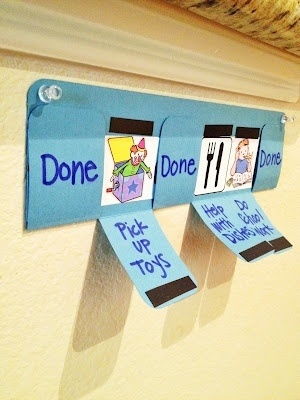
On the matter of chores …


chores

It’s a Speech & Language session, and as a way to make sentences involving action words and pronouns, we’re discussing chores. I ask Charlie, age five, what kind of chores he does at home; the things he does to help out.

“I no got chore!” Charlie states, proud.

“You don’t have any chores?” I ask, correcting grammar as I go.

“No!”

“Don’t you pick up your toys?” I prod, explaining. “That’s a chore.”

Shakes his head.

“Why not?” Many kids today don’t have as many chores as they can actually successfully master, but most are at least asked to pick up after themselves, to put their dirty laundry in the hamper, or their dishes in the sink. In Charlie’s case, I know for a fact that his mom and I had a discussion about adding routines and responsibilities, and that she told me she had initiated some chores with him, one being picking up his toys. So I’m a bit flummoxed about his response. I take a longer look at him–is that a little twinkle in his eye I see? I wait.

“Because I no do good,” he says after a pause. Yep, definitely a smirk. There’s a story there.

“What do you mean?” I ask, keeping my face neutral, though internally I’m already chuckling. Charlie’s a pip. Angel-faced and flaxen-haired he is indeed a good boy, but it would not do to underestimate his little mind’s cunning. Whatever this is, I know it’s going to be fun.

He grins. “Mommy say I clean up room I get stars,” he begins, looking at me intently to make sure I’m going to ‘go all adult’ on him or something and critic him; or worse–tattle to his mom.

“Okay … so your mommy said that you had to clean up your room, and that if you did so you would get stars,” I repeat what he said, both to give him a model of better language and to make sure that I understood him–his grammar leaves many holes in sentences and makes his speech less intelligible than should be at his age. It is why I’m seeing him in therapy. I keep my face smiling gently, not promising anything but hoping to still encourage him to spill the beans.

“I everyday put all stuff under bed,” he states victoriously.

“You put all the stuff under your bed instead of back where it belongs?” I prompt, grateful for years of perfecting the occasionally necessary poker-face.

Bigger grin now. This was no error. This was planned. “Shoes and shirt and toy and book and sister pajama and pacifiers she throwed (sic) on floor …” he pauses for emphasis, “and mommy no find thing no more and mommy say I no clean up good. No more have to.”

I can’t help but laugh. Charlie 1: Mamma 0.

Told you he’s an imp.

sweepbug