Make It Work!

I bet you have such days …

When things don’t seem to work as expected, when all your plans fall through and what you thought would take two minutes takes two hours. When that quick phone call to settle some bitty thing becomes forty-five minutes of muzak followed by a hang-up then forty minutes more before you get transferred again, only to be put on hold for speaking to another department … When the quick break for a sandwich becomes condiments that spritz in the wrong direction, an upset can of cookies (complete with crumbs), a shattered glass requiring three broom cycles and a vacuum … Days when one client after the other is either late, cranky, moody, muddy, or all. When the world becomes an exercise in patience, a realigning of time and expectations.

These days sure happen to me all too often. I bet you have them, too.

It used to get my blood-pressure up, to have things unexpected. In general I do not much care for surprises. My friends and family know that I’m not the person to plan dark roomed “Happy Birthday!” parties to. No thanks. I like knowing what to expect and having a bit of opportunity to see how to best manage stuff that happens. Good or bad. So having a kink in my day never was my recipe for happy.

Nowadays, though it does not rank high on my preferred-day way, it mostly makes me chuckle. I figure that it is a pause for learning, something to call my attention to doing too much, too fast, or with too little an awareness. The unexpected grounds me faster than a cup of cold water (sometimes it IS spilled or splashed cold water … in a double-attention-getter …). It stops me into “what just happened?” and “how on earth …?” And that very pausing stirs a breeze of mindfulness into my brain.

So, while I still don’t like to spend my lunch break sweeping shards, cleaning counters, or on the phone with some ‘press-this, press-that’ company; I try to see it as something that helps to pace me or to point to where I have lost touch with the clock that is not of this world. Where I have turned too low the timer within me, the ticking of my body, the breath that should not become fogged by too much thought or busyness.

I still get stunned–surprises do that to me. But I take a breath, as well. And chuckle. Laugh a bit into myself. The ridiculousness of it all helps me find the gratitude that’s tangled with the grunt and sigh. It is a gift, really, when everyday tasks that I’ve done a million times without awareness bring back the reality of how complex they truly are, and how blessed I am to be able to perform them mostly sans a thought or pause or conscious memory. It is even a precious thing to have the things I usually take for granted–a company to call to make things right (or try to), the vocation I love living, the freedom to set my schedule, the miracles of water in my faucet and electric power at my finger tips. So many do not have those and would gladly take a spilled cup for having the water flowing to begin with.

And suddenly the disruption is not so terrible and the wait is not so bad. This realignment of meaning helps shift me, even if the situation stays the same. I get the best ideas, sometimes, when I’m on hold, a captive audience, forced to still and listen. The muzak goes right through me. It is my own thoughts that unfurl, birthing new ideas. I am reminded of the most arcane and unexpected and forgotten things when I am climbing to change yet another light-bulb that went zip a moment before session, or rush to change a stained article of clothing before a client comes. Somehow these unplanned, often unwanted, wrinkles in my planning pause me long enough to bring in an unseen angle or perspective.

Don’t get me wrong: I still do love my little islands of predictability. It is lovely when days go just as I had planned (or at least close to), and when my energy is parsed the way I’d hoped. It doesn’t take much for me to run out, you see. Some hiccups in my autonomic nervous system makes my body ultra-prone to fast exhaustion. Weather changes, temperature shifts, being vertical too long–they can and do seriously tire me. And yet, I am not frail. Just living with a finicky apparatus. All the more reason, one might declare, to not live life too gingerly as if on eggshells (please, oh please only figuratively! I’ve cleaned the kitchen once already, courtesy of spilled coffee grounds this very day …).

For days when patience is a bit harder to come by? “Just make it work” is my mantra of sorts for those. I have not invented it, of course. People all over our blue Earth marble have been saying it in all manner of variations, for longer than my mind can fathom, and while facing far more difficulty than I usually have to endure.

Small hitches in the schedule? Unexpected hiccups? Murphy working overtime to make life inexplicably complicated? I remind myself that it is all workable. Sometimes the solution is immediate, sometimes it takes time (I would sure love to know the schedule, though, Dear Universe, if you are listening!). Sometimes I can resolve it on my own, sometimes only with serious creative collaboration.

Either way, when the Universe throws a wench in my today and threatens to mess up my tomorrows, I try breathing smiles into it. A chuckle, even, if I can. Extra points for finding blessings in the messes … Gold stars for managing cooperation in the least likely ways or with those I do not find it easy to collaborate with.

I’m reminded of a photo of Paris in flood in 1924. People faced the very wet prospect of ruined shoes and clothing given that the only possibility was trudge calf-deep in watery plazas. Or was it really the only way? In ingenuity, someone or some ones, came up with a creative (if rickety) solution … and wrangled up some cafe chairs …
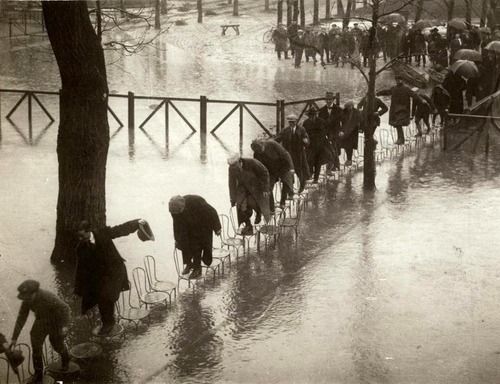
paris flood

Paris flood, 1924, photo by Henri Manuel


Life Lived

life lived2

There’s immense beauty in life lived. In every wrinkle bought by time and much expression. It is evident, open, there to see. There is beauty in the well-lined faces of elders. In our own. They are pathways earned by living. Furrows sewn by memory and feeling. Intricate etchings of how one came–and still comes–into one’s own, how spirit’s grown.

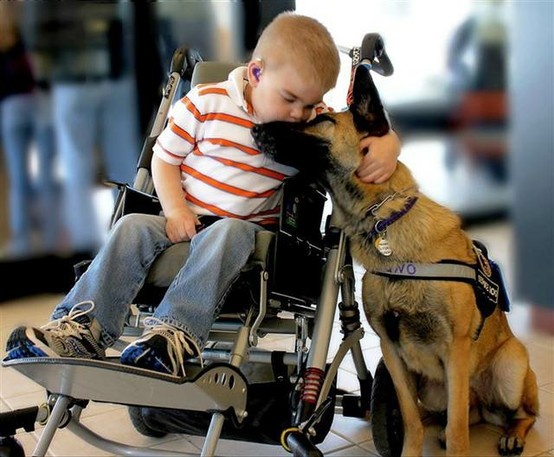
A little boy of four told me the other day: “My granny is very pretty. She has lots of lines all over her face like spider webs because she’s old. She gets more lines every year for her birthday. I like her face. It is so soft and her eyes love me.”

There is history to tenderness and respect for the older. Many native traditions venerate their elders and hold their wisdom in high interest and regard. They know that life leaves marks, and most of them are well-earned knowledge. The lines upon a person’s face reflect not decline or oddly shameful claims of “one’s age showing” but rather are a mirror to a person’s wisdom, depth, growth.

Many of us have lost the Way, in modern times. In the rush to seek erasing life from our expressions, we’re urged to look away from those who forged before, who cleared the paths, who taught us all we know. We are expected to see wrinkled faces as what we should fear becoming. It is our own life we deny when we do not accept that we would none of us be had it not been for the elders’ lives, how it is now our history. The aged’s perspective is what holds our own horizon steady. They know of corners we do not yet see for we are in too low a vantage point, compared. Their faces show it. Maps of living. Losing sight of it is losing part our ourselves, of what we may have the blessing to become sometime later be.

The little boy who sees his granny’s life etched in the softness of her face and the love in her eyes–he gets it. His priorities are calibrated. He sees the beauty of life lived, not the images peddled by companies seeking fortunes by telling people lies: that life reverses, that years should not be seen, that age that shows is somehow shameful and wrinkles should be believed to depict a worn-out living, unworthy of respect. The opposite is real, and this child’s vision is clear, aligned with Truth: that the paths we walk become a part of us. That our beauty lies in our compassion, in what we learned of ourselves and others, in how we live. Beauty is not measured in complexion or in how well we do in life’s erasing.

If only more could see. The beauty of life lived. Reflected.

I am someplace in early middle years. Not nearly old enough to spider-web, but in the place where I receive a few new gifts of wrinkles for each birthday, and hopefully some of the wisdom they can depict of some experience. I see them, welcome into my visage: laugh lines, small remembering of oft expression, better understanding of the interplay of gravity on time and skin.

The same little boy looked at me the other day, his eyes full of inspection, his young forehead creased lightly in concentration. He searched my face. Lifted a hand to my cheek. “You have some wrinkles, too,” he noted. That’s pretty.” He sighed. Satisfied. 

life lived1

life lived

Pendred Syndrome–a Query

A query from a parent:

“My son was just diagnosed with Pendred syndrome. He already has hearing aids from when we discovered he has hearing loss when he was 8 months old, but he needs stronger ones now because his hearing got much worse. The doctor said that he may end up deaf and that we need to check his thyroid, too. My son is already getting PT with early intervention because he is not walking yet at 18 months but we’re going to put him in speech therapy, too. What is Pendred syndrome and is it true my husband and I gave it to him? Will the therapy help with his hearing? There’s so much technical stuff and I’m really worried.”

Dear Worried Mom,

Of course you are worried. It would be overwhelming for any parent to have their child diagnosed with a problem, let alone one that can continue to affect them and that may change with time. A good step is to seek more information–as you are doing now, and hopefully will continue to do.

I’m glad that your son is already getting amplification (i.e. hearing aids) and that they are going to be adjusted/changed to reflect the change in his hearing–this is very important, and is a big step of helping him develop the best way possible. Am glad that he’s getting PT, too, if his motor skills can use some help; and that you are going to begin Speech-Language-Therapy with him, to ensure he makes the most out of his hearing and that his speech and language can develop as well as possible.

I hope that your pediatrician and the clinicians you’ll be working with (in Early Intervention, the ENT, the Audiologist, etc) will refer you to more information about Pendred syndrome, hearing loss, and rehabilitation of hearing loss in young children. Do let them know you are concerned and discuss your worries with them–I am quite confident that they will have resources, support, and more specific answers for you.

In the meanwhile, here’s a summary of some of the main features and issues in Pendred syndrome. This is not in any way a comprehensive review of Pendred or what the course of it would be in your son’s case. Nor is it a specific recommendation as to what to do in your son’s case, but I hope this overview will nonetheless give you some information to start with.

Pendred syndrome is a genetic disorder that causes early hearing loss in children. The syndrome is named after Vaughan Pendred, the physician who first described people with the disorder. It is actually the most common syndromal form of deafness in children–it is estimated that Pendred syndrome accounts for 5-10% of hereditary deafness cases! It is an autosomal recessive disorder (which basically means that both parents need to be carriers of the recessive gene–but the parents often have no symptoms and often don’t know that they carry the gene), and is associated with abnormalities of the cochlea, sensory-neural hearing loss, and diffuse thyroid enlargement (goiter). It can also sometimes create problems with balance.

Children who are born with Pendred syndrome may begin to lose their hearing at birth or soon after birth (like in your son’s case), and often lose hearing by the time they are three years old. The hearing loss is sensory-neural in type. When hearing is present at birth, it will usually worsen over time, with some children with Pendred syndrome becoming totally deaf (but not all, some children do have residual hearing or a lesser hearing loss). The hearing loss in Pendred syndrome is usually bilateral (in both ears), although one ear may have more hearing loss than the other.

Childhood hearing loss has many causes. Researchers believe that 50 to 60 percent of cases are due to genetic causes, and 40 to 50 percent of cases are from environmental causes (e.g. substances that damage the inner ear, such as certain antibiotics or chemotherapy medications).

The first part of a diagnosis of Pendred syndrome often includes the discovery of a hearing loss via a child failing a screening test or the presence of a hearing loss being found. Not all hearing loss in childhood is related to Pendred Syndrome, so the clinicians evaluate many things before considering the diagnosis and it can indeed take a bit of time before things are known for sure. Things like the kind, timing, amount, and pattern of hearing loss; the anatomy of the inner ear structures; the child’s balance and thyroid, etc. All these can help the health care professional determine whether to seek genetic testing and imaging tests for the inner ear, and to conclude whether a child has Pendred syndrome or some other type of progressive deafness.

Pendred syndrome can make the thyroid gland grow larger (when a thyroid gland grows too large and can visually bulge on the lower neck, it is called a goiter). The thyroid is a small, butterfly-shaped gland in the front of the neck, just under the ‘Adam’s apple’ and just above the collarbones. It plays an important role in the way the body uses energy from food, as well as in normal growth and development. Some thyroid issues in childhood (e.g. Grave’s Disease) can cause growth problems. However, in Pendred syndrome children often develop properly even if their thyroid is affected and their levels of thyroid hormones are usually normal. Not everyone with Pendred syndrome gets a goiter, and it typically develops in adolescence or early adulthood. Not all goiters are problematic, but if a goiter becomes large, it can impact breathing and swallowing and then treatment may be necessary. So an endocrinologist (doctor trained with diseases and disorders that involve the hormonal/endocrine system) is probably a good person to get involved even if only for followup.

By the way, it is still not clear to scientists why some people with Pendred have more issues than others (e.g. some have goiter and others don’t).

Alongside hearing loss, Pendred syndrome also can affect the vestibular system, which is the system which controls balance. The good news is that most children and adults with Pendred learn to adapt to whatever vestibular dysfunction they have and can manage routine tasks and daily balance requirements well. That said, because of the vestibular issues, some babies with Pendred syndrome may start walking later than other babies.

To get a bit technical: It is believed that Pendred syndrome is caused by mutations (i.e. changes) in a gene called SLC26A4(formerly known as the PDS gene) on chromosome 7. To be born with Pendred syndrome, a child would need to inherit two mutated SLC26A4 genes—one from each parent. Because it is a recessive gene, the parents are only carriers of the mutation (i.e. they don’t have the syndrome themselves). In a family where both parents are carriers, a child has a chance of 1:4 to be born with Pendred, and a 1:2 chance to be born a carrier. It is often recommended that if people are concerned about the possibility of Pendred (e.g. in a child or future children) that they seek genetic testing and counseling.

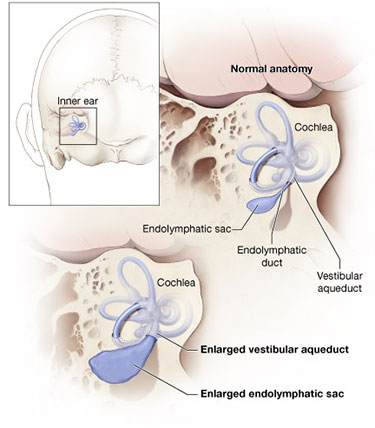
The anatomy of the inner ear is often viewed through imaging techniques such as magnetic resonance imaging (MRI) or computed tomography (CT), which allows viewing the cochlea and the vestibular system. The cochlea is the spiral-shaped part of the inner ear that converts sound into electrical signals that are then sent along to the brain through the auditory nerve. A healthy cochlea has two-and-a-half turns, but some persons with Pendred syndrome may have a cochlea with only one-and-a-half turns. The vestibular system includes a part called vestibular aqueduct. It is a kind of a bony canal that runs from the vestibule (the part of the inner ear between the cochlea and the semicircular canals) and the inside of the skull. Inside the vestibular aqueduct there is a fluid-filled tube called the endolymphatic duct, which ends with a balloon-shaped sac. People with Pendred syndrome may have an enlarged vestibular aqueduct, and the endolympatic duct and sack may also be enlarged.

Below is an image of the inner ear in some people with Pendred syndrome, taken from: http://www.nidcd.nih.gov/health/hearing/pages/pendred.aspx

http://www.nidcd.nih.gov/staticresources/images/PendredFS-enlarged-vast.jpg

When it comes to helping children with Pendred: First of all, to minimize the risk of worsening hearing loss, children with Pendred syndrome may be advised to wear head protection when engaged in activities such as bicycle riding and skiing (to avoid trauma to their head). They may be advised to avoid contact sports or situations that can lead to extreme, rapid changes in pressure such as scuba diving or hyperbaric oxygen treatment.

Like with your son, the treatment of children with Pendred syndrome indeed often involves a team of specialists. These could include an audiologist, speech-language-pathologist, otolaryngologist, endocrinologist, geneticist, physical therapist, and primary care physician. Not all need to see the child all the time, and not necessarily throughout childhood, but it is always good to have those who are working with the child communicate with each other as need be so that they can coordinate goals and needs and work as a team. Don’t be shy about asking professionals to collaborate–they can’t and won’t do so without your consent.

Hearing amplification (hearing aids, and for those who need them: cochlear implants) can greatly minimize the impact of hearing loss on language and development. Children with Pendred syndrome should start early treatment with a speech-language-pathologist, to help gain communication skills and learn how to maximize their use of their hearing aids or cochlear implant. So I think it is probably an excellent thing for your son to begin with an SLP now, when any gaps or difficulties, if there are any, hadn’t had a chance to grow wide. In addition to hearing rehabilitation through working on discriminating, identifying, understanding, and processing sounds and language better, speech-language-pathologists can also help children with Pendred syndrome with speech, voice, and language development. The hearing itself may not be made better, but how the child used the hearing they have can be get a lot better with treatment. Treatment can help minimize the impacts of hearing loss on development, language, communication, and learning. Physical therapy can help with balance issues, and help aid with motor-goals (such as walking, and later running, climbing, and so on).

It seems that your son is already up to a good start, by having a parent who is interested in getting more informed about his condition and who is seeking to follow through on the best treatment plan for him. I wish you and your son all the best, and a lovely, joyful, satisfying healthy childhood.

In Memoriam to The Fallen


memorial candle flag

yom-hazikaron-memorial-day-

In this evening and upcoming day of Memorial

As Israel remembers its fallen

As parents, siblings, loved ones weep and mourn:

Let it be the last day of new pain

Let there be

Please, oh God

No more war.

Anywhere.

No more dead, no more graves

No more maimed

No more grieving.

Let the bloodshed be ended.

Let the warmongering cease.

Let those who entice pain, find ways of words.

Let those who live hate, open hearts, make new doors.

There’s a way.

No more war.

We’re all people.

All someone’s baby, sibling, loved one, neighbor, friend

We all share more than what can divide us

We all hurt, love, hope, bleed.

No more violence.

There is no need.

Let there be

Hearts that open

Light to hold, hope to share, peace to mold.

Let there be

No more war.

As we weep for the fallen

As we remember what happened and wished that did not

As we tally the terrible price

The unnecessary ripping

Every death, every wounding

Agonises an ache in our hearts

A hole in our souls

Let there be

From now on

No more war.

peace can do better

no more war

Universality of Love

Today, I marvel at the universality

Of love.

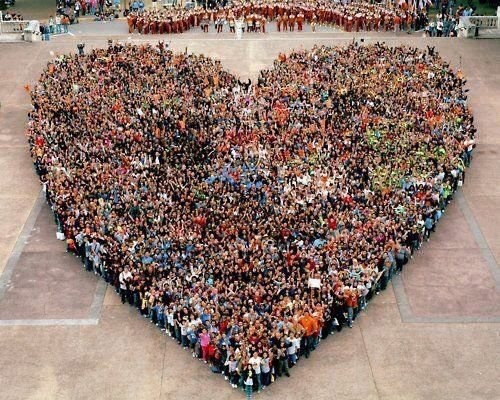
At the way deep care connects us all.

And should. And can.

How it forms us.

How it spells the words of heart upon a child’s new soul.

How it breathes hope into desperation.

How it nourishes across languages and color, tradition, race, religion, state, connecting all.

How it writes upon the slate of birth

And opportunity.

How it shapes resilience to withstand strife and sorrow.

How it holds through thick and thin, through calm and turmoil.


Today, I marvel at the universality,

At the miracle.

Of love.

So utterly expected

So innately ordained

So perfectly humane

Yet so often bent by apathy, oblivion, ignorance, senseless hate, violence, disdain.

The very shock we feel at its absence

In itself speaks volumes

Of Love’s natural flow.

Its ingrained, spirit-sustaining need.

The bounty of fortitude and growth that it can seed.


Today,

I marvel at the awesome

Touching

Never mundane

Breathtakingly beautiful

Universality of love.

mothers love


love

love1

love2

love3


love5


love7

love4


Beautiful Like Me!

She came dancing up the stairs, ecstatic, barely able to contain her smile. And she was a sight to behold:

Pastel rainbow tutu skirt over purple denim and red t-shirt with a sparkly princess on it (and a few star stickers), pink tennis shoes (with rainbow laces), green and yellow polka-dot socks (with frilly tops), rainbow-loom bracelets on both wrists, three plastic beads necklaces (one with 1/2 inch hearts interspersed), five hair pins (with various glittery bits and in various states of sliding off), shimmery hair ties holding two droopy pigtails of dark brown corkscrew curls. A smile as wide as the ocean. And a periwinkle clutch, princess stamped and glitter splattered.

Joy incarnated.

She went directly to the long mirror, struck a pose. Her mother chuckled–the last thing her daughter looked at before leaving home was their mirror. The girl stops to admire her reflection in store windows, too.

“I’m so beautiful!” the little one noted in delight.

She was not referring to her features or her body–chubby cheeked, dimpled, lisping, and lovable all over. The beauty was in the gestalt effect of her composition. Hers is aesthetic enjoyment rather than self-adoration.

Her ensemble changes week to week, varied shades of glorious. Never her elation. The wells of her joy are bottomless, oh, the endless possibilities of pleasing presentations!

She’s a walking fashion statement. She’s as happy in oversize overalls and chunky boots (with sparkly necklaces and mismatched socks). No one would be surprised if she ends up an artist, designer, or otherwise eclectic. She’s her own being already. Absolutely comfortable in her skin. Contagiously delighting in her creations.

Yesterday, she twirled around before of my mirror. Swung her arms, touched her necklaces, straightened an errant rainbow lace, wrapped a ringlet around a finger. She grinned throughout.

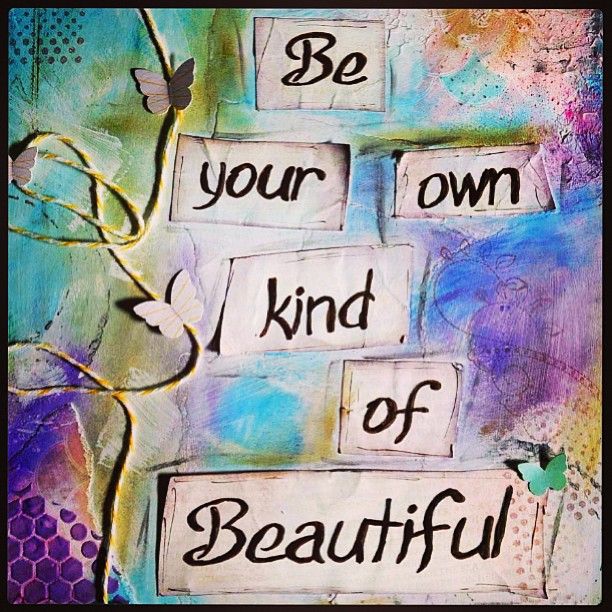
“I’m so beautiful,” she sighed, satisfied, “I am beautiful like me!”

beautiful1


King of the Red Train

A small boy today shared last night’s dream:

“I was the king of the red train. Red is the best. It was even more longer (sic) than the subway and another subway and another subway and it was going very fast like a cheetah and I wasn’t scared because I was the king of the red train.” (slowing to explain) “The king is the boss of the train and the whole country.” (picking up speed again) “And all the people were happy because the train was going so much fast (sic) and that’s very good. You know why?” (pausing, waiting for my query before continuing elatedly) … because they were going to get home before their ice cream melted!” 

train