

The woman on my answering machine sounded anxious: “I got your name from a friend of mine. You come highly recommended and you really helped her kids. I know you are really busy but can you please call me back about my child? I have a 5th grader who really needs your help.”
I called her back. Based on her wording–and her urgency–I fully expected to hear details about a child who is falling behind academically. A child with teachers worrying about difficulty with vocabulary, comprehension, attention, expressive writing, memory, fluency, or a combination. Possibly a referral from an orthodontist about tongue thrust issues, or about stuttering. Or hearing remediation.
The mother’s pleading was real enough, but the cause for it surprised me (though it ought not to–this is not the first time!): Her son, entering 6th grade in the fall, was receiving “only B+ and A-” on his reports and tests. She wanted “to give him some extra help so he can do better at school.”
Being a clinician, I don’t see children unless there is cause to see them. Normally developing children don’t usually need speech-language-therapy. Still, sometimes parents don’t know how to exactly explain the difficulties their children are experiencing, so to be sure there is no issue needing remediation, I probed some more: was there a particular reason she thought he should be better than he was already doing? What were her son’s strengths and weaknesses, did he receive assistance in the past? Though the child’s grades were very respectable, especially for a highly competitive private school, grades don’t tell the whole story about a child’s abilities. Also, some children can be good students and still perform below their actual potential because their actual ability is excellent, not average. It is important then to find out what holds them back. Was that the issue here? Why would a mother worry about a child’s basically good–if not exceptional–academics?
From the information the mother provided, it seemed that the child’s ERBs were average and that his IQ test (which had been required for his school admission at the time), showed average abilities in both verbal and performance measures. His vocabulary scores have always been age-appropriate. He conversed well in two languages, and read voraciously. The child was solidly within the 60th percentile or so in all measures. Moreover, the mother reported that he is a happy, social, kind young man with many interests, who enjoys sports and likes most his teachers. Even by the mother’s own account, the child was doing well.
And yet, as she was seeking ‘help’, apparently not well enough.
There are several issues in why this is a problem. One is that grades can be inflated so that they do not actually reflect a child’s abilities in a race to showcase a higher class/school average than may otherwise be warranted. It doesn’t have to happen in all schools to be a problem. Paradoxically ‘partial inflation’ would even make it worse: if some schools inflate grades and push “B”s to look like “A”s, then a “B” in a school that does not inflate grades can appear a failure in comparison even though the measured ability is the same.
Another problem is that in today’s competitive education and unrealistic expectation for ‘above average’ performance from everyone (a statistical impossibility), even good is no longer good enough. Even a ‘real’ B, is not seen as adequate for a student who may well be a B-student. Average is unacceptable. Excellence is required. B and A- are not sufficient. Especially not when there are the of A+ and even A++ or A+++
In a timely article in CounselingResource, Gordon Shippey, a Licensed Professional Counselor from Atlanta, touches on this very topic, as well as the realities of grade inflation. His article, “A is for “Acceptable”, is a must read.
Among many other things, Shippey notes: “If A was acceptable, there would need to be A+, A++ and A+++. In fact we’d need as many different gradations as could reasonably be detected. This would give exceptional students something to aim for beyond “A.”
Actually there ARE already the A+ and A++ and A+++ as realities in some schools. Students now no longer aim for 100 on a test (that became ‘merely acceptable’) but feel the pressure need to get ’105 or 110 or more for ‘bonus’ or a ‘truly well done job.’ It may give excellent students some margin of distinction, but it does not release the squeeze on others, for whom even an “A” no longer seems okay.

When I went to school, 100 was as high as you could get. It meant perfection. It meant no errors, best performance. Full stop. Now 100 is ‘almost best’ and ‘almost excellent’; and an A paper or even an A+ paper does not equate with remarkable.
The bell curve did not shift, but the names we call each place on the curve did. A no longer depicts a small portion of children with superior performance (7% or so, of students). Now A is for Average.
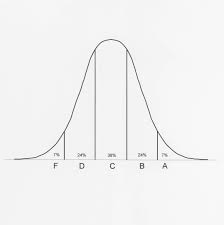
Normal Grade Distribution Curve
There is something seriously wrong when average performance for an average student is looked at as failure. Average children are not stupid. Average means “as expected.” Average means “okay.” Children with average school performance are presenting skills equivalent to what is expected of the majority of children their age. Expecting all children to be ‘above average’ is not realistic. Pushing a good-effort B student to get only “A”s (and above) is a recipe for stress and worry, for frustration, disillusion, anxiety.
I certainly understood the mother’s plea. She was being carried along in the currents of requirements and expectations Shippey speaks about, and she believed–and her belief was strongly reinforced by teachers’ notes, societal pressure and the higher-education reality–that it was required of her child to be remarkable. Remarkable is the new ‘expected.’
Grades used to be a measure of a child’s ability and effort. We rightfully demanded that children to do their best and put an honest effort, but it was pretty clear that not everyone could be at the top of the class. By definition, this cannot be.
Nowadays, grades are not so much a measure of a child’s ability and effort as they are an artificial soup made of an (often unfair) measurement of a teacher’s skills, a school’s ranking and a district’s relative superiority. Grades are measured for political gain and their manufacture sustains a multimillion industry of ever reinvented ‘teaching programs’ (and recently, ‘common-core’ goals), which are rarely developed by educators. Grades are big business. Less so about the kids.
The saddest part is, that children know it.
Children always sense unfairness or hypocrisy, they may not know to explain it but they feel when they are in a halls of mirrors. They realize that they are cogs in a machine. They perceive that they are being measured by academic yardsticks that do not really measure them and yet they are to be judged solely by.
The system needs to change. It is unhealthy, and children are reflecting it–in anxiety, depression, disillusion, burn-out, anger, attitude, apathy, a sense of invisibility and impossible demands.
In the meanwhile, the dilemma of this mother (and many other parents)–and in a way mine as a clinician who can hone a child’s ability or give them a leg up–is whether to feed into the system and push that child forward. Whether to put him into intense tutoring and ask him to perform beyond his skills and at the price of other areas of development; or leave him to learn at his normal (if average) rate and enjoy his childhood at the price of his potential future.
If it were your child, your potential client, what would you have done?




























You must be logged in to post a comment.