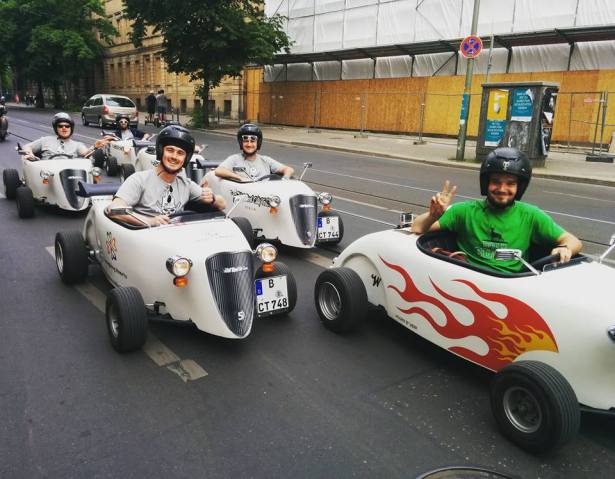
Photo: Inbar Asif
Low to ground
Safe and sound
Sharing smiles all around
Their devotion
Abounds
As they glide
Side by side
Through the streets
In joyful ride.
For Sammi’s Weekend Writing Prompt: Devotion in 25 words

Photo: Inbar Asif
Low to ground
Safe and sound
Sharing smiles all around
Their devotion
Abounds
As they glide
Side by side
Through the streets
In joyful ride.
For Sammi’s Weekend Writing Prompt: Devotion in 25 words


Photo: Castell Deudraeth in Portmeirion, Wales
“My room is haunted,” Daria mentioned over toast and jam.
Margaret rolled her eyes and Daria stopped chewing.
Margaret sighed. Vacation or not, her twin was sure to find drama someplace.
“Honest, M! Something kept whispering ‘Aber Iâ’. What does that even mean?”
“Ice haven, Miss,” their waitress manifested with more tea, Welsh rolling heavy on her tongue, “also, glacial estuary.”
“And?” Daria pressed.
“There used to be a mansion on these grounds, Miss. In the 1700s. Was called ‘Aber Iâ’.”
“See?” Margaret looked pointedly at her sister. “You must’ve heard someone say it and it stuck in your mind.”
“Someone said it in my room!” Daria insisted. “All night!”
The waitress shifted uneasily. “What room are you in, Miss?”
Margaret glared.
“Might be the bwbach, see?” the young woman fiddled with her apron. “She can be restless sometimes but she’s never done no one any harm.”
Trivia:
For What Pegman Saw: Portmeirion Village, Wales


Photo: Pixabay on Pexels.com
“I will not celebrate with celery,”
She said, and then
She frowned,
For no celebrity that’s
Worth her salt
Will turn down green
When it is found.
“We can still have a
Celebration,”
She tried correcting course,
But the celestial already
Knew
She had no true
Remorse.
For the SoCS prompt: Cele-
(I was having WAY too much fun with this one! 😉 )


Photo: Ofir Asif
Fly by
The moon
And kiss a new star
Goodnight.
Fly by
The sun
And let its light touch
Your mind.
Fly by
In play
To draw a blue skies
Outlined.
Fly high
Today
And know I’m not far
Behind.
For the Sunday Stills challenge: High flight


Photo: Simon on Pixabay
He grew up in the shadow of Sagarmatha, where people’s moods shifted with Miyolangsangma’s and with the weather on the mountain foreigners insisted on calling “Everest.”
“Sagarmatha is her palace,” Dādā warned. “The uninvited should not trespass into the realm of the Goddess of Inexhaustible Giving. She turns many back. Some die.”
Most in the village agreed, and still they sent men to guide foreigners to the summit. Faith did not pay for necessities, while the visitors, eager if unequipped for the altitude and Miyolangsangma’s moods, paid well. Surely the Goddess understood.
“Foreigners are ignorant,” the old man argued. “But you know better than to show irreverence.”
He did know better. But Dādā needed medicine.
“I’ll stop by Rongbuk Monastery,” Garvesh proffered on the eve of his first ascent. “I will get the monks’ blessing.”
“It will not stop Karma,” his grandfather sighed. “Or what may be our last goodbye.”
∞ ∞ ∞
Trivia and Glossary:
For What Pegman Saw: Mount Everest, Nepal


Photo by D. Tong on Pexels.com
It was his job to be the critic.
He’d taken it on when he was but a child and there was naught by chaos all around him.
Criticizing was a way to put some order into madness, to have at least the illusion of control.
Not that he’d criticize them openly and risk the switch or belt or backhand or the things that were … well … worse.
But criticize he did.
Mostly himself.
At first as practice.
Then as habit.
Then as something he would do without even a pause to think.
Offer a knifing critic.
Of his actions. Of his wishes. Of his hopes. His thoughts. His dreams.
What had began as coping, turned a prison.
And the jailer was inside him.
The sentencing, his own.
For the SoCS Saturday Challenge: Critic(al)


The youngsters always met by The Pillar.
Their parents had. Their grandparents had, and the great-grands before that and on and on till time before time. It was a rite of passage of sort. A congregation-point for those just past the threshold from children to adults.
There was no timetable for how long it was before a set of youths made way for those younger still. Yet the time never seemed to be very long, no matter the outward circumstances.
In olden times such changeover was marked by many youths’ marrying shortly after adult bodies and responsibilities were taken on, as it was believed that matrimony was the lead to sensibilities. Any youths lagging behind in house-making would soon enough stop visiting The Pillar anyway, perhaps as it would feel unseemly for them to be seen hobnobbing with total greenhorns to the adult world.
In modern times, with childhoods that stretched well beyond the bounds any elder would consider reasonable, and with less children in town to nip at the heels of those frequenting The Pillar, youths nonetheless rarely mingled by it for much longer than they would’ve in the past. Just their chronological age had shifted some, from puberty to closer to the end of high-school.
Looking back, few could tell exactly what about The Pillar had drawn them to the location. Sure, the isolation allowed for some actions full-fledged adults would likely frown on (though they’d done the same — and sometimes worse — themselves), but there were plenty other isolated places to find privacy in. Blustery in winter and mosquito-swarmed by summer, the field where The Pillar stood was not exactly the height of comfort. Still by tradition or something more, the youth were drawn to it like moths to light.
It was the fairies, some whispered, magic of the Fair Folk, conjured so they could feed upon the newly discovered energies of youth, necessary to the Fairies’ sustained immortality. Others pooh-poohed the folklore, perhaps unnerved by the notion that anything but their own will had caused them to view as irresistible what later on looked quite the dreary spot.
“It was just the adventure,” the latter would grumble. “Every child in town grew up dreaming of being old enough to go to The Pillar. Of course we wanted to finally do so.”
Still they could not explain what had made them suddenly wish to visit it. Or why it had just as suddenly lost its charm.
When pressed, they’d shrug that “it’s been there as long as anyone remembers.” As if that was explanation enough.
Lore or not, the youngsters always met by The Pillar.
And there The Pillar stood. Slanted by age or forces beyond comprehension. Till another age of the earth would come.
For Sue’s Thursday Photo Prompt: Timeless


He’d always forget the flowers.
Birthdays. Anniversaries. Valentine’s Day. Births of children.
It’s not that he didn’t love her. She knew he did. He showed it in how he always cleared ice off her wind-shield. In how he took the garbage out and did dishes she’d left in the sink for the morning. In how he put the toilet paper ‘over’ even though he preferred it ‘under.’
But he always forgot the flowers.
The day of the biopsy results he came home with a gilded bouquet.
“These won’t wilt,” he said. “You’ll see them and not forget me.”
For Rochelle’s Friday Fictioneers


Photo: pngtree.com
He had made the pilgrimage as promised. He didn’t know if he believed the ancestors would know he’d kept his word, but life was complicated enough without angering spirits, ancestral or not.
And it would have made his mother happy to know he’d visited the bridge his great-great-great-great-grand (or however many generations it was) had helped build. She’d always longed to make the trip back herself, and couldn’t.
“The sweat of your ancestor dripped into the stones,” his mother had told him, “his blood and thus yours lives in them.”
He heard her voice in Jia’s when the child, sober in pigtails and pink frilly dress, studied the structure. “So this is where we came from?”
He nodded.
His daughter walked to the first pile and touched it reverently. “Zēngzǔfù built this one,” the six-year-old stated. “Nǎinai told me. She showed me in my dream last night.”
For What Pegman Saw: Jaingxi province of China


Photo: Smadar Halperin-Epshtein
The days stretch on
In sun and shade,
Highlighting the contrast
To the lifespan of
A butterfly,
Its new wings splayed
In the warmth
To dry.
And I wonder
What the ancient rock thinks,
In contrast,
Of the human
Lifespan
Fleeting by.

A place to improve my writing skills, and that's all.
We're not thriving, we're creatively photosynthesizing under duress.
History of the Bloomingdale area on Manhattan's Upper West Side
A creative miscellany of mythic fantasies
a weekly flash fiction prompt inspired by google maps
A community for writers to learn, grow, and connect.
To participate in the Ragtag Daily Prompt, create a Pingback to your post, or copy and paste the link to your post into the comments. And while you’re there, why not check out some of the other posts too!
I can't sleep...
Alternative haven for the Daily Post's mourners!
never judge a girl by her weight
original fiction and rhyme
You have reached a quiet bamboo grove, where you will find an eclectic mix of nature, music, writing, and other creative arts. Tao-Talk is curated by a philosophical daoist who has thrown the net away.
A photographer's view of the world - words and images to inspire your travels and your dreams
Life in progress
Straight up with a twist– Because life is too short to be subtle!
WordPress & Blogging tips, flash fiction, photography and lots more!
Light Words
 Na'ama Yehuda
You must be logged in to post a comment.