Teaching Without Telling

Photo: Sue Vincent


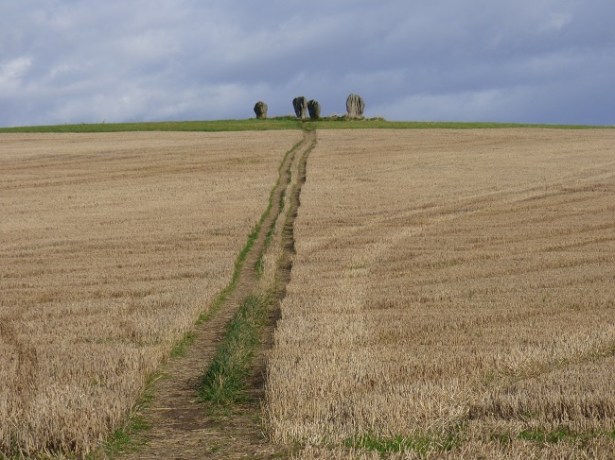
If only she could get there …

The mist and tears obscured her view, but she trod on, insistent and desperate for the safety of the circle. It had saved her ancestors. It had become a thing of lore.

But if the magic still held, she would be helped. The spirits that guarded the stones would weave protection over her. Bar the weapons. Shun the anger. Ward off those who wanted to do harm.

She tripped twice, the cold air breathing malice on her nape. She fought the urge to curl upon the damp ground and give up. She gathered up her tattered courage and wrapped the threads of memories around her shoulders. The incantations of her grandmother, sang softly into the cauldron, stirring soup and stories, teaching without telling, showing without spelling out what was forbidden to be known.

In the darkening damp she mumbled some forgotten fragments. “Help me, Nana,” she sobbed when her knees skinned on a stone and her breath caught.

“Rise, Child,” she thought she heard. She wanted to believe.

She rose. She stumbled on.

If only she could get there, she would be saved. The spirits will protect her in the mists of old.

The pitchforks. The firebrands. The mobs in their lust and calls for blood in smoke? They would not be able to see her. Not once she crossed into the circle. Once there, she would be scooped up, sheltered, danger gone.


For Sue Vincent’s WritePhoto


The Wait

Photo: Sue Vincent


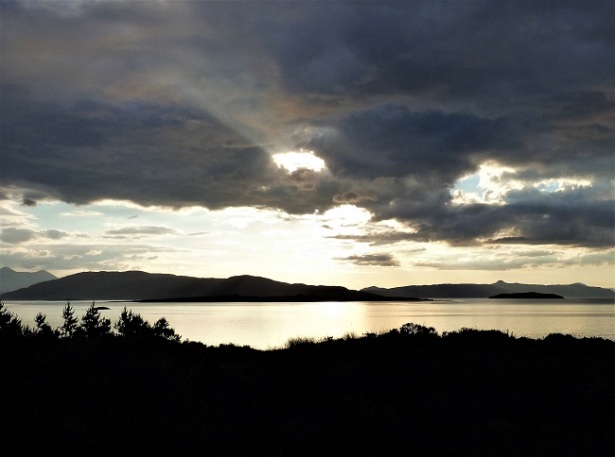
In the days of old they’d walk out on the water at high tide, appearing to float atop the waves.

It was a sign of trust.

Also of recognition. For they’d come from the water, after all. Their bodies might have forgotten how to live in it, but their cousins — seals, dolphins, whales — still held links to what was possible. And they spoke of long swims and deep dives and frolicking, and of how one day they’d all come home again.

And so they hoped.

And let themselves be carried by tentative feet on mossy rocks built far in and well past the breakers, all the way to the beginnings of the depths.

First as children whose hands were grasped by others’. Then as youngsters showing off their balance and their fearless speed (and perhaps a bit of memory from within their cells, of swiveling agility and joy being in of itself a kind of swimming). Then as new adults, saddled with fuller understanding and big bellies or wrapped by legs and arms of small ones holding tight around the waist and neck. Then as elders, wary of a fall and fearful even more of a child letting go of their hand and drowning. And at the last, as age counted no more, carried, offered, sent home to the sea.

Yes, in the days of old they’d walk out onto the water.

In celebration. In commemoration. In passage. In ritual and prayer and courage and communal hope.

Till they forgot.

And the waves licked the rocks till very little path was left, and dolphins and seals and whales no longer were spoken to and had moved on, and the earth and depths curled tight to wait.

For the people’s lungs still ached for the swim, and their heart still beat to the rhythm of the surf as they slept, and they still made a bit of ocean in their eyes, especially when they wept.


For Sue Vincent’s Write Photo


As One

Photo: Sue Vincent


It would be a long day of hiking to get to where she was going, but that only meant she’d have all those hours to herself. Time to cherish. Laura rarely had alone time now that she was taking care of three little ones. Four, if you counted the one who was adult in years but child in coping.

The others were coming by van and bike and car, and at least one that she knew of was likely to arrive by horse. Like spokes on a wheel, they where converging onto the place that had birthed and maintained their connection.

They were barely taller than grasshoppers when they had made their pact. The icy waters of the stream that slid in mirror-like pools sewn by white foam amidst the forests behind their homes, were known to either meld souls together or break them. They were adamant to have theirs fuse.

“Friends for life!” their reedy voices had risen breathless in the cold that needled every part of their unclad bodies. Only their palms, holding on to dear life, gave warmth.

Not one of them was going to admit that the submersion ritual had sounded better in the stories. Not one of them was willing to allow their fear or blue lipped trembling be the weakest cog.

“As one submerged, as one emerged!” they had cried and dipped and clung and sprung up in a sputter, pausing just a moment to stare in delighted disbelief at their hands — still in an unbroken circle, vow completed, magic done — before scrambling out onto the banks and into their awaiting piles of warm clothing.

It was unlikely that none of their parents had noticed the simultaneous wet hair and mossy, muddy patches. The river was off limits to unsupervised young. On any other day they would’ve been subjected to interrogation, yet none of them had been told off and not a one was punished. As children they’d believe themselves successfully secretive, the magic camouflaging the blatant disobedience.

As a mother now herself, Laura leaned toward believing that the real secret was the adults’, who must have seen the rosy cheeks and glowing eyes and realized the true magic of shared friendship. She found herself smiling at the memory as she walked across moors and over hills, through copses and sheep-speckled fields and bubbling streams and into the forest.

As she neared, her breath lifted and tightened in joyous anticipation. It was hard to believe it had been thirty years. They’d kept in touch all those decades. Through many moves and schools and colleges, through marriages and births and loss and celebrations — they wrote and called and saw each other in all manner of combinations. But this was the first time in a quarter century that they would be all of them together in one spot.

To submerge and renew the magic. In the stream.

From the distance came the clop-clop of what had to be Timmy’s draft horse, mixed with Sally’s giggles and Benny’s tenor mingling with Robin’s guitar strings and Bonnie’s soprano. A faint whiff of smoke filled Laura’s nostrils. Good! No frozen buns this time!

She reached to straighten the bathing-suit strap under her clothing. “As one submerged, as one emerged,” she whispered, lengthening her stride.


For Sue Vincent’s WritePhoto


Man In The Straw

Photo: Sue Vincent


“And the man in the straw danced and danced …”

“Till the morning came and changed his chance?”

Thomas stroked his granddaughter’s head. She never tired of the story. Her favorite, and she knew it by heart. As he knew her many expressions, the myriad of small sounds she made as she dreamed each night.

She was his favorite. His only, but still his favorite. No one could convince him otherwise.

“Grandpa?” the child burrowed deeper into her blankets.

“Yes, Pumpkin?”

“Do you think the man in the straw ever wanted to be something else?”

He felt his eyes widen as he glanced down at her. Her eyes were open, too. Gone were any traces of the soft daze of moments before sleep.

“What do you think, Pumpkin?” he returned the question, uncertain whether what he’d read into it was indeed in the child’s mind, and unwilling to insert his own assumptions into what may well be a different query altogether.

There were many things to wish were different. In the folktale. In life, too. He often wondered if she so loved the old story exactly because it spoke of vulnerabilities and challenge, of facing fears and finding fault and making do and fighting on. All things she’d know more than enough of.

The child nibbled momentarily on her lower lip. “I think maybe he sometimes wanted to be the man in the spiral. Or Fire. Or the mask. Or the stag.”

“Hmm …” he nodded, hoping she’d say more, wondering if she would. There was a depth to the child. Currents he did not always understand or believe he ought to. An Old Soul, his beloved Mara had said of the newborn even in the few days she had with the child before the angels called.

“But,” the little girl sighed, curling up so her back rested against her grandfather’s thigh as he sat on the edge of her cot. “I think he knew he was the Man In The Straw …”

The pause lingered. The child yawned.

“… and that he was meant to dance and dance …” she whispered, her breath deepening, her eyes closed. “… till morning came and changed his chance…”


For Sue Vincent’s WritePhoto


Almost

beyond SueVincent

Photo: Sue Vincent


“I wonder how many had spent a night in this place through the centuries.”

Dennis looked up from his walking boots. The laces had knotted and he was adamant about untangling them without cutting, even though he had a spare. Mirna’s chin rested on a palm propped on an elbow, the remainder of her body already cocooned in her puffy neon orange sleeping bag.

“You look like a giant orange slug,” he smiled.

“Oh, but thank you!” she giggled, wriggling playfully. “I’ve always wanted to achieve slug proportions.”

“I bet thousands upon thousands,” Dennis added.

“Of what?”

He gestured with his head at the space that sheltered them. The ancient stones still fitting together after multitudes of years.

“Yeah,” Mirna sighed. She turned onto her belly and peered out through the mossy rectangular opening. The moors stretched, bleak, to the horizon. As the day waned, the vista appeared increasingly forbidding. “I wonder who they were.”

“Shepherds. War refugees. Travelers. Hunters. Peddlers. Serfs. Messengers. Families seeking safety from the elements,” Dennis tugged on the knots gently as he spoke, and for some reason the controlled movement reminded him of the concentration involved in getting embers out of fire-sticks. He’d tried that once, out of sheer boredom, and the effort had left him out of breath, sweaty, and highly appreciative of the convenience of flint, not to mention lighters and water-proof matches.

“And now, more travelers,” Mirna noted. She rolled over and sat up in her sleeping bag, feeling very slug-like. “Here, let me.” She reached for one of Dennis’s boots, pulled out a hair pin and used it to loosen a knot, releasing one long loop of shoelace, then another.

Dennis shook his head and handed her the other boot. “So much for my skills,” he grinned sheepishly. “At least I know I’ll manage to light the field stove and make tea. Then we can watch the sunset, snug as bugs in a rug in our matching sleeping bags, and can be almost like all those who’d rested here before us …”

A whiff of wind puffed into the shelter and a straggling ray of light licked the mossy stone above Mirna’s head. A late-day cloud raced across the bog. A bird called.

A shudder traveled down Mirna’s spine.

It felt like a hello.

Almost.


For Sue Vincent’s WritePhoto


In The Dell

blue Sue Vincent

Photo: Sue Vincent


They built the cone carefully. Everyone knew things like that had to be just so.

“Will they come?” Nelly fretted, slim fingers worrying the edge of her tunic.

“Sure thing,” Dahlia’s nod was as resolute as her voice. “We did it exactly. And it is the right time.”

Nelly nibbled on a lip. Aunt Lorena’s mind wasn’t what it used to be. What if the elder’s confusion extended to passing on instructions?

“There,” Dahlia placed the last stick, straightened, and took a step back to admire their handiwork. She tucked a wild lock of dark hair behind an ear and chuckled. “Looks as if they’re putting their heads together.”

More like a bunch of kindling in a miniature teepee, Nelly thought. She shook doubt out of her head. “Do we wait here?” she scanned the expanse of bluebells that carpeted the ground amidst the trees.

Dahlia twisted her mouth, stuck a corner of that disobedient lock of hair into her mouth, and pondered. The small wood felt quiet. Almost as if the air itself was waiting. “I don’t think so,” she said finally. “We better give them space.”

Nelly wasn’t sure if she felt relieved or disappointed.

After a last scan of the area, the two girls walked away, stealing glances every few paces, lest they miss something when their backs were turned.

“I think that’s far enough,” Dahlia suggested when they’d gone about twenty yards. “We don’t want the fairies to think we left completely.” Or to miss them.

Nelly nodded silently.

An afternoon ray of sun wove through the branches to rest on her cousin’s narrow face, and Dahlia noted to herself how Nelly’s golden braid and cornflower eyes blended seamlessly into the magical scenery. Like a princess, she thought in satisfaction. Exactly what they needed.


For Sue Vincent’s WritePhoto


Tomorrow’s Orb

Photo: Sue Vincent


” … And that is when the sun became the liquid gold …” Marianna tucked the blanket tighter around the child and bent to kiss the flaxen head. The short soft hairs tickled her lips. She hadn’t yet gotten used to the severe buzz cut. She resisted touching her own head.

“…and in the morning?” the little one murmured, half-asleep.

“It will turn itself back into an orb and rise into the dawn …”

The almost translucent eyelids fluttered open once to rest on the flaming horizon, before closing, heavy, onto the small cheeks. The girl’s breathing deepened and slowed in time with the surf, arms secured around a well-loved doll.

Marianna stared at the reflection of molten lava on the water, listened to the murmured rush of the waves, rocked on her heels, and hugged herself.

At least the weather’s holding.

The child turned. An arm slipped out of the protection of the blanket and Marianna tucked the slim limb back under the covers, securing the doll where it could not be seen. It was a forbidden toy, yet Marianna could not bring herself to discard it. Not when so much had already been lost. She swallowed, and her hand rose of its own accord to feel the expanse of her head, the hair no longer there.

It was the least of it. Better they be seen as male, anyway.

The sun sank, gold, into the sea. She thought of the bedtime story and of the simple acceptance of young minds. Of the trust, the effervescent hope. Her own breath deepened as her daughter’s face at rest loosened a coil of tension in her chest into tendrils of comfort.

They’d made it this far. The beach was secluded. The trees and darkness offered their own respite. She, too, needed sleep.

May morning come, she thought. She lay her head on their pack of belongings and spooned the child against her heart. The last of the light licked the dampness from her cheek. May we safely see tomorrow’s orb rebirthed.


For Sue Vincent’s Write Photo prompt


Pathfinders

crown SueVincent

Photo: Sue Vincent


They filed into the toothy circle, a long double line, holding hands over the green strip that split them apart.

The stone pillars stood, immobile, ever present, waiting.

There have always been golden fields in all directions. Wild, then cultivated. The rustling of the ripened plants replacing a hush that would otherwise feed unease.

For there will be no voice heard.

No word.

No song.

No shout.

Nothing said.

Just a long line of humility, stepping up the path and through the eye of the ancient circle. Waiting to be cleansed.

To be whole.

To be seen.

To walk on.

Ahead.

Out the other side and down the second path where a widening triangle fanned into the distant horizon, mirroring the measure of relief.

And from the far far spaces, well beyond the hills, the sound of voices, whispers freed, a humming on the breeze.


For Sue Vincent’s WritePhoto


A Hole In The Sky

dusk SueVincent

Photo: Sue Vincent


“There’s a hole in the sky,” the child’s voice rose then hushed in part-fear, part-wonder.

“Indeed there is,” his father nodded.

The boy flicked his eyes away from the luminescent heavens just long enough to discern that his father wasn’t joking. He’d half-hoped his father would be, and his chest flooded with something like alarm when it did not seem that he was. What does it mean to have a rent in the ceiling of the universe? Would something fall through it? Would the world cave in like a shattered egg?

“Will it repair?” His voice was small.

The man put down the kindling he’d been arranging in preparation the evening’s fire. He straightened to a stand and leaned a heavy hand on the narrow shoulders of his son. Bird-like, the boy was. Fluttery and slight.

His youngest had always been a bit prone to the dramatic. The first to pick up on a change in atmosphere, the first to be reduced to tears, the first to wail at even the smallest prickling. Also the first to smile a welcome, the first to notice a green leaf peeking out of the frozen ground, the first to note the song of birds or a task well done.

He worried about such a skinless child, walking a life that did not always refrain from brushing far too crassly against tenderness. There were plenty of those who had repeatedly pressed him to be firmer with the youngster. To “toughen up the boy into a man” or “teach him how to grow a thicker skin.”

“How would I change the stripes upon a tiger?” he’d find himself replying. “Can I will a doe to become a lion?”

He could not bring himself to pain the boy as means to scar him into roughness. The child was made to be whomever he was made to be, and all a father could do was try to shepherd him toward maturity. Such as when taking the boy on this father-son hunting journey.

He squeezed his son’s shoulder and the boy raised a frightened face to meet his eyes.

“The sky will repair, Son,” he said, “though it may not go back to what it was before. For nothing can. It will move on — from day to night to cold to warmth to wind to storm. It will tear holes in clouds for sun to stream through. It will shred them to no shade. It will sew the threads together to again cover the sun. It is all as it is and all as it should become.”

The boy nodded. He swallowed down the tears that threatened, and tried to still the tremulous vibration of the world inside his mind.

“Now, as the sky does what it can,” the man handed his son a water-skin. “Let us do what we must. If you will fetch water, I will light the fire in tonight’s hearth.”


For Sue Vincent’s WritePhoto Challenge


Waterfall

torrent SueVincent

Photo: Sue Vincent


The weather was perfect. The hike had been pleasant. They stopped for a picnic on the bank of the stream as it rushed toward the waterfall. The normally bubbling brook was swollen with recent rains. The white water speeding down the creek and tumbling over the edge was energizing. The sun felt delicious on their faces. The flowering fields were glorious in early spring.

Other families were enjoying the day, too. Most stayed above the waterfalls. Any intrepid hikers who navigated down the steep slope to view the falls from the bottom were met with signs that warned against entering the water. The rocky pool was filled with unseen boulders, not to mention freezing cold with winter flow and melt.

Suddenly, the calm at the top of the falls was interrupted by a cry. A child of about ten years slipped on the bank above the falls. The wet surface, still damp from earlier rains, allowed no traction, and the child slid into the water. The strong flow quickly grabbed hold of her and she was swept toward the 45-foot drop. The girl’s mother screamed. The father tried to grab hold of his daughter but ended up helplessly in the water, too. Another man attempted to help, only to himself be lassoed by the water. The child’s mother and siblings, the Good Samaritan’s wife, and the picnickers watched in helpless horror as all three were swept by the white water and tumbled over the edge, quite possibly to their deaths.

The eldest son of the picnicking family ran down the trail along with a few others, hoping to assist survivors (or at least retrieve bodies so they not be carried further downstream and through additional cataracts). Rescue services were called. People rushed to the head of the falls to try and look down, afraid of seeing the worst.

Miraculously, all three survived the fall. The father and daughter managed to swim to the edge of the pool. The man who’d tried to help had made it through, as well. Both men were wounded. One with a broken nose. The other with an injured hand and lungs. The little girl was shaken, shaking, and freezing, but otherwise unharmed. With the help of others, all three were able to get up the trail back to the top of the falls, where they were reunited with their terrified families.

While recuse was coordinated, the girls of the picnicking family took off their sweaters, jackets, and socks and bundled the freezing little girl, who was drenched to the bone and had lost her shoes in the water, into layers of dry clothing.

It became evident that rescue personnel would need to hike the two miles in, so it was decided to try to walk out toward the paramedics. Slowly, with people assisting the wounded and carrying everyone’s belongings, the convoy of children and adults trudged along the trail, all stunned by what they had just experienced and/or witnessed. When help arrived, the child’s father was carried by stretcher the rest of the way and then all three evacuated in a waiting ambulance.

“I’m still processing this,” a witness shared later that day. “These moments while they were being carried toward and then fell over the waterfall … a mere few yards to our left … and us seeing it all happen … This could have been such a tragedy for the families and an awful trauma for all of us … It is amazing that this is how it ended.”

“How to process what I saw?” another witness wrote. “I couldn’t get the thought out of my mind, that the picture I’d taken of the happy family twenty minutes before all this occurred, could have been the last photo of their complete family … I saw near-death, fear, terror, anguish, redemption, joy, awe, and lots and lots of love. I saw people who came together, oblivious of background, because we are all part of the human race and we all value life and our families … and at the end of the day want to live together in peace and harmony and make this world a better place for our children. I saw people reach out and help one another, and think only of the other, not themselves.”


§§§§


Note: When I saw Sue’s photo prompt, I knew that this one was not going to be fiction. Not when the photo she chose is so uncannily reminding of the very waterfall where the child had slipped earlier this week. Yes, the story above is true. My sister’s family was the “picnicking family” mentioned above, my nephew had ran down the trail to help, my sister and nieces had helped dry and bundle the child in their clothes. In the photo below, you can see the falls. They’d been picnicking mere steps from where the people in the photo are standing. How all three survived not just the dangerous tumble, but the sharp rocks at the bottom of the falls is still a marvel. Whew. Here’s to humanity first. To teaching children how to swim. And to miracles.

Waterfall A Levenberg

Waterfall A.L.


For Sue Vincent’s Write Photo Challenge