
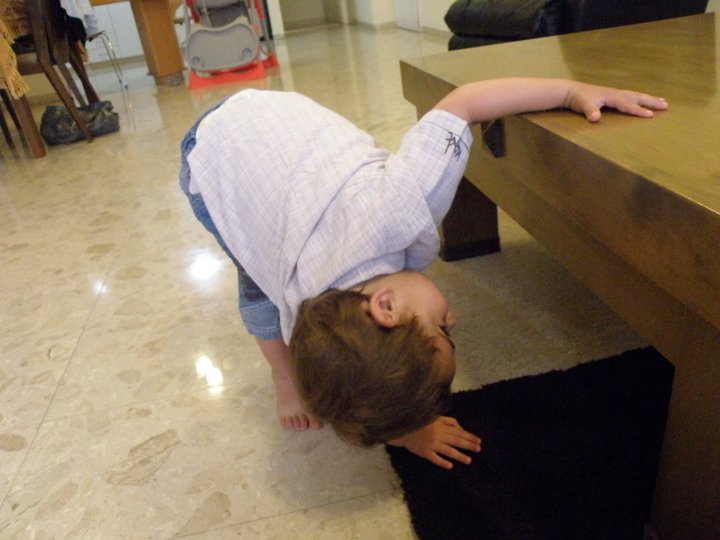
Kids are wizards of pointing out minutia of life that can seem quite arbitrary to us. They note things we missed completely. They seem to ‘insist’ on irrelevant details like the way the plate is organized, who got to open the refrigerator this time, or what touches what. Everything takes far LONGER to do with a little one around …
In good part it may well be because their life moves slower. Time is yet to be shackled onto watches and the ticking of a schedule. They pause mid-sleeve, pondering the way light filters through the cloth, unconcerned with how rushed the morning is. They stare in wonder at a pigeon when the light changed and it is time to cross the street. They have an urgent question or need just when you finally sat down to eat.
And they notice. Everything.
They collect each leaf and pebble. There is no such thing in their vocabulary as a “quick run to the store and back” … not when there’s a big exciting world out there. There is endlessness to explore: Cracks in the pavement. Bits of paper flown by winds. Funny people. Yippy dogs. Horns and beeps and squeaks and windows with wonders and when finally at the store, multitudes of candy at eye-level … How could it be that this was not what you came all the way for? …
They teach us patience, that’s for certain.
They also teach us that time is what we make of it. That stress can catch one breath, and relaxation ride right in upon another. That one can laugh before their tears have dried and emotions coexist and flow without a judgment.
They hold a mirror to the things we have forgotten or have misplaced our truth about or have given up on trying to critically examine.
They listen. Even when they do not seem to.
More than most anything else, they note the mismatch of expression, the ambiguity of tone and matter. The odd things our mouths can say and we do not hear.
In part it is because small children are so literal. They get confused when they listen to the WORDS we say and find it not to match the words’ MEANING. Their reaction (and ensuing cuteness) can have us realize hidden ambiguity. They reflect what we once saw and now are almost blind to: how the world works even though words so often mean things they do not really mean.
Want a few examples?
A father talked about his mother looking after the children when he and his wife had to both be away. “She has a heart of gold,” he gushed. His preschooler daughter piped up and added, “no daddy, you forgot. Nana’s TEETH are gold …”
A mother had forgotten something she needed to ask me. “I’ve had it at the back of my head all day,” she sighed, frustrated. Her three-year-old scrambled up onto the couch and took a look, exclaiming, “No mamma, it is nothing there!”
“It is all politics and money,” another parent moped when a kindergarten admission did not go the way she’d hoped, “there’s absolutely nothing new under the sun!” Her almost kindergartener son looked at her sideways. “That not true, Mommy,” he said, rather accusingly. “I have new Spiderman shoes! You forgetting my new Spiderman shoes?!!”
Then there are the cats and dogs that do not really rain; the invisible pins and needles one can be on (and no wonder one’s child refuses to sit where the parent sat a moment prior!!); the feet in mouths (“You can’t do that no more, Daddy. You’re too old. You can’t reach like baby Deena!”); the bleeding hearts (think on that …); the pants on fire…
Language is a treasure trove of meaning, and learning symbolic language is a big task. It calls for the ability to hold two lines of listening: one for the words, another for the context. Children get very good at that around age 5 or so, though they get thoroughly confused before they realize that “listen to what I say” is far from straight forward.
Kids practice logic. They spend a good bit of their time making connections, figuring out how things work and what brings on what. If you pour too quickly, you spill everything. If you push your brother, mom gets cross. If you don’t stop whining, you may lose a privilege. If you mix milk with chocolate syrup magic happens and you get chocolate milk!
They get right fast at figuring out what makes what, and a never-ending list of ‘why’s helps them figure things out. They realize there are desired outcomes and less favorable ones, some adults that are easier to get things from, that there is misfortune and consequence. They get uncannily creative at hopeful attribution of fault …
They map their world into cause and effect. Into how things happen. Who does what.
And sometimes they make connections that are not quite as we would have put them. … Like the little girl with the (newly) pregnant mom, who asked quite loudly and in public: “Daddy, how did God put a baby inside mommy and didn’t tell her about it until she peed on the stick?”
The B&Bees








 Na'ama Yehuda
You must be logged in to post a comment.