What do you do with a melted child?

I could hear them before they even entered the building … his screech, her frustrated murmuring, unclear words with clear intent to hush and stop the fussing.

It did not get better in the vestibule, or the stairway. Screaming, banging on the rails (there’s fantastic echo in the building–apparently it is spectacularly irresistible for maximizing the effect of tantrums).

The mother’s pleas inched up in volume, from “stop this” to “please behave” and “you are making too much noise” to “other people are going to get mad at you” and “if you don’t stop this there’d be no playdates.” The immediate effect was a proportionate rise in the child’s loudness.

I decided to go meet them half-way. It is not something I usually do, so my very appearance in the hallway was enough to generate sufficient surprise to elicit momentary silence. I capitalized. “Sounds like you are having a hard day,” I noted, directing my words to both red-faced figures, one with mortification, one with the exertion of maximizing vocal output on steep stairs.

“I’m melting,” he noted, quite matter of fact, I might add.

“Oh,” I responded.

The mom looked from him to me and back again. “Melting?”

“A meltdown, I suppose,” I smiled, turned to the boy. “It sure sounds like a major meltdown.”

He nodded emphatically, satisfied.

“Do you think you had enough of a meltdown for one time?” I offered my hand to him. “It sounds pretty exhausting.”

He considered, placed his little hand in mine. Turned to his mother with a rather smug expression. “I done melting now.”

“I’m glad,” she managed.

“What was this about?” I wondered aloud.

“He wanted to be the one to press the button for the bus stop …”

“Ah.”

“But someone else on the bus already pressed it … so he refused to get off …”

I looked at him with a raised eyebrow. He nodded, approving of the testimony. “It was my turn to push the button,” he accused.

“Hmm, maybe other people on the bus didn’t know that.”

He looked shocked at the very notion. How could anyone not know what he clearly had?

We climbed. He pondered.

“It only got worse from there,” his mother added, still debriefing. “I had to carry him off the bus, screaming. He threw himself on the ground …”

It explained the stage of his clothing … it had rained earlier …

“He got himself all wet …” she sighed, “I’m sorry for bringing him in such a mess.”

He turned to her, his face a mask of indignation. “Of course I wet, Mama! I was melting!”

meltdown1

Happiness glide

happy chipmunk

“I had the best weekend ever!” the preschooler’s eyes sparkled.

“Oh, wow, that’s so great!” I responded, grinning. It is contagious, you know, this kind of zest for life. And the enthusiasm of this little one was particularly catching. He literally beamed delight.

“We had the best ever dinner and the best ever pizza!” he bounced on his heels, the words not coming nearly fast enough. “And I saw the best movie ever on the Netflix. And my grandpa makes the best popcorn and it like magic in the microwave and I have the best pajamas ever!”

“You have new pajamas?!” My monkey brain had to assume.

He paused and regarded me with some confusion. “I already HAVE the best pajamas ever! It’s superman pajamas!”

Silly me.

He kicked off his shoes and glided on the wood floor with his socks, balancing with his arms. “Wheee! Best floor ever!”

“Did you have the best weekend ever, too?” he added, not quite waiting for a response before sighing contentedly. “You did, right? Because it was the best weekend ever!”

The details change a bit; there’s not always popcorn, sometimes its just TV and not Netflix, sometimes it is the park, or playing ball, or baking cookies, or his dad reading him  story. Doesn’t matter. The weekend is always–always–the best one ever.

And it makes for Happy Mondays; every one.

Rules? What Rules?

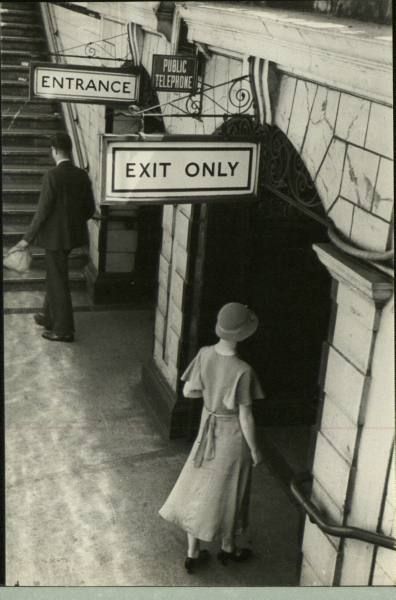
A friend sent me this photo, taken 1910 … and I thought, it was the best BEST example ever, of bending the rules … (or at least those rules that make no sense beyond to those who made them … )


livefree

I was reminded of it today, after speaking with a young boy who complained that he got into trouble–yet again–for breaking “another of the teacher’s stupid rules.”

The boy’s mother had her mouth already open to reprimand him for using a word one ‘should not say’ in the context of one’s educators … but I gave her one of my ‘please don’t’ looks … and she took a deep breath and nodded.

“What kind of rules?” I asked.

“Stupid ones,” he grumbled. Then seeing that I was actually waiting to hear an example, he sighed. “Like not being allowed to hold our pencils while we’re reading. She keeps taking points off when I break the rule.”

“Did she tell you why she doesn’t want you to do that?”

“I don’t know,” he shrugged, “because she said so?”

I chuckled. “Fair enough … sometimes grownups say that you should not do things just because they say so … but I was wondering if she ever actually told you why. Sounds to me she maybe has a reason–maybe kids play with their pencils? Drop them a lot and it is distracting? Doodle in the books?”

The boy peered at me with a look that let me know that I have just lost about 200 points of coolness in his view along with several dozen in the IQ department. “Sometimes we’re supposed to write in our books,” he stated, “… anyway, if she said it was for that it would make sense, sort of” he added. “I don’t drop mine. I just hold it. She doesn’t want us to hold the pencils just because.”

I raised an eyebrow. “Just because?”

“Yeah,” he stressed. “She said that we don’t need a pencil in our hands for our brain to read…” the boy pouted. “How does she know what my brain needs for reading? What if the pencil reminds my brain what the letters are?”

Point made.

I actually could see how it could do that.

I told the little guy that if it helps him to hold the pencil when he’s reading, to go ahead and do so.

He looked at me, suspicious. “It’ll get me in trouble.”

“Not if you tell her that I told you it’s okay for you to keep holding it if it helps your brain.” I smiled, more than a tad conspiring.

His eyes grew large, and the grin that followed had enough wattage to light up Manhattan’s night sky.


“A” is for Average?

tired child

The woman on my answering machine sounded anxious: “I got your name from a friend of mine. You come highly recommended and you really helped her kids. I know you are really busy but can you please call me back about my child? I have a 5th grader who really needs your help.”

I called her back. Based on her wording–and her urgency–I fully expected to hear details about a child who is falling behind academically. A child with teachers worrying about difficulty with vocabulary, comprehension, attention, expressive writing, memory, fluency, or a combination. Possibly a referral from an orthodontist about tongue thrust issues, or about stuttering. Or hearing remediation.

The mother’s pleading was real enough, but the cause for it surprised me (though it ought not to–this is not the first time!): Her son, entering 6th grade in the fall, was receiving “only B+ and A-” on his reports and tests. She wanted “to give him some extra help so he can do better at school.”

Being a clinician, I don’t see children unless there is cause to see them. Normally developing children don’t usually need speech-language-therapy. Still, sometimes parents don’t know how to exactly explain the difficulties their children are experiencing, so to be sure there is no issue needing remediation, I probed some more: was there a particular reason she thought he should be better than he was already doing? What were her son’s strengths and weaknesses, did he receive assistance in the past? Though the child’s grades were very respectable, especially for a highly competitive private school, grades don’t tell the whole story about a child’s abilities. Also, some children can be good students and still perform below their actual potential because their actual ability is excellent, not average. It is important then to find out what holds them back. Was that the issue here? Why would a mother worry about a child’s basically good–if not exceptional–academics?

From the information the mother provided, it seemed that the child’s ERBs were average and that his IQ test (which had been required for his school admission at the time), showed average abilities in both verbal and performance measures. His vocabulary scores have always been age-appropriate. He conversed well in two languages, and read voraciously. The child was solidly within the 60th percentile or so in all measures. Moreover, the mother reported that he is a happy, social, kind young man with many interests, who enjoys sports and likes most his teachers. Even by the mother’s own account, the child was doing well.

And yet, as she was seeking ‘help’, apparently not well enough.

There are several issues in why this is a problem. One is that grades can be inflated so that they do not actually reflect a child’s abilities in a race to showcase a higher class/school average than may otherwise be warranted. It doesn’t have to happen in all schools to be a problem. Paradoxically ‘partial inflation’ would even make it worse: if some schools inflate grades and push “B”s to look like “A”s, then a “B” in a school that does not inflate grades can appear a failure in comparison even though the measured ability is the same.

Another problem is that in today’s competitive education and unrealistic expectation for ‘above average’ performance from everyone (a statistical impossibility), even good is no longer good enough. Even a ‘real’ B, is not seen as adequate for a student who may well be a B-student. Average is unacceptable. Excellence is required. B and A- are not sufficient. Especially not when there are the of A+ and even A++ or A+++

In a timely article in CounselingResource, Gordon Shippey, a Licensed Professional Counselor from Atlanta, touches on this very topic, as well as the realities of grade inflation. His article, “A is for “Acceptable”, is a must read.

Among many other things, Shippey notes: “If A was acceptable, there would need to be A+, A++ and A+++. In fact we’d need as many different gradations as could reasonably be detected. This would give exceptional students something to aim for beyond “A.”

Actually there ARE already the A+ and A++ and A+++ as realities in some schools. Students now no longer aim for 100 on a test (that became ‘merely acceptable’) but feel the pressure need to get ’105 or 110 or more for ‘bonus’ or a ‘truly well done job.’ It may give excellent students some margin of distinction, but it does not release the squeeze on others, for whom even an “A” no longer seems okay.

grade explanation

When I went to school, 100 was as high as you could get. It meant perfection. It meant no errors, best performance. Full stop. Now 100 is ‘almost best’ and ‘almost excellent’; and an A paper or even an A+ paper does not equate with remarkable.

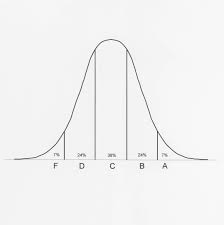
The bell curve did not shift, but the names we call each place on the curve did. A no longer depicts a small portion of children with superior performance (7% or so, of students). Now A is for Average.

grade

Normal Grade Distribution Curve

There is something seriously wrong when average performance for an average student is looked at as failure. Average children are not stupid. Average means “as expected.” Average means “okay.” Children with average school performance are presenting skills equivalent to what is expected of the majority of children their age. Expecting all children to be ‘above average’ is not realistic. Pushing a good-effort B student to get only “A”s (and above) is a recipe for stress and worry, for frustration, disillusion, anxiety.

I certainly understood the mother’s plea. She was being carried along in the currents of requirements and expectations Shippey speaks about, and she believed–and her belief was strongly reinforced by teachers’ notes, societal pressure and the higher-education reality–that it was required of her child to be remarkable. Remarkable is the new ‘expected.’

Grades used to be a measure of a child’s ability and effort. We rightfully demanded that children to do their best and put an honest effort, but it was pretty clear that not everyone could be at the top of the class. By definition, this cannot be.

Nowadays, grades are not so much a measure of a child’s ability and effort as they are an artificial soup made of an (often unfair) measurement of a teacher’s skills, a school’s ranking and a district’s relative superiority. Grades are measured for political gain and their manufacture sustains a multimillion industry of ever reinvented ‘teaching programs’ (and recently, ‘common-core’ goals), which are rarely developed by educators. Grades are big business. Less so about the kids.

The saddest part is, that children know it.

Children always sense unfairness or hypocrisy, they may not know to explain it but they feel when they are in a halls of mirrors. They realize that they are cogs in a machine. They perceive that they are being measured by academic yardsticks that do not really measure them and yet they are to be judged solely by.

The system needs to change. It is unhealthy, and children are reflecting it–in anxiety, depression, disillusion, burn-out, anger, attitude, apathy, a sense of invisibility and impossible demands.

In the meanwhile, the dilemma of this mother (and many other parents)–and in a way mine as a clinician who can hone a child’s ability or give them a leg up–is whether to feed into the system and push that child forward. Whether to put him into intense tutoring and ask him to perform beyond his skills and at the price of other areas of development; or leave him to learn at his normal (if average) rate and enjoy his childhood at the price of his potential future.

If it were your child, your potential client, what would you have done?


Pendred Syndrome–a Query

A query from a parent:

“My son was just diagnosed with Pendred syndrome. He already has hearing aids from when we discovered he has hearing loss when he was 8 months old, but he needs stronger ones now because his hearing got much worse. The doctor said that he may end up deaf and that we need to check his thyroid, too. My son is already getting PT with early intervention because he is not walking yet at 18 months but we’re going to put him in speech therapy, too. What is Pendred syndrome and is it true my husband and I gave it to him? Will the therapy help with his hearing? There’s so much technical stuff and I’m really worried.”

Dear Worried Mom,

Of course you are worried. It would be overwhelming for any parent to have their child diagnosed with a problem, let alone one that can continue to affect them and that may change with time. A good step is to seek more information–as you are doing now, and hopefully will continue to do.

I’m glad that your son is already getting amplification (i.e. hearing aids) and that they are going to be adjusted/changed to reflect the change in his hearing–this is very important, and is a big step of helping him develop the best way possible. Am glad that he’s getting PT, too, if his motor skills can use some help; and that you are going to begin Speech-Language-Therapy with him, to ensure he makes the most out of his hearing and that his speech and language can develop as well as possible.

I hope that your pediatrician and the clinicians you’ll be working with (in Early Intervention, the ENT, the Audiologist, etc) will refer you to more information about Pendred syndrome, hearing loss, and rehabilitation of hearing loss in young children. Do let them know you are concerned and discuss your worries with them–I am quite confident that they will have resources, support, and more specific answers for you.

In the meanwhile, here’s a summary of some of the main features and issues in Pendred syndrome. This is not in any way a comprehensive review of Pendred or what the course of it would be in your son’s case. Nor is it a specific recommendation as to what to do in your son’s case, but I hope this overview will nonetheless give you some information to start with.

Pendred syndrome is a genetic disorder that causes early hearing loss in children. The syndrome is named after Vaughan Pendred, the physician who first described people with the disorder. It is actually the most common syndromal form of deafness in children–it is estimated that Pendred syndrome accounts for 5-10% of hereditary deafness cases! It is an autosomal recessive disorder (which basically means that both parents need to be carriers of the recessive gene–but the parents often have no symptoms and often don’t know that they carry the gene), and is associated with abnormalities of the cochlea, sensory-neural hearing loss, and diffuse thyroid enlargement (goiter). It can also sometimes create problems with balance.

Children who are born with Pendred syndrome may begin to lose their hearing at birth or soon after birth (like in your son’s case), and often lose hearing by the time they are three years old. The hearing loss is sensory-neural in type. When hearing is present at birth, it will usually worsen over time, with some children with Pendred syndrome becoming totally deaf (but not all, some children do have residual hearing or a lesser hearing loss). The hearing loss in Pendred syndrome is usually bilateral (in both ears), although one ear may have more hearing loss than the other.

Childhood hearing loss has many causes. Researchers believe that 50 to 60 percent of cases are due to genetic causes, and 40 to 50 percent of cases are from environmental causes (e.g. substances that damage the inner ear, such as certain antibiotics or chemotherapy medications).

The first part of a diagnosis of Pendred syndrome often includes the discovery of a hearing loss via a child failing a screening test or the presence of a hearing loss being found. Not all hearing loss in childhood is related to Pendred Syndrome, so the clinicians evaluate many things before considering the diagnosis and it can indeed take a bit of time before things are known for sure. Things like the kind, timing, amount, and pattern of hearing loss; the anatomy of the inner ear structures; the child’s balance and thyroid, etc. All these can help the health care professional determine whether to seek genetic testing and imaging tests for the inner ear, and to conclude whether a child has Pendred syndrome or some other type of progressive deafness.

Pendred syndrome can make the thyroid gland grow larger (when a thyroid gland grows too large and can visually bulge on the lower neck, it is called a goiter). The thyroid is a small, butterfly-shaped gland in the front of the neck, just under the ‘Adam’s apple’ and just above the collarbones. It plays an important role in the way the body uses energy from food, as well as in normal growth and development. Some thyroid issues in childhood (e.g. Grave’s Disease) can cause growth problems. However, in Pendred syndrome children often develop properly even if their thyroid is affected and their levels of thyroid hormones are usually normal. Not everyone with Pendred syndrome gets a goiter, and it typically develops in adolescence or early adulthood. Not all goiters are problematic, but if a goiter becomes large, it can impact breathing and swallowing and then treatment may be necessary. So an endocrinologist (doctor trained with diseases and disorders that involve the hormonal/endocrine system) is probably a good person to get involved even if only for followup.

By the way, it is still not clear to scientists why some people with Pendred have more issues than others (e.g. some have goiter and others don’t).

Alongside hearing loss, Pendred syndrome also can affect the vestibular system, which is the system which controls balance. The good news is that most children and adults with Pendred learn to adapt to whatever vestibular dysfunction they have and can manage routine tasks and daily balance requirements well. That said, because of the vestibular issues, some babies with Pendred syndrome may start walking later than other babies.

To get a bit technical: It is believed that Pendred syndrome is caused by mutations (i.e. changes) in a gene called SLC26A4(formerly known as the PDS gene) on chromosome 7. To be born with Pendred syndrome, a child would need to inherit two mutated SLC26A4 genes—one from each parent. Because it is a recessive gene, the parents are only carriers of the mutation (i.e. they don’t have the syndrome themselves). In a family where both parents are carriers, a child has a chance of 1:4 to be born with Pendred, and a 1:2 chance to be born a carrier. It is often recommended that if people are concerned about the possibility of Pendred (e.g. in a child or future children) that they seek genetic testing and counseling.

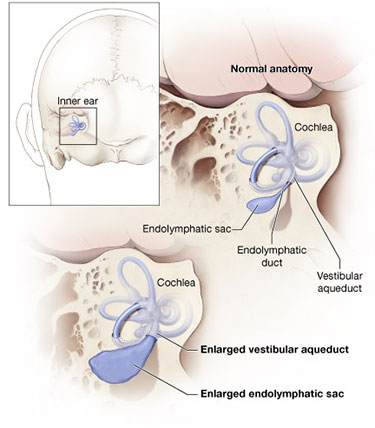
The anatomy of the inner ear is often viewed through imaging techniques such as magnetic resonance imaging (MRI) or computed tomography (CT), which allows viewing the cochlea and the vestibular system. The cochlea is the spiral-shaped part of the inner ear that converts sound into electrical signals that are then sent along to the brain through the auditory nerve. A healthy cochlea has two-and-a-half turns, but some persons with Pendred syndrome may have a cochlea with only one-and-a-half turns. The vestibular system includes a part called vestibular aqueduct. It is a kind of a bony canal that runs from the vestibule (the part of the inner ear between the cochlea and the semicircular canals) and the inside of the skull. Inside the vestibular aqueduct there is a fluid-filled tube called the endolymphatic duct, which ends with a balloon-shaped sac. People with Pendred syndrome may have an enlarged vestibular aqueduct, and the endolympatic duct and sack may also be enlarged.

Below is an image of the inner ear in some people with Pendred syndrome, taken from: http://www.nidcd.nih.gov/health/hearing/pages/pendred.aspx

http://www.nidcd.nih.gov/staticresources/images/PendredFS-enlarged-vast.jpg

When it comes to helping children with Pendred: First of all, to minimize the risk of worsening hearing loss, children with Pendred syndrome may be advised to wear head protection when engaged in activities such as bicycle riding and skiing (to avoid trauma to their head). They may be advised to avoid contact sports or situations that can lead to extreme, rapid changes in pressure such as scuba diving or hyperbaric oxygen treatment.

Like with your son, the treatment of children with Pendred syndrome indeed often involves a team of specialists. These could include an audiologist, speech-language-pathologist, otolaryngologist, endocrinologist, geneticist, physical therapist, and primary care physician. Not all need to see the child all the time, and not necessarily throughout childhood, but it is always good to have those who are working with the child communicate with each other as need be so that they can coordinate goals and needs and work as a team. Don’t be shy about asking professionals to collaborate–they can’t and won’t do so without your consent.

Hearing amplification (hearing aids, and for those who need them: cochlear implants) can greatly minimize the impact of hearing loss on language and development. Children with Pendred syndrome should start early treatment with a speech-language-pathologist, to help gain communication skills and learn how to maximize their use of their hearing aids or cochlear implant. So I think it is probably an excellent thing for your son to begin with an SLP now, when any gaps or difficulties, if there are any, hadn’t had a chance to grow wide. In addition to hearing rehabilitation through working on discriminating, identifying, understanding, and processing sounds and language better, speech-language-pathologists can also help children with Pendred syndrome with speech, voice, and language development. The hearing itself may not be made better, but how the child used the hearing they have can be get a lot better with treatment. Treatment can help minimize the impacts of hearing loss on development, language, communication, and learning. Physical therapy can help with balance issues, and help aid with motor-goals (such as walking, and later running, climbing, and so on).

It seems that your son is already up to a good start, by having a parent who is interested in getting more informed about his condition and who is seeking to follow through on the best treatment plan for him. I wish you and your son all the best, and a lovely, joyful, satisfying healthy childhood.

King of the Red Train

A small boy today shared last night’s dream:

“I was the king of the red train. Red is the best. It was even more longer (sic) than the subway and another subway and another subway and it was going very fast like a cheetah and I wasn’t scared because I was the king of the red train.” (slowing to explain) “The king is the boss of the train and the whole country.” (picking up speed again) “And all the people were happy because the train was going so much fast (sic) and that’s very good. You know why?” (pausing, waiting for my query before continuing elatedly) … because they were going to get home before their ice cream melted!” 

train

Just Like Daddy

A boy, age 4, stating proudly: “When I grow up I’m going to be just like my daddy. I’m going to put ties on by my whole self and a suit and I’m going to have a (sic) iPad and two iPhones even three and be busy and go to work everyday …”

He pauses, and a little frown climbs up his young forehead … He takes a breath, and continues, a little less enthusiastically: “yeah, I’m going to go to work …”

He pauses again, reconsiders. Looks up at me, a tad concerned. “Can grownups go to work and … um … play?”

just like daddy

“All kinds of upset”


The young girl stomped up my stairs red-faced, eyes shining with unshed tears, her usually tidy light hair disheveled, one pigtail-holder dangling dangerously close to losing hold. She slammed her book-bag on the floor, pulled at her coat sleeves and sat huffy by the table, arms crossed.

“What’s going on?” I asked.

“Nothing.”

Well … I was far from convinced … It seemed more like anything but.

“Sure looks like something is going on …” I offered, “you look upset, and you usually don’t just throw your bag on the floor and sit down … ”

“Sorry,” she mumbled and reached over to right the bag, not seeming particularly enamored with me, either.

“Oh, I don’t care about the bag,” I stated, realizing I could have certainly worded myself better. “I was just saying how you looked upset. I know that when I feel like tossing a bag onto the floor like that it is usually because I’m feeling upset.”

“Yeah.”

I waited.

“So I’m upset, okay?!”

The I said what you wanted me to say, so are you happy now? tone was evident, and it made me smile.

Wrong move. The girl’s forehead darkened. “What? So it’s funny?”

“No! Not at all!” I back-paddled, volume of smile lowered considerably. “I was smiling with affection. You don’t have to talk about any of this if you don’t want to. I’m just sorry that you are having a rough day.”

Silence. The child backed into the chair, progressively slumping as if all the air leaked slowly out of her. I waited. When she said nothing, I placed my hand on the table close to her, offering support. She looked up at me, unhooked one arm and played absentmindedly with my bracelet, then took my hand, and looked up again. Her green-gray eyes were brimming now and I could see that there were two trails of dried tears already on her cheeks, prepared to shuttle the incoming ones.

“I hate it when everyone tells me what to be!” She blurted, voice choked.

“Yeah,” I said softly.

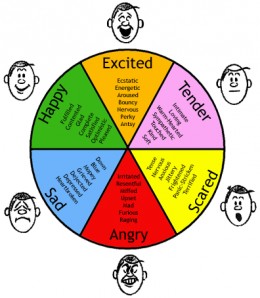
“I am upset!” She stated. “A lot! All kinds of upset. Remember how we worked on feeling words and synonyms and opposites and all that stupid nonsense?”

I smiled. I did remember. Of course I did not think that any of it was even close to nonsense (especially not ‘stupid nonsense’ …), but I didn’t think being persnickety would help and so I kept my mouth shut about that.

“Well,” she half-smiled, realizing. “Sorry … not stupid nonsense, but sort of. It was really boring … but, anyway … I’m also feeling really annoyed and irritated. Disgusted, too. All part of upset, isn’t it?”

“Aha,” I confirmed, figuring that as she was doing a really good job herself, the best I could do was keep myself from interfering or thinking I knew what she wanted me to say.

“So I am. Upset. Angry. Frustrated. Whatever. Why do adults get to make decisions about my life? It is my life, not theirs!” She looked up at me, her pretty face now more sad and disappointed than angry. Putting feelings into words often does that … Verbalizing helps emotions clarify and flow.

“I’m sorry,” I said. I did feel sorry. I hate seeing children upset, and I know how helpless kids can feel sometimes–some of them absolutely all too often and this particular child more often than I’d like her to.  I also felt proud of her. For a girl who not too long ago had very few words with which to describe anything, let alone her own feelings, this was seriously wonderful progress.

“My mom says I can’t go to sleep-away camp,” she finally spat out, letting go of my hand in dejection and curling back into herself. “She says that ‘I need the summer for catching up with schoolwork’ … What about what I need? What about if I need a break?” The tears cascaded now, the unfairness of it all flooding her.

I sighed. This was going to be the girl’s first time at sleep-away, and she was looking forward to the four-week-adventure for just about forever. Her cousin and a good friend were also planned to go to the same “sports and fun camp”, as she called it, and it had been my impression that the parents were naturally wary to have their little girl away for the first time, but still supportive. Whatever brought this on, I did not think that canceling the camp was a good solution, and certainly not for supposed academics.

She looked up at me, suddenly suspicious. “Did you tell her that I need to stay home to do school work all summer?”

I certainly did not, but even before I could say anything, she took a breath and shook her head, “I know you wouldn’t, though. You always say playing is important, too. You don’t even like homework for kids with long schooldays. I heard you tell my mom that, on the phone …” she looked up mischievously, imparting a secret. “Don’t tell her … she doesn’t know … but I listened on the other line …”

I chuckled. Eavesdropping is not the most polite thing, even if I couldn’t say I blamed her for being curious to know what was being discussed when the topic was herself.  Talking about boundaries and appropriate behavior could wait, however.

“You’re right,” I said. “I do think playing is important. As important as learning. Sometimes even more important. I’m not sure why your mother said what she did, but if you’d like me to, I would speak to her about the summer camp. In fact, I want to know from her what this is all about.”

Hope dawned behind the tears. “You’d tell her I should go?”

This got another chuckle. Smart cookie, this one. “Well … I certainly think it is a good idea to have a break, and personally I would like to see you going, but parents have all kinds of considerations … I would like to speak to your mother about this but I don’t know that I will tell her that you ‘should’ go.”

“Okay …” she deflated some. “I wish you would tell her, though. She’d have to send me there if you say so.” Sigh. Shrug. The child finally unzipped and emerged from her coat (I was wondering how long she was going to let herself be cooked, with the heat on in the room besides). She hung the coat on the back of her chair and moved an arm–slightly defiantly, I thought–over her eyes and cheeks. Why bother with a tissue when there is a sleeve nearby … and when she can thereby show her discontent for my not promising to order her mother around some …

I smiled, and she smiled back, blushing slightly. Kids know when we see through them (though we are sometimes far less perceptive when they see right through us!).

We went on with our session, but before she got picked up by her babysitter the girl stopped me mid-sentence as I was discussing a task we were completing. “You won’t forget to talk to my mom, right?”

“I won’t,” I promised.

“I mean, don’t forget to tell her I was really annoyed and angry and frustrated and all kinds of upset about it!”


You bet’cha, little one. And so well done … No way I would forget, and me all kinds of proud of you for that …
 

Feelings


Tree Life


“Are trees sad when people cut them?” The little boy came out of a week of school focus on earth, nature, resources, deforestation, and endangered animals.

“What do you think?” I returned the question. He has a reason for asking, after all.

“Yeah,” the seven-year-old sobered. “I think trees get sad because then they die and they can’t make leaves and flowers and acorns anymore.”

I nodded, sensing he has not quite finished and wanting to give him time to find the words.

A quiet moment passed, then his right eyebrow shot up the way it does when he gets an idea. Ideas for mischief, yes; but also for an answer that eluded him or a solution he did not see before. He touched the top of the table with his fingertips, and his eyes wandered over the floor, the bookcase, the closet door.

“You think maybe the trees are also not so sad,” he continued, “if people make stuff from them and then they get to be other things?”

“Um…hmm …” I noted in agreement, letting him work this through.

“Like if the tree gets to be a table or a chair or even a book then it is still important, right? But …” his young face wrinkled in too-old-for-his-age consternation, “but … maybe the trees are sad if they get burnt in the fire or something … because then they’re gone and can’t be anything anymore?”

“I see what you mean,” I offered, “but what if burning the wood helps keep people warm in the winter or cook their food?”

He brightened. “Yeah! I think maybe then the trees don’t get so sad … because they kind of make the food … ” His face got transformed once more, this time to seriously didactic, “But … but people still have to be very careful to not cut too many trees, right?”

“Right … ”

“… because the trees want to grow and be happy and also the squirrels and the birds need trees and monkeys and other things. Bugs, even. Some animals live on trees,” he instructed me, “That’s where they build their home. So people have to be careful because it is not fair to break all the animal homes and chop off all the trees to make things …” he paused. “And anyway, you can make tables from other things, too. Like plastic. Or maybe even a rock … I think …”

He quieted for a moment, his eyes wandered again around the room and rested on my bookshelves, on the National Geographic magazines on the side table, and the paper-packed folder with his work peeking out of the backpack on the wooden floor.

“I think trees really don’t mind if they get to be books, though” he added, satisfied. “Because then they can tell stories even if they can’t talk. I love trees and I love books.”

Couldn’t have said it better myself.

treelife

Clapping, singing, and Peek-A-Boo

A query came from another young mother:
“I have a six-month-old baby and I’m a single mom without much money to take her to mommy-and-me classes and such. Are there games or activities I can do with my baby at home to help her language development? She’s healthy and doing everything she’s supposed to do at this age, the doctor says. Thanks, Doing My Best.”


Dear “Doing My Best”,

It sounds to me like you are on the right path already by even wanting to know how to do more with your little one! Being a single mom is difficult, let alone having limited funds. The good news is that you don’t need to spend money on classes and expensive toys and gadgets–YOU, and things you already have at home, are the best ‘tools’ for your baby–you likely have everything you need already!

Babies have an innate ability to develop language, and are marvels in how they manage to make meaning of the world around them. Almost all they need for it is you and exposure to language through you–their caregiver. She needs your attention, sensitivity, time, and commitment. There are many things you can do during your everyday activities with her that would foster comprehension, listening, turn-taking, sound production, connection, shared attention and cognitive development–all the makings of language and communication development.

Language exposure is important, so talk to your child about everything you do. Use her name when you call her, look at photos of herself and yourself and other people she knows–point to the photos and tell her who these are. Books are great, as well. Read to her every night–it is never too early to start and make it a habit. Board books are sturdy and great fun, and you can let her turn the pages if she wants (lift-flap books where she can ‘find’ things are fun, too).

You don’t need to buy many books–maybe just get a few favorites. Borrow the rest at the library. Take her with you if you can and choose the books together. Make this part of your fun time. You don’t need to read every word in a book, either–flow with it, narrate the pictures, respond to her reactions (e.g. “yes, you are touching the lion, that’s the lion and he can roar… and that’s the giraffe, look how tall it is! It can reach all the way up in the tree!”). Make book-reading part of your connecting and listening time.

Everyday activities are excellent opportunities for language exposure: narrate whatever you are doing together, when you are out on a walk, in the playground, food shopping, or doing household chores (she can help …) such as folding laundry, straightening up, or mushing cooked veggies for her food (“Oh, here’s your red shirt! Let’s fold your shirt so we can put it in your drawer. Look how nice and clean it is! Now…where are your socks–here’s one sock, and here’s the other… You want to hold the socks? Here you are. Oh, aren’t you smart! You know they go on your feet! Let’s put them on–one sock on this foot, and another sock for that foot …”) etc.

Take turns by playing games like peek-a-boo, clapping, nursery songs that have predictable body movements (the wheels on the bus, itsy-bitsy spider … borrow a CD from the library if you don’t remember them, you’ll know them by heart in no time…). Take turns banging on things to make noise together (you don’t need to spend money on a drum, an upside down pot with a spoon works great, too …), build a ‘tower’ from a few blocks and knock it down, then build again and let her knock it down (plastic cups or containers work well. You can fill closed containers with some dried beans of pasta if you want–for heft and sound–just make sure they are sealed tight!). Babies love repetition, so be ready to do this quite a few times.

You can roll a ball back and forth, pick up toys together (it may take a while, if she decides that taking out of the box is just as much if not more fun!), hand her spoons to put in the drawer, fill and empty a basket of lemons or oranges (no items smaller than a Ping-Pong ball, because they can be a chocking hazard), fill and empty a cup with water during bath-time.

Model symbolic play: ‘feed’ the stuffed animals and dolls with a spoon, put them to bed, ‘offer’ them a bottle. Put them in the stroller and take them for a walk in the house, play peek-a-boo with the dolls and let her have a turn, as well.

Through it all, talk to her. Listen to what she is ‘saying’ (babbling…) back. Comment about what you are doing. Comment a lot about what she is doing, her expressions, the sounds she’s making, how she might be feeling, how she makes you feel. Praise her for achievements (picking up a cheerio and managing to get it into one’s little mouth is no small feet of coordination!), let her know you are interested and that she is interesting, lovable, adorable, and fun.

Language development is closely related to and develops right alongside cognition, motor ability, sensory ability, listening, and understanding things about the world (e.g. you let go of the spoon with sweet potato on it, and it falls on the ground, making pretty splatter…! Mommy picks it up and wipes the floor, and when you let go of it, it falls again! How fun!…). Use your everyday interactions with your little one to comment on your world and hers, on your shared experiences. You don’t need commercial specific toys: let her play with wooden spoons, plastic containers (these can nestle, and you can also put things in them…and take things out…), an empty seltzer bottle with some pasta in it, pots and pans. A dish-towel makes a great ‘peek-a-boo’ cover, and a blanket for the teddy bear, too.

Babies and toddlers are utterly and preciously amazing. She’s already learning every day, and you have the opportunity to be her most important connection, attachment figure, playmate, and teacher–all in one. Enjoy her, and I wish the two of you oodles of fun!

clap