Ethera

The Offering: painting and photo © Sue Vincent at scvincent.com

Photo prompt: Sue Vincent


She was Ethera, and she came at the peak of the longest night, on the cusp of the broadening daylight.

She was Ethera. A human. A spirit. A soul. Sometimes one. Often all.

She’d lived among them, flesh and blood and hope and heartache. She’d hungered and shivered and grew and raised and danced and cried and plowed. There had been nothing in her that foretold what she’d become once she passed the veil to the realm of Nether. Where summer did not come and winter did not grip the land and where the prayers of people held substance, unlike bodies, which did not.

She was Ethera. Unseen by most. Perceived by some. Hoped for by many. Feared by almost everyone.

Feared though she’d rarely brought on harm that wasn’t already in the making. Feared though she heralded truth, which for a reason she hadn’t been able to fathom, so many fought against.

She passed like air. Like wind. Like the willow whispering a breeze into one’s ear come silent night.

She was Ethera. And she came bearing gifts: Of scented fields. Of sunlit glens. Of fruit blushing ripe atop the trees. Of roots awaiting the fattening of rain. Of undulating earthworms sliding through the layers of the dirt to aerate the unseen.

As she could, too, pass between the layers of being.

She was Ethera. Some thought her fog. Some thought her ghost. Some knew her as the mist that rose to hold the moments yet to come and the droplets of the feelings those would bring.

She came at the deepest hollow of the longest night, and in her palms she held a bowl of alms, collected by the people’s dreams to appease the frost and sing the morning in.


For Sue Vincent’s Write Photo Challenge


The Great Loss


“Did Great-Grandpa really fight in the Great War?”

“He did.”

“What made it great, Mama?”

She sighed. This place’s heaviness only settled thicker during the holidays. She’d come every year on Christmas as a child. Too infrequently since. The ocean’s breeze whipped hair into the boy’s eyes and she tucked a lock behind his ear. He so reminded her of herself.

“Grandma Rose said it was because the Heavens everywhere lit with the great number of souls and broken hearts. The Great Loss, she called it.”

“A lot of Christmas angels, Mama?”

“Perhaps so.”

“I think Great-Grandpa is one, though.”


Note: Dedicated to all who are missing loved ones during the holidays, to all who are no longer with us for they’d given their lives (or parts of their souls) for others, in search of peace, in hope of no more war or hate or greed. May we do better, as a species. Let there be true peace on Earth.


For Rochelle’s Friday Fictioneers

(Thank you Sandra Cook for the evocative photo prompt!)


Walk The Line

DSCF1300a


“He’s never going to make it,” Benji declared.

Shelly shrugged. “I think he can.”

Benji twitched in irritation. “Mark my words. He’s never gonna make it. Not after all the eggnog he’d snagged.”

Shelly sniffed. Eggnog? There was eggnog? He wanted some!

Tilly wriggled between them and squeezed herself onto the couch. “What’cha doing?”

“Nothing.” Benji huffed.

“Ignore Benji, Sis, he’s just being his grouchy self.” Shelly scooted over a bit to make room for their sibling, who was younger by whole two minutes and by that officially the baby. Well, till the next babies had arrived.

“What is he doing down there?” Tilly squeaked. “If Mama sees him on the floor in the middle of the living room he is toast!”

“He’s trying to walk the line to the other side,” Shelly explained. Toast? Why’d she have to mention toast? Now he wanted toast.

“He’s walking funny,” Tilly noted.

“Of course he is. He’s drunk.” Benji muttered. “Now hush.”

“Sorry, Benji,” Tilly demurred, but true to form could barely keep herself still for half a second. “His tail is droopy. It is all in the tail, you know. He can’t keep to the line if his back-end is all draggy. Hey, Giddy,” she called, her whiskers trembling in excitement, “you can do it! lift your tail! It’ll give you better balance! It’s my turn next!”


For Keith’s Kreative Kue #242


Under The Wire

P1030309a


One needed a long leash.

One needed to be kept on a short one.

Metaphor for her life, it was.

She adopted both as babies. Whelped at the same time by the same stray dog, they were, and yet they could not be more different. People did not believe her when she told them that the two were litter-mates. Had she not seen it with her own eyes she might’ve doubted, too. She wondered sometimes if it was possible that they were fathered by two different dogs altogether.

A little like her own sons. Who had.

Only that she had survived her children’s births. Unlike the dog, who didn’t.

It had been a cold spell then as well. The roads had become ice-sheets and her breath had hovered so close that it was as if the air itself did not want to leave the warmth of her body for the arctic chill. A storm had been forecast and she’d just returned from the store with extra essentials when she’d heard the whine of something small and vulnerable coming from the crawl space under the house.

The laboring dog did not resist when she’d reached for the writhing pup. Panting and with her head hanging low, she just rose heavily to her feet and followed the pup to the garage. She must have recognized help, or perhaps she was just beyond protesting.

Three pups were born. One large, two small, one of which did not survive. Neither did the birthing mother, who suckled the pups but was dead by morning. Perhaps she bled internally or was too weak or otherwise beyond recovery. With the storm in full force there was no way to call the vet. Or to bury anything. She dragged the mother and babe outside, where the cold would preserve them till she could find a way to properly farewell them. And she took the two mewling wrigglers in. Where they’d stayed. Milo and Martin.

After her uncles. One robust and placid. One short and wily.

She’d padded a box with an old blanket, kept it by her bed, and set a timer. She’d fed them with an eye dropper first, then a turkey baster with a piece of cloth tied on for suckling. It wasn’t till their eyes opened and they’d began exploring that she’d let herself realize that she’d be keeping them.

And that they will be keeping her.

From the plans she’d been making.

Her sons no longer needed their mother. But the puppies did.

So she stayed.

And three years later, they were all still there.

One with his long leash. One with the short. And her, in the middle. Held by both.


For Keith’s Kreative Kue 241


Reconsidered Romance

Photo prompt: © Dale Rogerson


It was better in the movie.

She’d slipped on the snow and had a wet imprint of her behind on her dress and a freezing spot in her lower back. His shoes got drenched when he’d stepped in a slush puddle, and generated awful squeaky sounds in every step. The benches needed deicing or they risked breaking their necks if they as much as tried to climb them, let alone jump around.

“I am sixteen, going on seventeen, and I’m going back inside,” she declared, teeth chattering.

“I am seventeen going on eighteen, and I’ll beat you to the house…”


For Rochelle’s Friday Fictioneers


Common Good

fire AmitaiAsif

Photo: Amitai Asif


“What are you grateful for, Mama?” the girl asked, head bent over her slate.

“I’m grateful for fire,” the mother said.

“For fire?” the child paused, somewhat dismayed. Perhaps she thought she’d rise up to the top of gratitude instead. Perhaps because her foot, where an amber had landed and left a painful blister, was not particularly appreciative of flames. Perhaps because fire-related chores of breaking kindling and cleaning out the ashes needed doing before she could go out to play.

“Yes,” the woman smiled, one hand stirring the oats even as a foot rocked the cradle which held the girl’s new brother. “Because without fire there will be no breakfast, no tea, no warm bath. Without it there would be no hearth, no place to get out from the damp, nowhere to warm your hands. Without it there would be no pots, no pans, no knife, no shovel, no kettle, no cake, no bread.”

Speaking of the last, the woman rose to rake the coals and make room for the dutch oven before shoveling a heaping mound of glowing red atop the lid, so the sourdough loaf could bake. She could feel the girl’s eyes on her, reassessing what she’d been privileged to always take for granted. What the mother knew could not.

“It is the common that we often forget to be grateful for,” the mother added, her lilting voice directed at the infant, who’d began to fuss, as her words matched the pace of her resumed cradle rocking: “Air to breathe, water to drink, flour for bread, cloth and fleece, a garden and field, to grow our food in.

“And,” she tugged fondly on a ringlet by her daughter’s chin, “having the common things all tended to, gives us the comfort in which to appreciate the more obvious gifts we cherish … like you, and little David, and your Pa.”

“And Gwendoline,” the girl reminded, eyes flicking to the swaddled corn-doll that she liked to tend.

“And Gwendoline,” the mother grinned. She peeked at the letters on the child’s slate. “And children who do their chores, as you will need to as soon as your S and W here receive a bit of mend.”


For the Tuesday Photo Challenge: Common


Devilish

steve-bruce-AoTcgNWfmiQ-unsplash

Photo: Steve Bruce on Unsplash


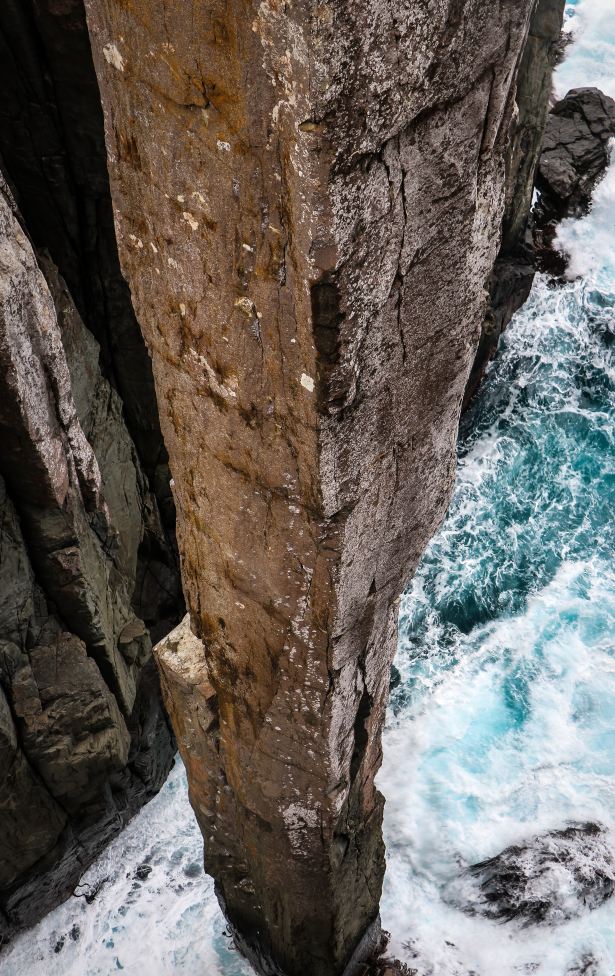
“It was the devil made those,” Aunt Beulah’s eyebrows almost met above the bridge of her nose.

“They’re just a form of volcanic rock, cooled down in a specific way …” Jedidiah tried.

“By which you mean, the devil.”

Jedidiah sighed. There was no way to reason with his relative once her mind was set. Science would find its way to be in service of her beliefs, and any fact would somehow be turned into further proof of her conviction.

In some ways, he knew, he was no different, only that his spiritual experiences had more to do with being one with the rock, fingers holding on to crags, feet clinging to the surface, defying gravity, confronting his mortality.

“You go climb the devil’s work,” Aunt Beulah muttered. She’d raised him and saw herself in his stubbornness. “And I’ll be in the church praying for Jesus to keep you from dying.”


For What Pegman Saw: Tasmania, Australia


No Big-Mart


“It says this way to the manor,” Doug tugged Lily’s sleeve.

“I know,” she shrugged to release his hold. At thirty-four, he was really quite too old to tug on clothing for attention.

“So why are we going in the opposite?”

She wondered how it was that there was a time when the nasal tone of his petulance didn’t bother her. Had she simply ignored it in the beginning, when infatuation took precedence to logic? Doug was still easy on the eyes, but her heart had become wiser.

“Because the manor will still be there later, while this Farmer’s Market stall might not.”

“What’s wrong with Big-Mart?”

Her lips tightened. She couldn’t believe he actually whined. “Big-Mart has no proper food. Everything’s processed. And anyway, I’d much rather support local farmers than corporate executives.”

She cringed at the sound of her own voice. She’d become her mother. To her boyfriend.


For Crispina’s Crimsons Creative Challenge #57


Backdrop

Photo: Sue Vincent


They were cold to the bone, but it did not matter once the light broke out to illuminate the edge of clouds.

“We’ll be home soon,” he breathed into her neck.

“I know,” she whispered, her teeth no longer chattering. She’d stopped feeling her toes so long ago she almost forgot she had ones.

It would have worried her, in the past. The risk of frostbite. Amputation. Loss of the ability to walk.

Not anymore.

They were beyond all these things now.

They were going home.

For the rest of time.

“How long?” she asked, fretting a bit in spite of herself. She never found transitions as easy as he had. Especially such big ones. Especially those that were irreversible.

“Soon,” his voice was barely audible but she felt it reverberate through her chest. The finality of it.

The knowledge.

His strength.

She sighed, and though he did not move she knew that he was smiling.

Another moment passed. Or perhaps it was an hour. She’d lost track of time now that it made no difference.

As her body chilled, her eyes stayed focused on the shimmering curtain of light. Its movement became the backdrop to the last views she will ever have of Earth.

Before it neared enough to carry them.

Home.

For all the eras yet to come.


For Sue Vincent’s Write Photo Challenge


You’ll See

Photo prompt: © Mikhael Sublett


“You’ll see,” he lifted the mallet to strike again.

She cringed as plaster and glass and bits of home clattered to the ground. Every resonating thud another shattering, another ruin, another wound that would not heal.

She bit her lips and knew she’ll never be the same.

For not stopping him. For not standing up to him. For not listening to all who’d warned her that he was a loose cannon who’d bring only sorrow. For insisting she loved him.

She saw now.

And stood silent as his mallet dented will. Her life in shards, devoid even of tears.


For Rochelle’s Friday Fictioneers

Note: Dedicated to all who live with violence and do not know a way out into help. Know that there is always hope, that you deserve a chance to heal, and that you need not carry shame.